
SchoolAI vs IntelliAssess: an AI tutor for students or feedback after a test?

By Motasem Aldiab, Technology Consultant and Trainer - Cloud, DevOps, Java, Data Science
Contents25
- The short answer
- SchoolAI vs IntelliAssess at a glance
- What SchoolAI is
- What IntelliAssess is
- Learning with AI, or learning from a test
- Feature by feature
- Teacher visibility
- Assessment
- Feedback to students
- Tutoring
- Languages and access
- One unit, two ways
- What students see
- When feedback from a test is not enough
- Rolling it out to a school
- Getting good results from either tool
- How far to trust AI with students
- Privacy
- Pricing
- Where SchoolAI is better
- Where IntelliAssess is better
- Using SchoolAI and IntelliAssess together
- Questions to ask before choosing
- Choose SchoolAI if
- Choose IntelliAssess if
Key takeaways
- 1SchoolAI Spaces let students work with AI while teachers read every conversation.
- 2Its paid plans are quoted; the free trial allows 5 Space launches a year.
- 3IntelliAssess writes and marks tests, scoring written answers against your rubric.
- 4On Pro, students get study notes, a study plan and practice from their own answers.
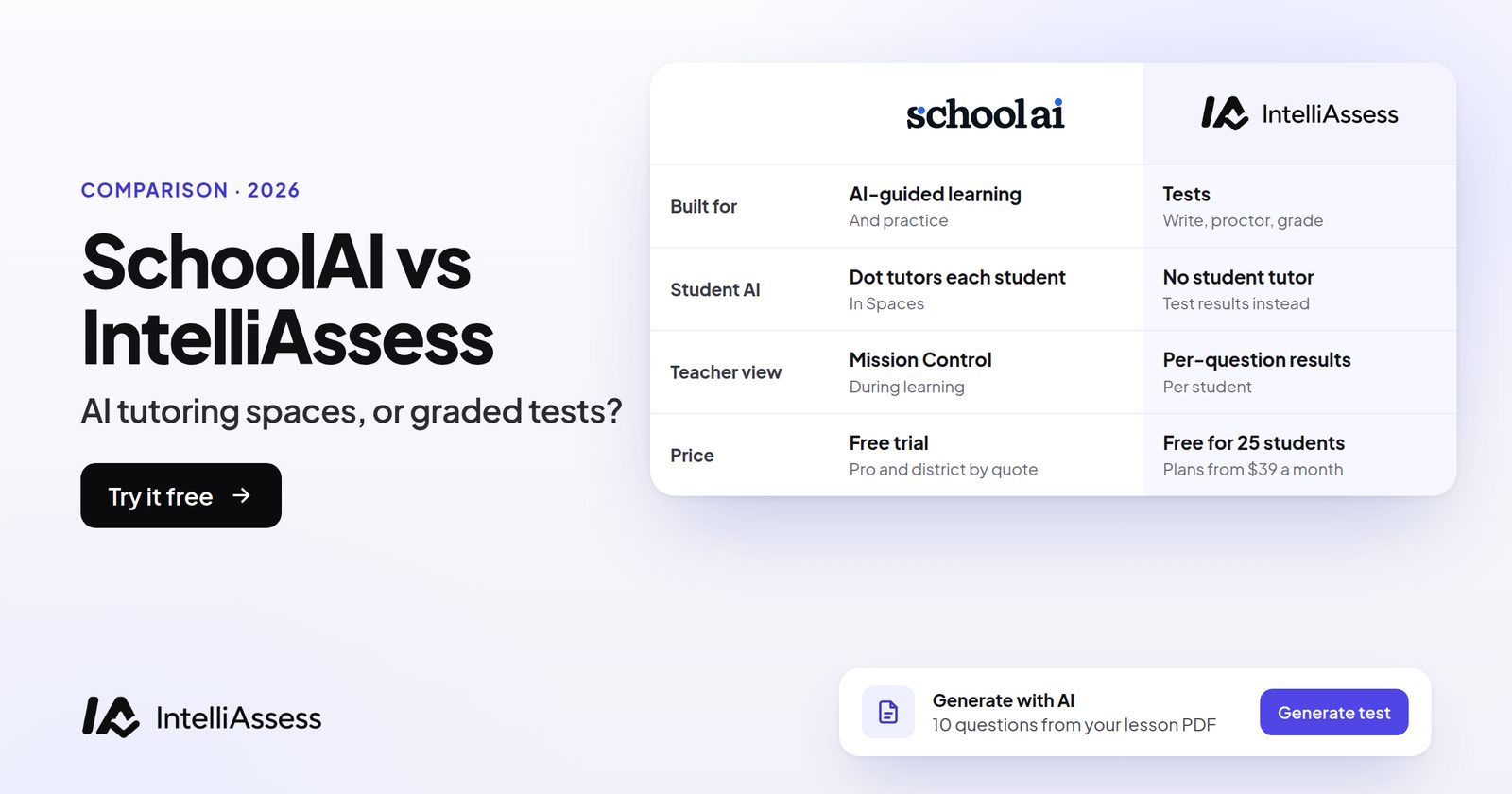
SchoolAI vs IntelliAssess compares a platform for student-facing AI, where students work with an AI tutor in Spaces their teacher designs and supervises, with a platform for the tests teachers set, which marks them and then uses AI to help each student learn from their own answers. SchoolAI offers teacher-designed Spaces, full review of student conversations, safety alerts and a personal AI tutor on its Scale plan, priced on quote. IntelliAssess writes tests from your lessons, delivers and marks them, scores written answers against your rubric, and gives students study notes, a study plan and practice on what they missed, free for 25 students or from $39 a month. They do different jobs, and many schools could use both.
The short answer
Choose SchoolAI for learning with AI during a unit: personalised tutoring and practice in Spaces you design, with every student conversation visible to you, safety alerts, and live translation in 60+ languages. Choose IntelliAssess for assessment and what comes after it: tests written from your lessons, marked at hand-in with written answers scored by rubric, optional proctoring, and AI study notes and practice built from each student's own marked answers. Use both if you want supervised AI practice during the unit and a marked test at the end.
SchoolAI vs IntelliAssess at a glance
| SchoolAI | IntelliAssess | |
|---|---|---|
| Main job | Student-facing AI learning experiences, supervised by teachers | Writing, delivering, marking and learning from tests |
| What students do with AI | Chat in Spaces; Sidekick personal tutor on Scale | Study notes, a study plan, "Explain this to me" and practice after a learning quiz |
| What teachers see | All student AI conversations in full; safety alerts; Mission Control | Marks, rubric scores, study notes and re-mark requests; no open chat to review |
| Teacher tools | Dot for lesson planning; tools for rubrics and classroom support; writing analysis | AI test writing from your files, rubric generator, AI grading |
| Tests and marking | Not described on the pages we read | Up to 100 questions across eight types, marked at hand-in, written answers scored by rubric |
| Proctoring | Not described | ID, selfie, liveness, webcam, microphone, screen and browser checks |
| Languages | Live translation in 60+ languages | English and Arabic, right to left |
| Privacy | FERPA, COPPA and SOC 2 Type 2; 1EdTech certified | Encrypted identity photos; no certifications listed |
| Price | Free trial (5 Space launches a year); Pro and Scale on quote | Free for 25 students; Starter $39 a month for 200 |
What SchoolAI is
SchoolAI describes Spaces as "AI-powered learning experiences you design and assign to students", with "200,000+ premade Spaces and resources" to start from. Teachers set the goals and guardrails; students work with the AI inside the Space. Mission Control gives "real-time and post-session visibility into student learning", teachers can "review and monitor all student AI conversations in full", and automated notifications flag "when student conversations flag safety concerns". PowerUps add tools inside Spaces such as a document editor, presentation creator, image generator, Desmos graphing calculator, flashcards and mind maps.
For teachers, "Chat with Dot" is a personal AI workspace for lesson planning and teaching support, purpose-built tools cover lesson planning, rubric creation and classroom support, and assistants help with writing feedback and adapting content, with writing analysis that includes summary feedback, inline comments and revision history. A Notetaker supports PLCs, parent conferences and IEP meetings. On the Scale plan, Sidekick is "a personal AI tutor that adapts to how each student learns", with student portals, student uploads and an embedded Sidekick in Canvas.
SchoolAI states FERPA, COPPA and SOC 2 Type 2 compliance and 1EdTech certification, and says its AI providers are "contractually bound never to train on or sell student data". It cites a two-year study of 13,882 student-AI conversations and says it is ESSA Level III validated.
What IntelliAssess is
IntelliAssess is built around the test. Its AI quiz generator writes questions from your PDF, Word or PowerPoint files, a YouTube video or a web page, up to 100 across eight types, checks each answer key in a second pass, and drafts a rubric for each written question. Students sit the test online from a link or Google Classroom; choice questions are marked at hand-in and AI grading scores each written answer against every rubric criterion, with a comment the teacher can change before release. For tests at home, proctoring adds identity and webcam checks.
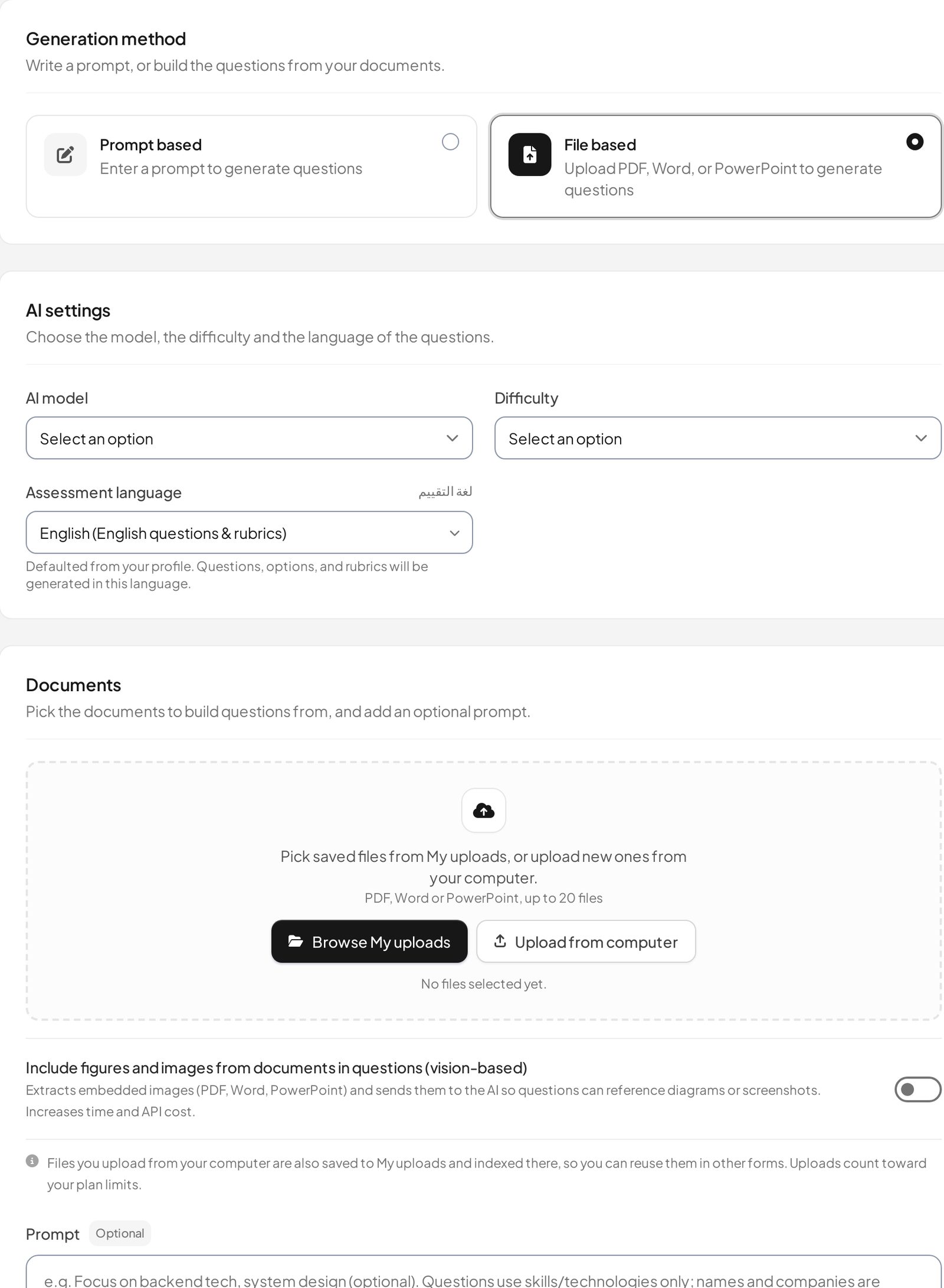
What happens after the test is where IntelliAssess overlaps with SchoolAI. On Learning-purpose quizzes, on the Pro plan and up, each student gets study notes on every question: a good answer, their answer compared with the right one, the idea behind the question, and two to four improvement tips. They also get a study plan for the attempt, with focus areas and resources whose links are checked. Students can ask "Explain this to me" on a question, practise what they missed, and ask the teacher for a re-mark. Exam results stay with the teacher until they choose to share them.
What it does not have: open AI chat or a tutor, lesson planning, live translation beyond English and Arabic, or security certifications on its pages.
Learning with AI, or learning from a test
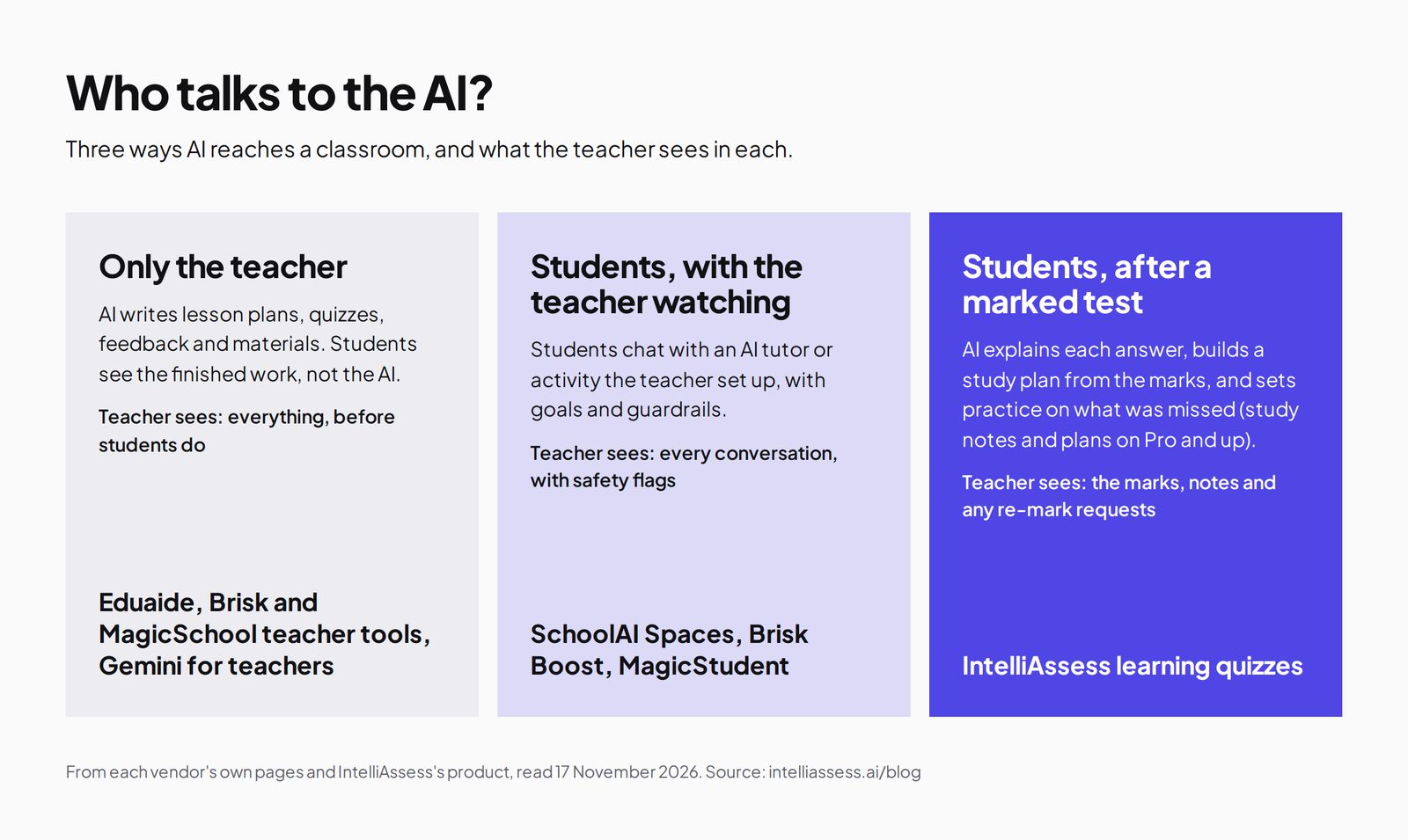
The two products put AI in front of students at different moments. SchoolAI puts it there during learning: a student asks questions, tries ideas and gets responses in a Space the teacher designed, and the teacher can read the conversation. That suits exploration, practice and support for students who need more help than one teacher can give at once.
IntelliAssess puts it there after an assessment: the AI works only from the questions the student was set and the marks their answers received. It explains what a good answer looks like and why theirs fell short, suggests what to practise, and builds practice on what they missed. There is no open conversation, which makes it narrower but also easier for some schools to approve for younger students.
Neither replaces the other. A school that wants AI tutoring should look at SchoolAI or a similar tool; a school that wants assessment with feedback students can act on should look at IntelliAssess.
Feature by feature
Teacher visibility
SchoolAI lets teachers review every student AI conversation in full, in real time and afterwards, with alerts for safety concerns. IntelliAssess shows teachers each student's marks, rubric scores and comments, the study notes generated for them, which the teacher can remove, and any re-mark requests; there is no conversation to monitor.
Assessment
SchoolAI's pages describe writing analysis and feedback but do not describe writing, delivering or marking tests. IntelliAssess does all three, with timers, shuffling and attempt limits on paid plans and optional proctoring for tests at home.
Feedback to students
SchoolAI offers writing feedback through its assistants, with summary feedback and inline comments. IntelliAssess gives a score and comment for each rubric criterion on written answers, and on learning quizzes, study notes on every question type and a study plan, built from the final marks.
Tutoring
SchoolAI's Sidekick on Scale is a personal AI tutor that adapts to each student. IntelliAssess has no tutor; "Explain this to me" explains one question the student has already answered.
Languages and access
SchoolAI offers live translation in 60+ languages. IntelliAssess writes, delivers, marks and gives feedback in English and Arabic. Students can join IntelliAssess with a link, through Google Classroom, or with a nickname and PIN if they have no email.
One unit, two ways
Take a Year 8 science class studying photosynthesis over three weeks, with a unit test at the end.
With SchoolAI, the teacher sets up a Space where students ask an AI tutor about the light and dark reactions, test their own explanations and get hints when stuck. The teacher watches Mission Control, reads conversations from students who seem confused, and adjusts the next lesson. The unit test is written and marked elsewhere.
With IntelliAssess, the teacher uploads the unit's slides and has a learning quiz drafted halfway through, and a unit test at the end. Students who get the quiz question on where oxygen comes from wrong see a good answer, a comparison with their own, the idea behind it and what to re-read, and can practise the questions they missed. The unit test is marked at hand-in, with written answers scored against the rubric for the teacher to review.
With both, SchoolAI supports exploration during the unit and IntelliAssess handles the quizzes, the test and the feedback that follows.
What students see
In SchoolAI, a student opens a Space their teacher launched and works with the AI inside it: asking questions, trying ideas, drafting writing, or using PowerUps such as flashcards or a graphing calculator. On Scale, they can have a personal Sidekick tutor and a student portal. Conversations are visible to the teacher, which students should be told at the start.
In IntelliAssess, a student opens a quiz or test from Google Classroom or a link, sits it, and later sees their results: every question with their answer, the right answer, their marks and the teacher's comment, filtered by correct, partly right or incorrect. On a learning quiz, each question can open study notes, and a study plan sits beside the results. They can practise the questions they missed and ask for a re-mark if they think a mark is wrong. A progress page shows their scores over time, and they never see other students' results.
When feedback from a test is not enough
IntelliAssess's study notes are built from what a student answered. That makes them specific, but it also limits them: they cannot follow a student's curiosity to a new question, have a back-and-forth conversation, or help with a task that is not in the quiz. A student who needs to talk an idea through, or who is stuck on homework that was never set as a test, is better served by a supervised tutor such as SchoolAI's, or simply by the teacher. Equally, a tutor conversation does not give a teacher a mark, a rubric score or a record of what each student got wrong on a common set of questions. The two kinds of AI support answer different needs.
Rolling it out to a school
SchoolAI's Pro plan adds SIS-powered rostering, full LMS integration and a dedicated customer success manager, and Scale adds district management tools and student portals; a free trial lets a teacher try five Spaces first. IntelliAssess is usually adopted by a teacher or department first: schools add students by email, CSV import or nickname and PIN, organise them into groups, and on Pro and up use team workspaces with roles such as Viewer, TA or grader, Teacher and Admin, shared question-library categories and an activity feed. Both can start small, which is the safest way to introduce AI to students and to learn what support your teachers need.
Getting good results from either tool
Both products work better when the teacher sets them up from real lesson material. In SchoolAI, a Space with a clear learning goal, a few example questions and guardrails on what the AI should not do (such as giving away answers) keeps conversations on track, and starting from one of its premade Spaces saves time. In IntelliAssess, a quiz built from the actual slides or reading, with a short rubric for each written question that describes what a good answer contains, produces more accurate scores and more useful study notes. In both, run the first activity with one class, read what students saw, and adjust before using it more widely. The AI is only as focused as the material and instructions it is given, so time spent on setup pays back in every lesson that follows.
How far to trust AI with students
Both products rely on AI being right most of the time and on teachers catching the rest. A tutor can give a confident but wrong explanation, and a marking model can score an answer too high or too low; a synthesis of 65 studies found agreement between AI and human raters on written answers "varied substantially". SchoolAI's answer is full visibility of conversations. IntelliAssess's answer is that the teacher reviews and can change every AI score before release, can remove any study note, and receives students' re-mark requests. In either case, read a sample every week, especially in the first month.
Privacy
Student-facing AI sets the highest privacy bar in a school. SchoolAI states FERPA, COPPA and SOC 2 Type 2 compliance, 1EdTech certification and contractual no-training terms with its AI providers. IntelliAssess stores identity and evidence photos encrypted, opens them only through short-lived links, records location only if you switch that check on, and keeps exam results hidden from students until the teacher shares them; its pages list no certifications or data location, so ask us before you buy if your district needs them.
Pricing
SchoolAI does not publish prices. Its free trial allows "5 Space launches per year"; Pro adds unlimited Spaces, rostering and full LMS integration, and Scale adds district-wide access, student portals and Sidekick. Both are quoted.
IntelliAssess publishes its prices: Free for 25 students; Starter $39 a month for 200, with AI grading and proctoring; Pro $99 for 500, which adds study notes and study plans for students; Intensive $249 for 2,000. Yearly billing costs ten months.
Where SchoolAI is better
- Student AI tutoring in teacher-designed Spaces, with a personal tutor on Scale.
- Full visibility of every student conversation, with safety alerts.
- Teacher tools for lesson planning and classroom support.
- Live translation in 60+ languages.
- Stated privacy credentials, including SOC 2 Type 2.
Where IntelliAssess is better
- Tests: written from your lessons, delivered and marked at hand-in.
- Written answers scored against each rubric criterion.
- Feedback after the test: study notes, study plans, explanations and practice on what was missed.
- Proctoring for tests at home.
- A published price and a free plan; Arabic.
Using SchoolAI and IntelliAssess together
Because they act at different points in a unit, the two fit together. Use SchoolAI Spaces for supervised exploration and practice while students are learning, and IntelliAssess for quizzes and the unit test, with feedback built from each student's marked answers. Build both from the same lesson materials so the practice and the test cover the same ground. The cost is two tools for students to use; IntelliAssess works through Google Classroom, so check how SchoolAI fits into your LMS.
Questions to ask before choosing
- Do we want students to talk to an AI, or only to get AI feedback on their own work?
- Has our district approved student-facing AI, and what does it require on privacy?
- Who will review student conversations or AI scores, and how often?
- Do we need tests written, delivered and marked, or only practice?
- Do we teach in Arabic, or need translation into many languages?
- What will SchoolAI cost at our size?
Choose SchoolAI if
- You want students to practise and explore with an AI tutor you design.
- You want to read every student conversation, with safety alerts.
- You need live translation for many home languages.
- Your district wants SOC 2 Type 2 and 1EdTech certification.
Choose IntelliAssess if
- You want tests written from your lessons, delivered and marked.
- You want written answers scored by rubric, with your final say.
- You want students to get explanations and practice from their own marked answers, without open chat.
- You teach in Arabic, or want a published price and a free plan.
Comparing more tools? See SchoolAI alternatives, scored on nine published facts, MagicSchool vs IntelliAssess, or every comparison.
Frequently asked questions
Is IntelliAssess an alternative to SchoolAI?
For assessment and feedback after a test, yes. For student AI tutoring in teacher-designed Spaces, SchoolAI does what IntelliAssess does not. Many schools could use both.
How much does SchoolAI cost?
SchoolAI does not publish prices. Its free trial allows 5 Space launches a year, and Pro and Scale are quoted. IntelliAssess is free for 25 students, then from $39 a month.
Can teachers see student chats in SchoolAI?
Yes. SchoolAI says teachers can review and monitor all student AI conversations in full, in real time and after the session, with alerts for safety concerns.
Does IntelliAssess have an AI tutor?
No. After a learning quiz, students get study notes, a study plan, an "Explain this to me" option and practice on what they missed, all built from their own marked answers. There is no open chat.
Does SchoolAI grade tests?
Its pages describe writing feedback and analysis but do not describe writing, delivering or marking tests. IntelliAssess marks tests at hand-in and scores written answers against a rubric.
Which is safer for younger students?
Both keep teachers in control in different ways. SchoolAI lets teachers read every conversation and sends safety alerts. IntelliAssess has no open chat at all; its AI works only from the student's own marked answers. Check your district's guidance either way.
Can I use SchoolAI and IntelliAssess together?
Yes. Use SchoolAI Spaces for supervised AI practice during a unit, and IntelliAssess for quizzes and the unit test, its marking and the feedback that follows.
Does IntelliAssess work in Arabic?
Yes. IntelliAssess writes questions, rubrics, study notes and feedback in Arabic, right to left. SchoolAI offers live translation in 60+ languages.
Which plan includes IntelliAssess study notes?
Study notes, study plans and "Explain this to me" on learning quizzes are on Pro ($99 a month for 500 students) and up. AI grading of written answers and proctoring start on Starter.
Does SchoolAI work with Google Classroom?
SchoolAI's pages mention LMS integration, rostering and an embedded Sidekick in Canvas, but the pages we read do not name Google Classroom; ask SchoolAI. IntelliAssess publishes to Google Classroom and syncs grades there, so students start from the class they already use.
Keep reading
All articles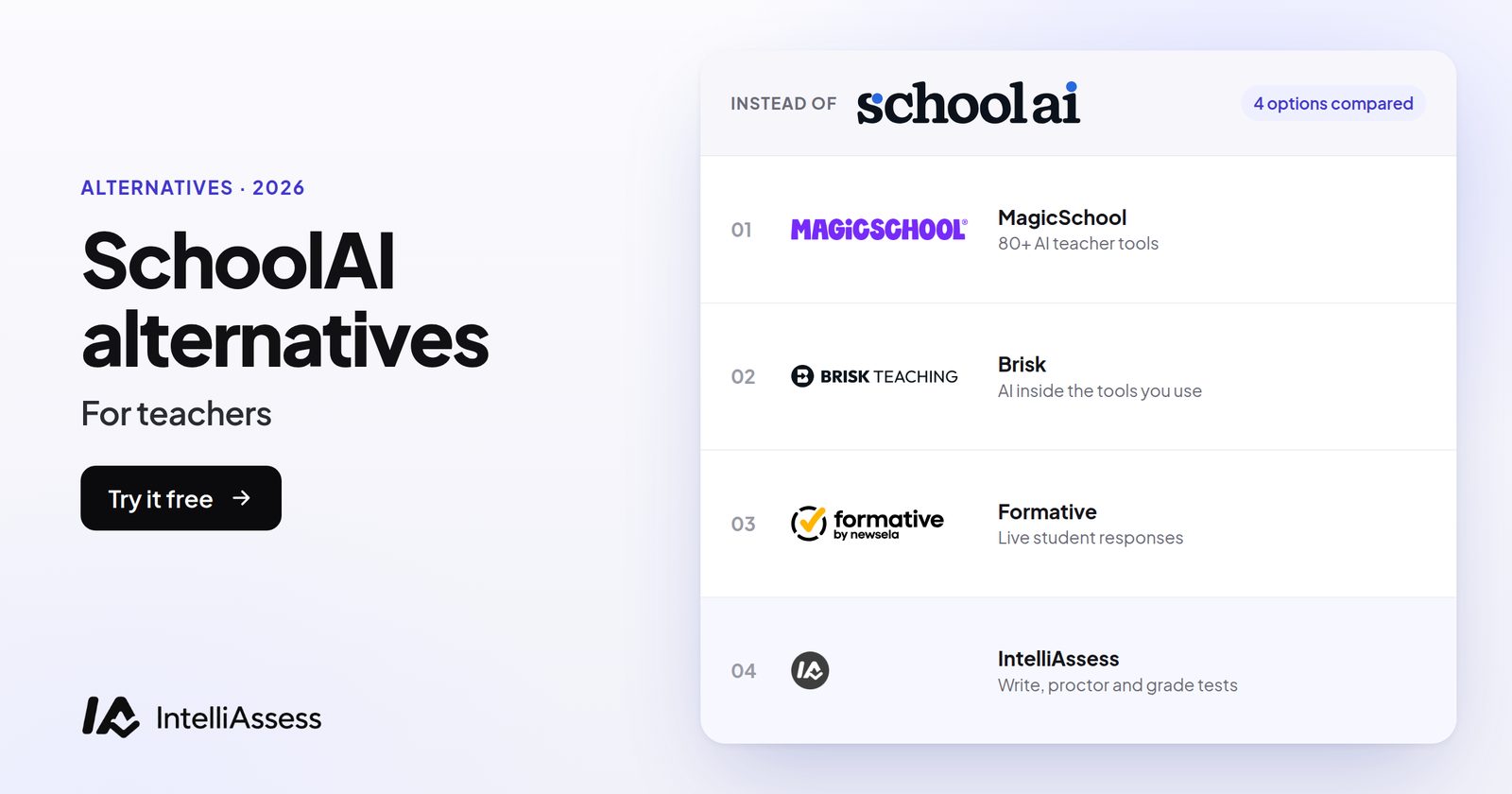
Read next
SchoolAI alternatives: 7 AI tools for teachers and students scored (2026)
Seven AI tools scored on the same nine facts, with SchoolAI as the reference, and what each lets teachers see when students use AI.
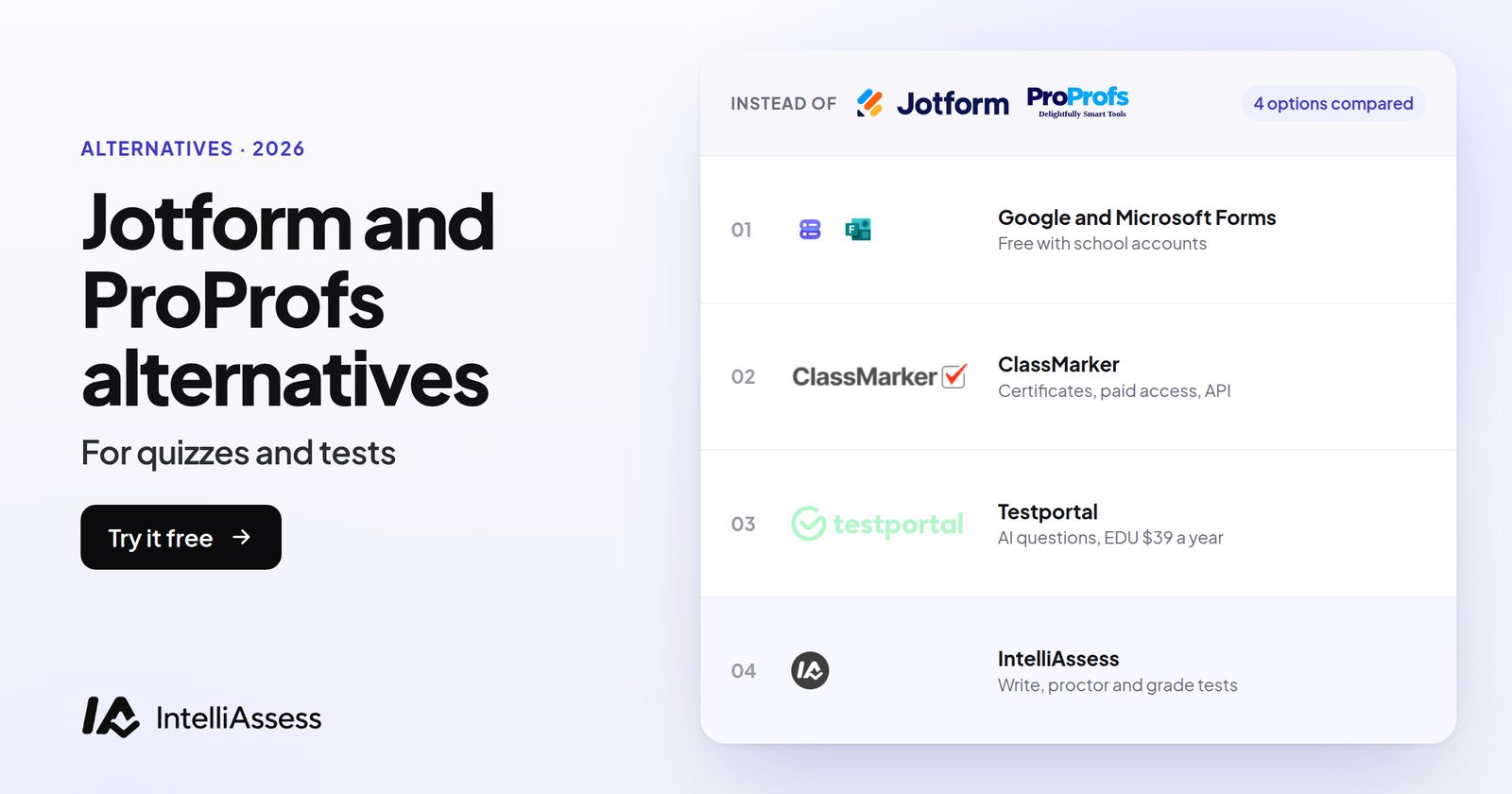
Jotform and ProProfs alternatives for quizzes and exams (2026)
Jotform and ProProfs side by side, then the alternatives by forms, certificates or real exams.
Motasem Aldiab 2 min read
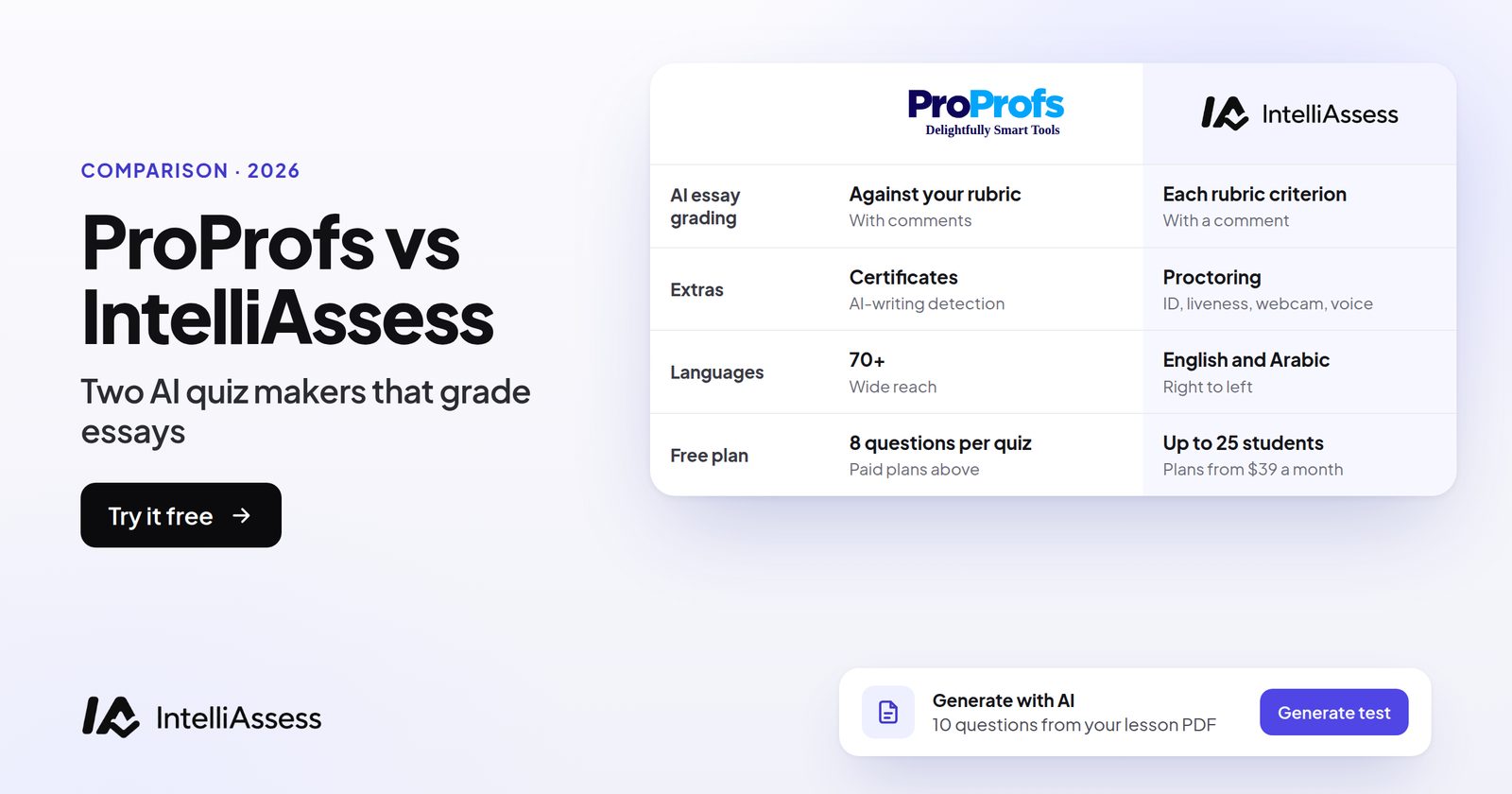
ProProfs vs IntelliAssess: two AI quiz makers that grade essays
ProProfs and IntelliAssess both write quizzes and grade essays with AI; ProProfs leads on certificates and languages, IntelliAssess on sources, identity checks and Arabic.
Motasem Aldiab 2 min read