

7 Best TestGorilla Alternatives for Skills Assessment in 2026
 Jul 28,2026
 By motasemaldiab
Skills-based hiring keeps growing — 70% of employers in NACE’s Job Outlook 2026 survey now use it, up from 65% the year before (NACE, 2026) — and TestGorilla’s fixed 350+ test library is a common starting point. But its annual-only billing and lack of native rubric grading for open-ended answers push some teams to look elsewhere. This list covers 7 verified alternatives, what each one is actually built for, and where its pricing is transparent versus contact-sales-only — because that distinction, more than feature lists, is often what decides the purchase.
How we evaluated these: this is a research-only comparison based on each platform’s own pricing pages, help documentation, and product pages as of July 2026 — not hands-on testing. Where a platform’s pricing page didn’t load or didn’t disclose tier details, that’s stated explicitly rather than filled in with secondary-source estimates that couldn’t be verified. IntelliAssess is the publisher of this article; that relationship is disclosed upfront.
For a full head-to-head, see “TestGorilla vs. IntelliAssess: Content Generation, Grading, and Pricing Compared (2026),” our full pricing cost breakdown, or the broader guide to online assessment platforms in 2026.
1. IntelliAssess — Best for AI-Generated, Rubric-Graded Assessments
IntelliAssess’s biggest differentiator is self-serve customization: it generates questions directly from material you upload — a syllabus, a job description, a PDF — instantly and without a sales call, rather than asking you to pick from a pre-built library or commission a custom build. (Mercer | Mettl also offers customized assessments, further down this list — but as a quoted, human-built professional service, not instant self-serve AI generation.)
Why it’s great: Beyond document-grounded generation, IntelliAssess natively grades open-ended and constructed responses against AI-generated, multi-criteria rubrics, with a human-in-the-loop override step for the final say. It also supports BYOK (bring your own key) pricing across OpenAI, Gemini, and Groq, letting teams with their own AI provider account bypass the platform’s built-in usage limits entirely.
Best for: Recruiting teams hiring for specialized or role-specific positions, and educators grading against their own course material — anywhere the assessment content needs to reflect something specific to you, not a generic library entry.
Key feature: AI proctoring combines identity verification, liveness/pose detection, real-time violation alerts, and a live invigilator view — deeper real-time monitoring than a webcam-plus-log approach.
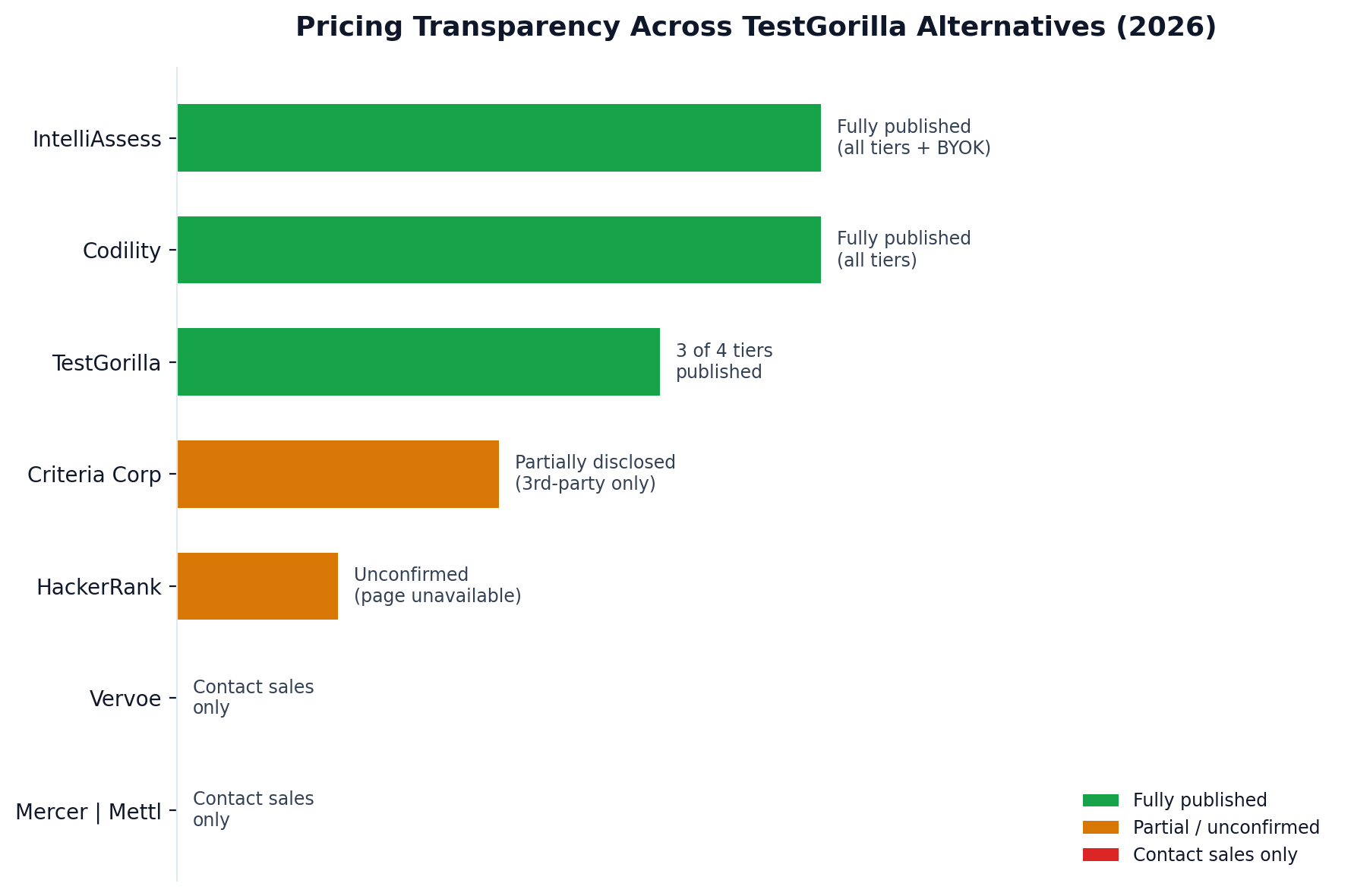
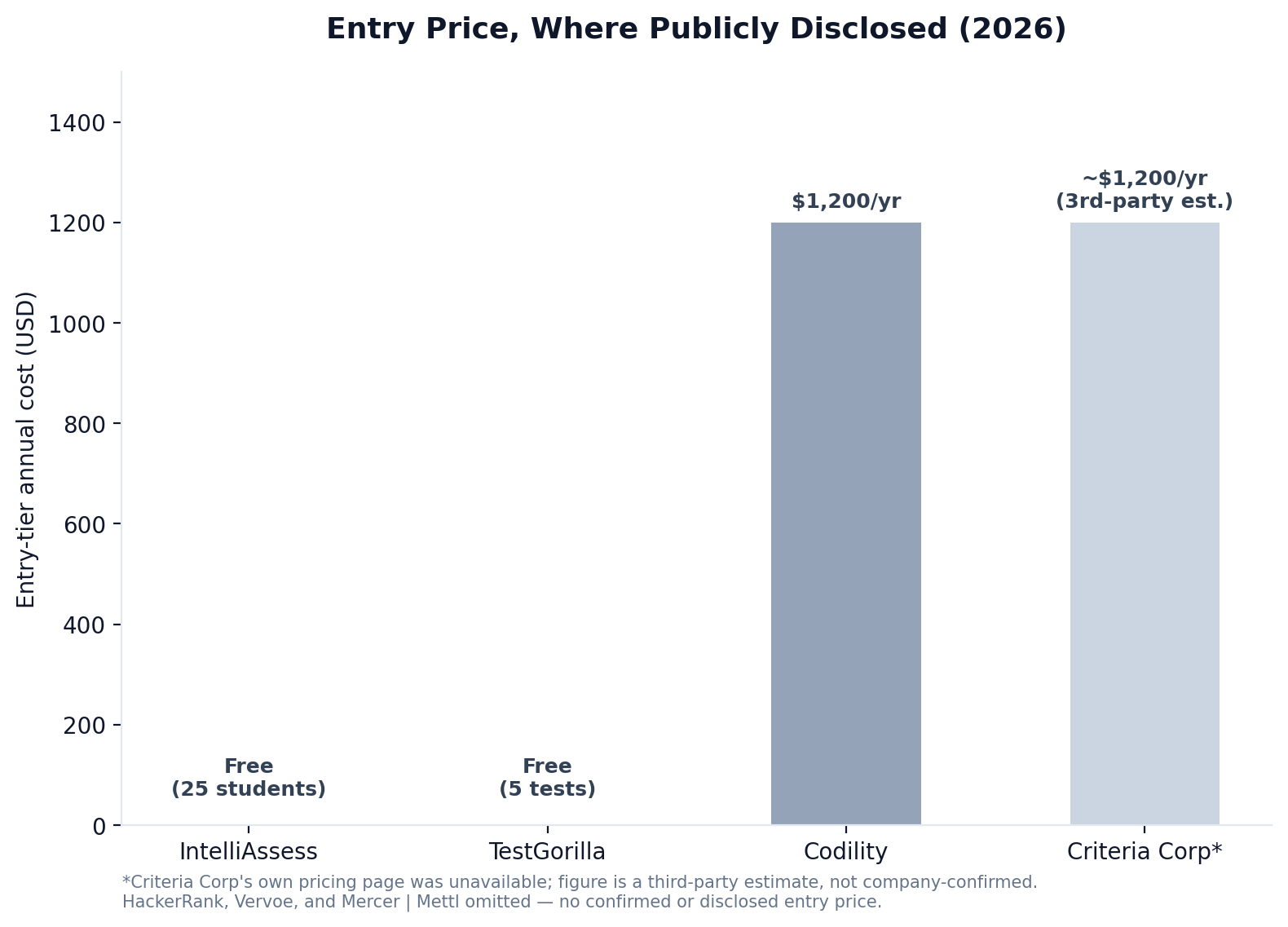
Pricing: Free (25 students), Starter $39/month (200 students), Pro $99/month (500 students), Intense $249/month (2,000 students), all published with no custom-quote tier, plus BYOK on any tier (intelliassess.ai pricing page).
2. Codility — Best for Engineering-Focused Technical Hiring
Codility is the most transparent of the pure coding-assessment tools on this list, with all three tiers published directly on its pricing page.
Why it’s great: It’s purpose-built for engineering hiring specifically — task libraries covering both engineering and AI-related skills, standard analytics, and assessment validation input from occupational psychologists at the top tier. AI Copilot and plagiarism detection are included even at the entry tier.
Best for: Engineering teams that need deep technical/coding evaluation rather than general skills or soft-skills assessment — this is a narrower tool than TestGorilla or IntelliAssess, not a general-purpose replacement.
Key feature: Credit-based invite system similar to TestGorilla’s, but fully disclosed: Starter includes up to 120 invite credits/year, Scale up to 300/year.
Pricing: Starter $1,200/year (120 invite credits, 1 user), Scale $6,000/year or monthly option (300 invite credits, 3 users), Custom (contact sales, unlimited volume) — all three tiers confirmed directly from Codility’s pricing page.
3. HackerRank — Best for High-Volume Developer Screening
HackerRank is one of the most recognized names in technical hiring, with a large question bank built around live coding environments.
Why it’s great: Deep language and framework coverage for developer-specific screening, plus an established reputation among engineering hiring teams.
Best for: Teams hiring developers at volume who need a widely-adopted, familiar coding assessment brand.
Key feature: Live coding environment supporting a wide range of languages, positioned for technical-only screening rather than general skills assessment.
Pricing: HackerRank’s pricing page was unavailable during this research pass, and third-party sources disagree meaningfully on the numbers — some cite roughly $100–200/month entry tiers, others cite $450–750/month for comparable plans. Given that spread, treat any specific figure you see elsewhere as unconfirmed and contact HackerRank directly for a current quote.
4. Vervoe — Best for Skills-First Video and Task-Based Hiring
Vervoe leans into task-based and video assessment rather than traditional multiple-choice testing, aiming to evaluate how candidates actually perform work.
Why it’s great: Assessment formats include text, multiple-choice, video responses, and on-the-job simulation tasks, with AI-based automatic grading and ranking, plus direct ATS integrations (Greenhouse, Lever, Workday).
Best for: Teams that want candidates evaluated on realistic task performance rather than abstract test questions.
Key feature: AI-enabled grading and ranking designed to reduce manual review of video and task submissions.
Pricing: Vervoe’s pricing page shows enterprise-only, contact-sales pricing with no published tiers or figures — plan on a custom quote regardless of team size.
5. Mercer | Mettl — Best for Large Enterprise, Multi-Country Deployments
Mettl is built for scale: end-to-end exam management across pre-hiring, training, certification, and hackathon use cases, with support for 30+ languages across 90+ countries.
Why it’s great: Broad question-type support (roughly 26 types) and an assessment suite spanning 200+ job roles/levels, with strong data-security posture including GDPR compliance built for multinational deployments.
Best for: Large, multi-country enterprises needing a single platform across the full employee lifecycle, not just hiring.
Key feature: Unified platform covering hiring, training/development, and certification exams — broader scope than any other tool on this list.
Pricing: Fully custom — Mettl’s pricing page offers no published tiers at all, only a request-a-quote form. Budget for a sales conversation before you can compare cost.
6. Criteria Corp — Best for Psychometric and Cognitive Pre-Employment Testing
Criteria focuses on the science-backed side of assessment: cognitive ability, personality, and emotional intelligence testing alongside skills tests.
Why it’s great: Standardized, validated assessments aimed at reducing subjectivity in hiring decisions, with remote proctoring (video monitoring, identity verification) and structured-interview tooling layered on top.
Best for: HR teams that want psychometric and cognitive assessment as a formal part of the hiring process, not just a skills test.
Key feature: Volume-based pricing tiers that lower the per-assessment cost as usage scales, rather than a flat seat-based fee.
Pricing: Criteria’s own pricing page was unavailable during this research pass. Third-party sources describe a quote-based model starting around $1,200/year with per-assessment costs roughly in the $10–$25 range at lower volumes — treat these as third-party estimates, not confirmed figures, and verify directly with Criteria before budgeting.
7. TestGorilla — Best If You Don’t Need Customization or Rubric Grading
TestGorilla itself still earns a spot on its own alternatives list: its 350+ pre-built test library is a real, defensible advantage if you’re screening for a genuinely generic, well-defined skill and don’t need the assessment content shaped around your own material.
Why it’s still worth knowing: A large question bank (100+ items per test, 12–20 served per candidate) means fast deployment with no prompt-writing or document upload required, and its webcam/IP/plagiarism-detection proctoring stack is real, if more limited than platforms with live invigilator views.
Best for: Teams that need a standardized test for a common role today and have no need to customize content or grade open-ended answers with a rubric.
Key feature: Talent sourcing access to a 2M+ candidate pool bundled into paid tiers — a feature none of the other 6 alternatives on this list offer.
Pricing: Free ($0, 10 credits/month, 5 essential tests, 1 seat), Core ($142/month billed annually = $1,704/year, 2 seats, full library), Plus (starts $400/month billed annually = $4,800/year, unlimited seats, AI interviews), Enterprise (custom) — confirmed directly from TestGorilla’s pricing page.
Comparison Table
| Tool | Best For | Pricing Transparency | Entry Price | Rubric Grading | Content Customization |
|---|---|---|---|---|---|
| IntelliAssess | AI-generated, rubric-graded assessments | Fully published, all tiers + BYOK | Free (25 students) | Yes, AI-generated + HITL | Self-serve, document/prompt-grounded |
| Codility | Engineering technical hiring | Fully published, all tiers | $1,200/year | No | No (task library) |
| HackerRank | High-volume developer screening | Unconfirmed — pricing page unavailable | Unconfirmed | No | No (question bank) |
| Vervoe | Video/task-based hiring | Contact sales only | Contact sales | No | Limited (task customization) |
| Mercer | Mettl | Enterprise, multi-country | Contact sales only | Contact sales | Yes — but quoted, human-built professional service, not self-serve | Yes — same caveat |
| Criteria Corp | Psychometric/cognitive testing | Partially disclosed only | ~$1,200/year (unverified, third-party) | No | No (standardized tests) |
| TestGorilla | Generic role screening, no customization | Fully published (3 of 4 tiers) | Free (5 tests) | No (plagiarism check only) | No (fixed library) |
How We Selected These
We started from the alternatives named across six independent “TestGorilla alternatives” roundups (SelectHub, ProProfs, Testlify, JuggleHire, TestTrick, and Bryq) and narrowed to platforms with a distinct positioning rather than near-duplicates of each other. We evaluated each against four criteria: content creation approach (fixed library vs. generated/customizable), grading depth (objective-only vs. rubric-based for open-ended answers), proctoring mechanism, and pricing transparency — specifically, whether a reader can get a real number without a sales call.
This is research-only: we did not conduct hands-on trials of any platform for this piece. All feature and pricing claims are sourced to each company’s own pricing or documentation pages, linked inline, as of July 2026. Where a company’s own pages didn’t disclose pricing or didn’t load during this research, we said so explicitly rather than substitute an unverified secondary-source number. IntelliAssess, the publisher of this article, is included in the list; that’s a disclosed conflict of interest, and its ranking here reflects the same sourcing standard applied to every other entry.
Frequently Asked Questions
What is the best TestGorilla alternative overall?
IntelliAssess is the strongest alternative for teams that need self-serve, AI-generated content grounded in their own material plus rubric-based grading for open-ended answers — no other platform on this list combines both (Mercer | Mettl offers custom-built assessments as a quoted professional service, but not instant self-serve generation or rubric grading). For pure engineering/coding screening specifically, Codility is the most transparent and purpose-built option.
Is TestGorilla still worth using in 2026?
Yes, specifically for generic, high-volume screening where you don’t need customized content or rubric-based grading of written answers. Its Core and Plus tiers are both publicly priced, which is more transparent than half the alternatives on this list.
Which of these alternatives has the most transparent pricing?
IntelliAssess and Codility both publish complete pricing for every tier with no contact-sales requirement anywhere in their structure. TestGorilla publishes 3 of its 4 tiers (only Enterprise is custom). Vervoe and Mercer | Mettl require a sales conversation at every tier.
The Bottom Line
Top pick: IntelliAssess, for any team whose assessment needs go beyond a generic, off-the-shelf test — document-grounded generation and rubric-based grading aren’t available anywhere else on this list. Best narrow alternative: Codility, if your only need is engineering-specific coding assessment and you want fully transparent pricing. Decision rule: if your content is specific to your role, course, or company, choose IntelliAssess; if you need deep coding-only evaluation, choose Codility; if neither applies and you just need a fast, generic test today, TestGorilla’s library still works.
Ready to see the difference on your own content? Try IntelliAssess with your syllabus or job description.


 Sep 02, 2026
