

TestGorilla’s Fixed Library vs. AI-Generated Tests: Why One Doesn’t Match Your Syllabus
 Sep 02,2026
 By motasemaldiab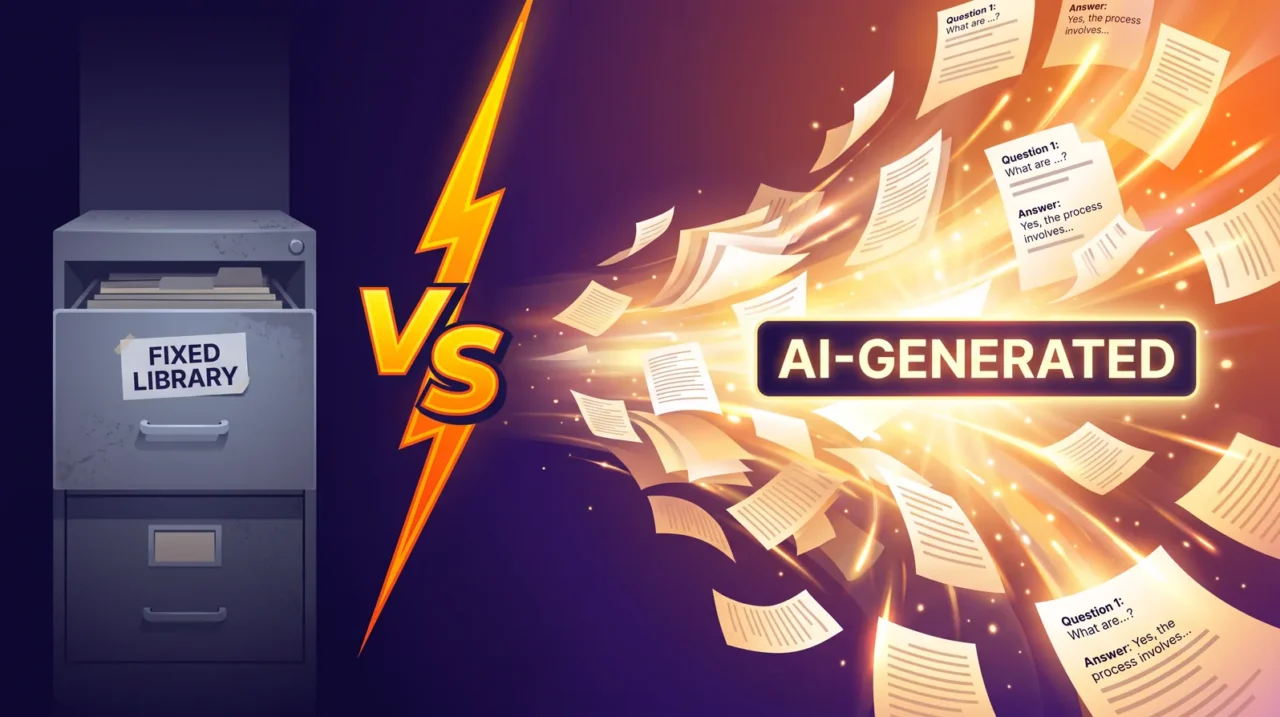
TestGorilla’s entire product is built around a library: 350+ pre-built skills tests, and you pick the one closest to what you need. That is the only way to build an assessment on TestGorilla. IntelliAssess has curated libraries too, but they sit alongside a second option: AI-generated tests built from your own syllabus, job description, or course material. Neither approach is wrong on its own. The real comparison isn’t “library vs. generation”, it’s “library only” versus “library, or generate from your own content, your choice.”
Key Takeaways
- TestGorilla assessments come from a fixed library of 350+ pre-built tests. You select the closest match, you don’t shape the content, and that is your only option.
- IntelliAssess also has curated libraries (a Verified Question Library and a Verified Form Library). Unlike TestGorilla, that’s a choice rather than the only path, because you can generate from your own material instead.
- IntelliAssess’s generation is grounded in the document you upload, with built-in duplicate detection and answer-key validation running before you ever see the output.
- Independent field research across 91 classes and roughly 1,700 students found AI-generated questions performed comparably to expert-created ones.
- The practical difference isn’t “library vs. no library”. It’s “library only” versus “library, or generate from your own content”.
TestGorilla vs. IntelliAssess: Content Source at a Glance
| TestGorilla | IntelliAssess | |
|---|---|---|
| Content source | Fixed library, 350+ pre-built tests, only option | Verified Question/Form Library or generation from your own document, job description, or prompt |
| Matches your syllabus or JD exactly | No, closest available match only | Yes when you generate, because output is grounded in what you upload |
| Duplicate-question prevention | Randomized order from a fixed bank | Active embedding-based deduplication across regenerations |
| Setup effort | Minimal, browse and select | Browse a library (same effort as TestGorilla) or upload a file / write a prompt for custom content |
| Best for | Generic, standardized screening only | Generic screening via its own library and specific, custom content |
For the full platform comparison beyond content sourcing, see TestGorilla vs. IntelliAssess: Content Generation, Grading, and Pricing Compared.
TestGorilla’s Library Model
TestGorilla’s test library covers common, well-defined skills: specific programming languages, standard software proficiency, general cognitive ability. Each test draws from a bank of 100+ questions, with 12 to 20 served per candidate (TestGorilla’s own Help Center). That is a real strength when the skill you’re testing is generic, because you aren’t writing anything. You’re browsing and selecting.
The tradeoff is exactly what you’d expect from a library: it’s built for the general case, not your specific one. If your role has a company-specific tool stack, or your course covers material outside TestGorilla’s catalogue, there is no path to a test that reflects that. There is only the closest pre-built substitute. That gap is exactly what AI-generated tests are built to close.
How AI-Generated Tests Work
IntelliAssess takes a document (a syllabus, a job description, a PDF of course material) or a text prompt, and generates questions grounded in that specific content rather than a generic template. The result reflects what you actually taught or what the role actually requires, not the nearest library match.
There are four separate ways to build an assessment, not just one: a text prompt describing the topic, file-based generation from up to 20 uploaded documents (PDF, DOC, DOCX, PPT, PPTX), fully manual authoring, or importing an existing Google Form. For file-based generation specifically, two details matter for trust. A text extraction preview lets you see exactly what text the platform pulled from your document before it generates anything, and PDF Vision mode reads embedded images and diagrams from the file through a multimodal model, so a chart or figure in your source material can genuinely inform the questions rather than only the surrounding text.
For the deepest technical detail on how the generation and grounding architecture works, see The Complete Guide to Online Assessment in 2026. This piece stays focused on the practical comparison.
IntelliAssess Also Has a Library, Which Most Comparisons Miss
IntelliAssess isn’t generation-only. It has two curated libraries of its own that work much like TestGorilla’s library. The difference is that on IntelliAssess the library is one option among several, not the only one.
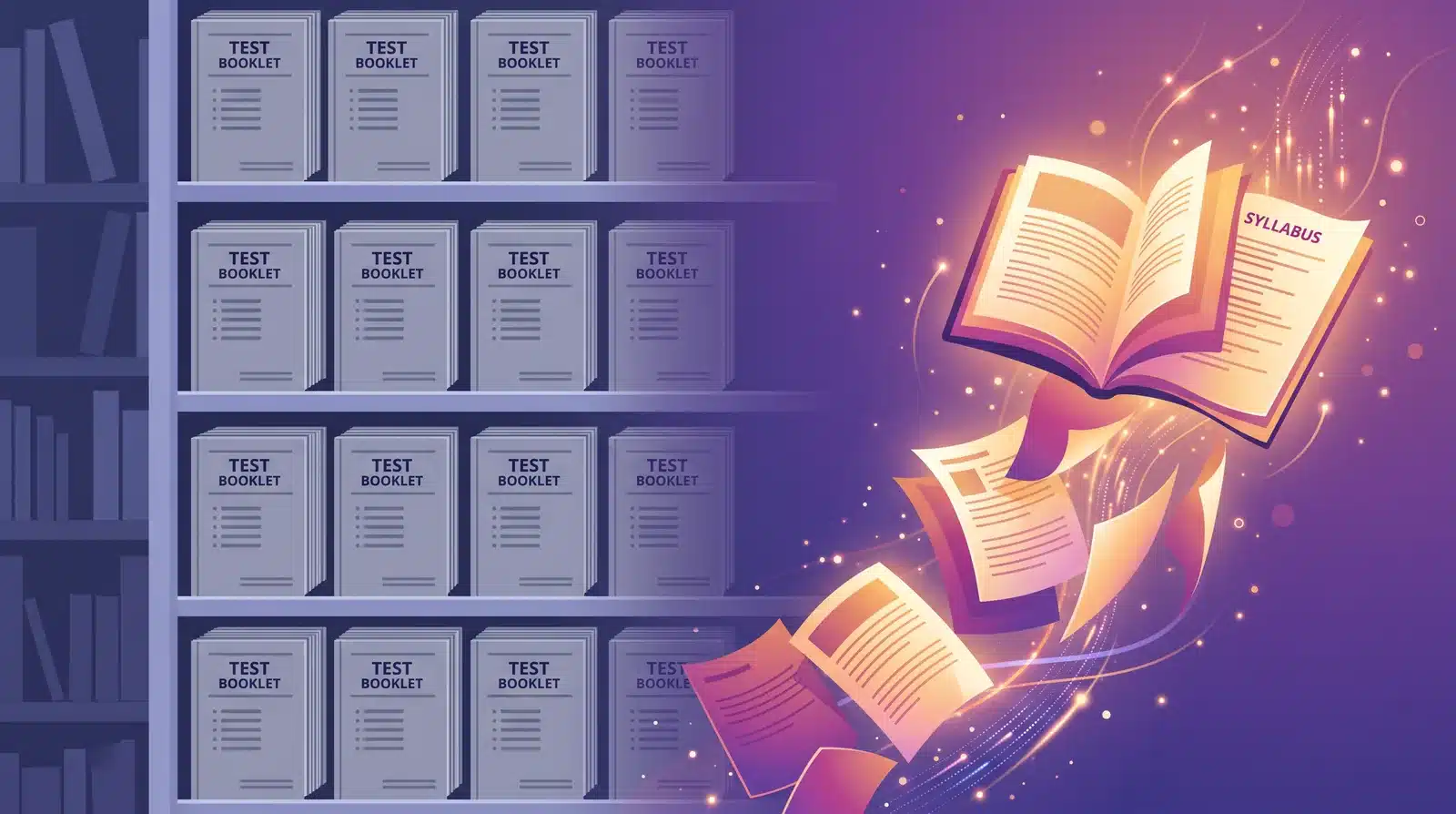
The Verified Question Library is a curated, platform-verified bank of questions organized into categories and subcategories. It works the same way TestGorilla’s library does: you browse, filter, and pull questions into an assessment, read-only, with no generation involved. The Verified Form Library goes a step further with complete, ready-made assessments you can clone directly into your own account. That is the same “pick something pre-built and go” workflow TestGorilla offers as its entire product.
So the honest comparison isn’t “TestGorilla has a library, IntelliAssess generates from scratch.” It’s this: TestGorilla’s library is the only path available, while IntelliAssess’s library is there for when generic content is genuinely fine, with generation available for everything else. If your role or course is standard enough that a pre-built library entry actually fits, IntelliAssess doesn’t force you to write a prompt or upload a document just to prove a point. You can browse its library exactly like you would TestGorilla’s. The gap only opens up once your content stops being generic, which is the point where TestGorilla has nothing left to offer and IntelliAssess still does.
One additional wrinkle worth knowing: IntelliAssess’s Verified Question Library grows from its own users. A teacher can submit a question from their private library for platform verification, and if accepted it becomes part of the shared Verified Question Library that others can pull from. TestGorilla’s closed, vendor-curated library has no equivalent path.
The Quality Control Most AI Question Generators Skip
Generated questions go through automated repair passes before you see them. This isn’t a single generation call with no checks.
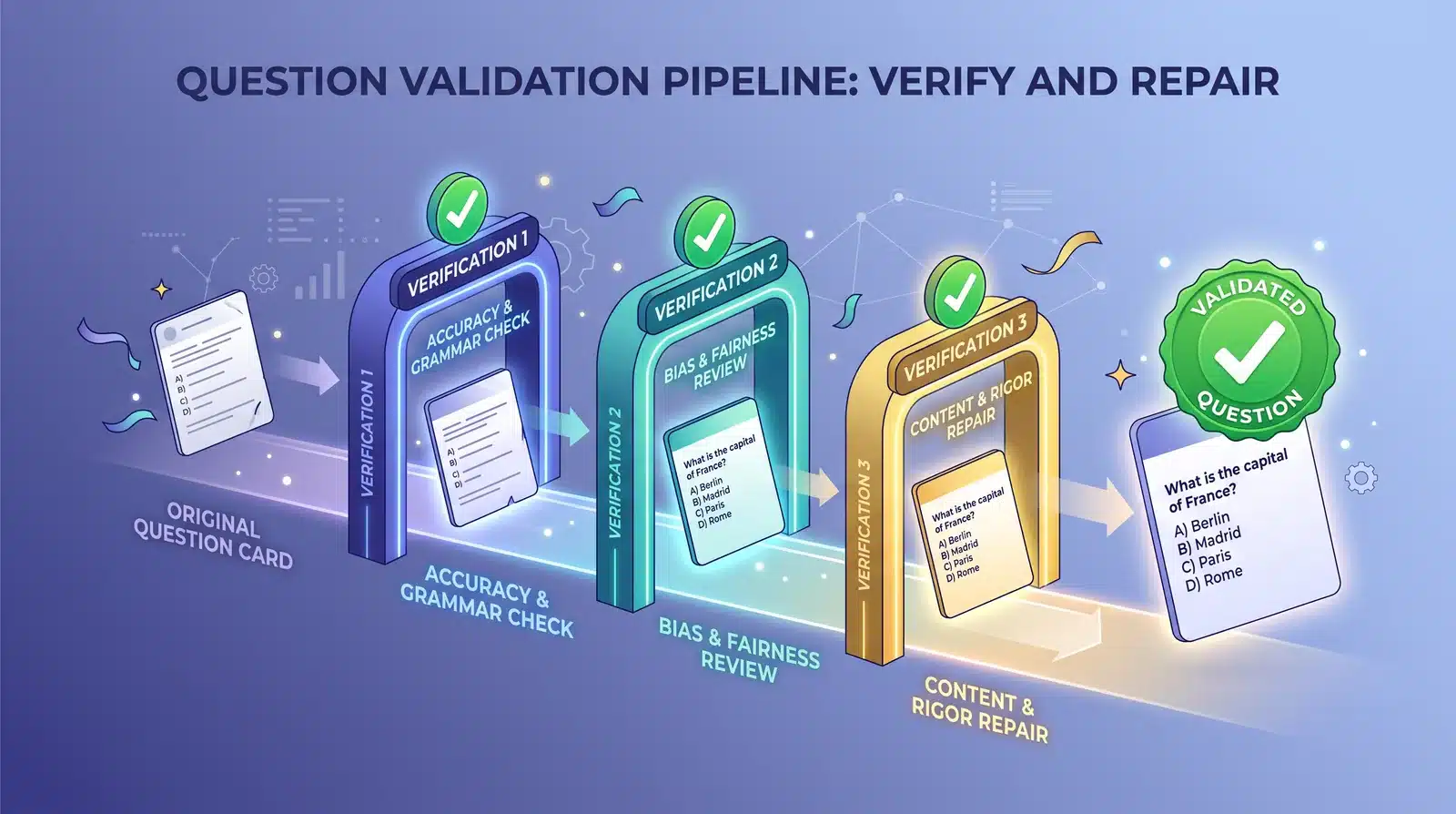
A few specific mechanisms handle the failure modes people actually worry about with AI-generated content. A multi-select verification pass checks that the correct-answer set is internally coherent and repairs it if not. A separate repair pass guarantees every true/false question has a definite boolean answer rather than an ambiguous one. And every generated question is validated against its own answer key before being served.
The most underrated piece is duplicate prevention. Every question you generate gets embedded and compared against your own recent questions, actively pushing regeneration away from near-duplicates across multiple rounds if needed. That directly answers a real concern: generate ten quizzes on the same topic and you get ten different quizzes, not the same handful of questions reshuffled.
Are AI-Generated Tests Actually Reliable?
The concern is legitimate, and the independent research is more reassuring than most people assume.
A large-scale field study spanning 91 classes and nearly 1,700 students found that AI-generated exam questions “performed comparably to expert-created questions designed for standardized exams,” using item response theory analysis to compare difficulty and discrimination (Isley et al., “Assessing the Quality of AI-Generated Exams: A Large-Scale Field Study,” arXiv, August 2025).
A separate study in medical education quantified this more directly: 69% of AI-generated exam questions were fit for inclusion with little or no modification required, while 31% were rejected, specifically for factual inaccuracies or non-alignment with what students had actually learned (Ahmed, Kerr & O’Malley, “Quality assurance and validity of AI-generated single best answer questions”). The rejection rate is real. So is the fact that it’s a catchable failure mode under review, not an invisible one.
That doesn’t mean zero oversight is the right approach, because it isn’t. The reason single-question regeneration and per-question feedback tools exist at all is that teachers do adjust generated content. The point is that the starting point is closer to expert-level than most people expect, not that review becomes optional.
Why This Difference Actually Matters
The difference is invisible until your content is specific. Then it’s the whole ballgame.
If you’re testing a widely standardized skill with no company-specific or course-specific wrinkle, TestGorilla’s library gets you a validated test with zero setup. But the moment your role requires a specific internal tool, or your course covers material outside a generic curriculum, a library-based platform has nothing to offer beyond “closest available match”, which may not actually test what you need tested.
AI-generated tests grounded in your own document have no such ceiling. Upload the actual material and the questions are about that material, not an approximation of it.
Which Should You Choose?
The practical test is simple. If a pre-built library entry already covers your content, use it. If it doesn’t, AI-generated tests are the only route to an assessment that actually matches what you teach or hire for.
Choose TestGorilla if you’re screening for a widely standardized skill with no organization-specific content, and speed of setup matters more than precision.
Choose IntelliAssess if your role or course has any content that isn’t generic (a specific tool, a specific curriculum, a specific job description) and you want the assessment to actually reflect it.
If you’re still comparing options broadly, see 7 Best TestGorilla Alternatives for Skills Assessment in 2026. If cost is the deciding factor, see the full pricing breakdown. And if you’re weighing usage costs at high volume, bring-your-own-key pricing changes the maths on heavy generation.
Frequently Asked Questions
Can TestGorilla generate custom tests from my own material?
No. TestGorilla’s model is a pre-built library of 350+ tests. There is no mechanism to generate questions from an uploaded document or job description, so you are selecting from what has already been built.
Does AI-generated content mean lower quality questions?
Not inherently. A large-scale field study across 91 classes and nearly 1,700 students found AI-generated exam questions performed comparably to expert-created ones (arXiv, 2025). Quality depends heavily on whether generation is grounded in specific source material rather than a bare prompt, which is the mechanism covered in detail here.
How does IntelliAssess prevent the same question from repeating across quizzes?
Every generated question is embedded and compared against your recent question history, and generation actively steers away from near-duplicates across multiple rounds if needed. Generating several quizzes on the same topic produces genuinely different questions each time, not a reshuffled repeat.
Can I see what text the AI actually pulled from my document?
Yes. A text extraction preview shows exactly what text was extracted from an uploaded file before any question generation happens, so you are not trusting a black box.
Does IntelliAssess also have a pre-built test library like TestGorilla?
Yes. There is a Verified Question Library of curated questions you browse and pull into an assessment, and a Verified Form Library of complete, cloneable assessments, both functioning much like TestGorilla’s library. The difference is that on IntelliAssess it is one option alongside generation, not the only way to build an assessment.
Are AI-generated tests better than a pre-built test library?
Neither is universally better. A pre-built library wins on speed when the skill is generic and well defined. AI-generated tests win whenever the content is specific to your syllabus, curriculum, or job description, because a library can only offer the closest available match. The strongest position is having both, so you can browse a library when generic content is fine and generate when it isn’t.
The Bottom Line
TestGorilla’s library is a real advantage for generic, standardized screening, and IntelliAssess matches that exact use case with its own Verified Question and Form Libraries. The gap opens up the moment your content is specific to your organization or course: TestGorilla stops there, IntelliAssess doesn’t. For most hiring and nearly all academic use, content ends up being specific enough that this gap matters, and AI-generated tests end up doing the work a fixed library cannot.
Want to see how your own syllabus or job description generates? Upload a document and build a full assessment from it on the free tier.


 Sep 02, 2026
