

TestGorilla vs. IntelliAssess: Content Generation, Grading, and Pricing Compared (2026)
 Jul 28,2026
 By motasemaldiab
TL;DR: IntelliAssess wins for teams that need assessments grounded in their own syllabus, job description, or course material, plus rubric-based grading for open-ended answers — capabilities TestGorilla’s pre-built library doesn’t offer at any price. TestGorilla wins for teams that just need a fast, generic test for a common role and don’t want to touch a prompt or upload a document. Choose IntelliAssess if your content is specific to you. Choose TestGorilla if a standardized test off the shelf is genuinely enough.
Why This Comparison Matters Right Now
Skills-based hiring keeps expanding — 70% of employers in NACE’s Job Outlook 2026 survey report using skills-based hiring, up from 65% the prior year (NACE: Employer Use of Skills-Based Hiring Practices Grows, 2026), and the pre-employment assessment tools market is projected to grow from roughly $1.95 billion in 2026 to $4.06 billion by 2035 (Business Research Insights, 2026) — market-sizing estimates vary meaningfully by research firm and by how narrowly “pre-employment testing” is scoped, so treat this as directional context rather than a precise industry figure. As more teams adopt structured assessment, the platform they pick determines whether that assessment actually reflects the role or course they’re evaluating — or just the closest pre-made equivalent.
TestGorilla built its business on a large, pre-made test library. IntelliAssess takes a different approach: generating questions directly from the material you upload, then grading open-ended responses against a rubric instead of just checking for plagiarism. This comparison covers four things that actually decide the purchase: how each platform creates content, how it grades, how it proctors, and what it costs — with every claim about TestGorilla sourced to its own public documentation, not assumption.
For a full ranked look at the field, see “7 Best TestGorilla Alternatives for Skills Assessment in 2026,” our full pricing cost breakdown, or the broader guide to online assessment platforms in 2026.
How this comparison was researched: Every TestGorilla claim below is sourced directly to TestGorilla’s own pricing page, help center, or product pages, linked inline. This is a research-based comparison, not a first-hand trial of both platforms — no head-to-head hands-on testing was conducted for this piece. Published by the IntelliAssess team; where a figure relies on a third-party estimate rather than a primary source, that’s stated explicitly in context.
Quick Comparison Table
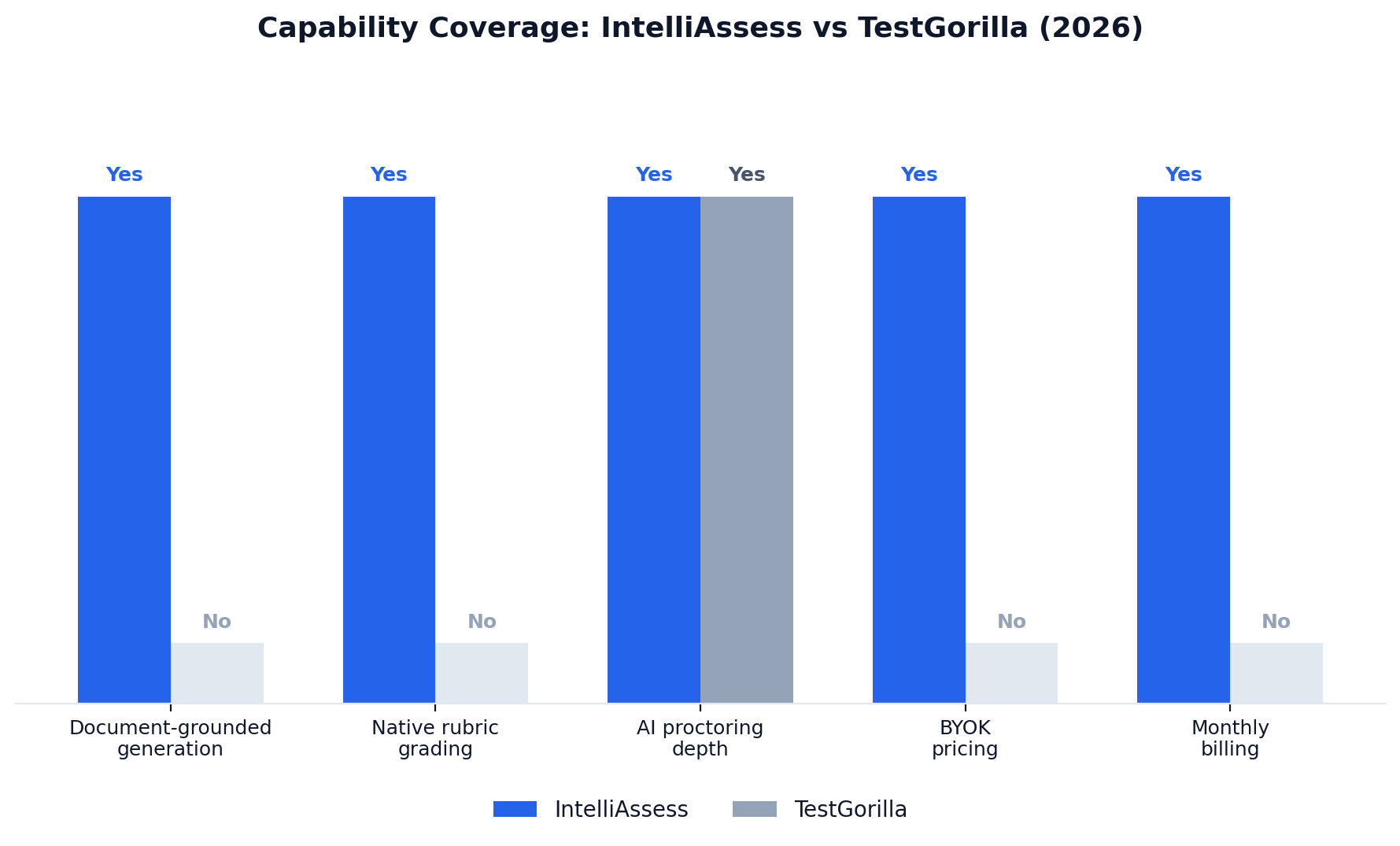
| Category | TestGorilla | IntelliAssess |
|---|---|---|
| Best For | Fast, generic role screening with no customization need | Teams needing content grounded in their own syllabus, JD, or course material |
| Question Creation | Pulled from a fixed library | AI-generated from your uploaded documents or a text prompt |
| Library Size | 350+ pre-built tests, 100+ item bank per test (TestGorilla Help Center) | Not library-based — generation is content-grounded, not pre-made |
| Grading (open-ended) | Plagiarism detection only, no rubric scoring | AI-generated multi-criteria rubrics with human override |
| Proctoring | Webcam monitoring, IP logging, randomized order (TestGorilla Assessments) | Identity verification, liveness/pose detection, real-time violation alerts, live invigilator view |
| Live Human Proctor | Not offered | Not offered |
| Pricing Model | Annual-billed contract, credit-per-candidate | Monthly tiers + BYOK option |
| Entry Price | Free (5 essential tests, 10 credits/mo, 1 seat) | Free (25 students) |
| Cheapest Paid Tier | $142/mo billed annually = $1,704/year (Core, 2 seats) — no true monthly billing | $39/month (Starter, 200 students) |
| Cost Transparency Above Entry Tier | Core and Plus ($400/mo, $4,800/yr) both publicly listed; only the top Enterprise tier is custom-quoted | All four tiers publicly listed, including Intense at $249/mo — no custom-quote tier at all |
| Our Verdict | Wins only for zero-customization generic screening | Wins on content relevance, grading depth, and pricing transparency |
Which Platform Actually Creates Your Assessment Content?
IntelliAssess wins on content relevance because it generates questions from material you provide, rather than asking you to find the closest match in a pre-built library.
TestGorilla’s core product is its test library: 350+ pre-built skills tests, each drawing from a question bank of at least 100 items, with 12–20 served per candidate to reduce repeat exposure across hires (TestGorilla Help Center). That’s a real strength for speed: there’s no prompt to write, no document to upload, just a library to browse. We break that tradeoff down in detail in TestGorilla’s fixed library vs. AI-generated tests. But it’s fixed content — you’re selecting from what TestGorilla already built, not shaping it around your actual role requirements or curriculum.
IntelliAssess generates assessments directly from what you feed it: a prompt specifying topic, difficulty, and audience, or an uploaded PDF, DOCX, or TXT file that grounds the questions in your actual syllabus or job description. It supports seven question formats — single-choice, multi-select, true/false, short answer, fill-in-the-blank, long-answer, and mixed — with single-question regeneration if one item in a draft isn’t right, and a per-question AI chat thread to refine wording without rebuilding the whole assessment.
The nuance: if you’re hiring for a truly generic, well-defined role — say, a standard SQL screening with no company-specific wrinkle — TestGorilla’s pre-validated library saves you the step of writing a prompt at all. That’s a legitimate reason to still consider it for high-volume, low-specificity screening.
Verdict: IntelliAssess wins for any role, course, or exam where the content needs to reflect something specific to you — which is most hiring and nearly all academic use.
Which Platform Grades More Than Multiple Choice?
IntelliAssess wins on grading because it evaluates open-ended answers against a rubric, not just a plagiarism check.
TestGorilla automates scoring well for objective formats — multiple choice and coding tests with automated checks are its strength. For written, open-ended responses, though, its main integrity tool is plagiarism detection on the text submitted, not rubric-based evaluation of the content itself (TestGorilla Assessments). That catches copied answers; it doesn’t score how good an original answer actually is against defined criteria.
IntelliAssess builds rubric-based grading in natively: an AI-generated multi-criteria rubric — built from the assessment content itself — scores subjective and open-ended responses automatically, with a human-in-the-loop step letting a teacher or hiring manager adjust individual criteria scores, override the AI’s grade, and append their own notes before anything is final. It pairs this with personalized feedback for the person assessed: a breakdown of strengths, weak concepts, and specific areas to improve.
The nuance: for assessments that are purely multiple-choice or auto-graded coding tests, this difference doesn’t matter much — both platforms score objective formats well. It matters specifically once you’re evaluating written, constructed, or case-study-style responses.
Verdict: IntelliAssess wins decisively for any assessment leaning on open-ended or written answers; the two platforms are roughly equivalent for pure multiple-choice screening.
How Does Proctoring Compare?
Both platforms proctor through automated monitoring rather than a live human proctor — the difference is in what each system watches for.
TestGorilla’s integrity layer includes webcam proctoring, IP address logging, randomized question order, and plagiarism detection on written answers (TestGorilla Assessments). Notably, it does not offer one-on-one human proctoring — flags are automated and reviewed after the fact.
IntelliAssess’s proctoring includes identity verification through face enrollment and real-time comparison, liveness detection through pose and movement checks (to catch static-image or video spoofing), real-time violation alerts for multiple faces, a missing face, an identity mismatch, or looking away, plus a live invigilator view showing a real-time violation timeline during the exam itself.
This distinction matters more than it might have a year ago: proctored assessment fraud rates reportedly rose from 16% to 35% in 2025 as AI-assisted cheating increased (Aiseptor AI Cheating Statistics 2026) — worth treating as directional market context rather than a precise industry figure, since this is a vendor-published statistic without independently disclosed methodology. What’s better established is the broader trend: as generative AI tools become more accessible, integrity tooling that only checks after the fact carries more risk than tooling that flags anomalies in real time.
The nuance: neither platform claims a specific fraud-catch rate for its own system, and any webcam-based proctoring — including IntelliAssess’s — carries a documented industry-wide risk of false positives affecting certain camera conditions and environments. Neither platform is a perfect solution to remote integrity; both are automated-monitoring approaches with different depth.
Verdict: IntelliAssess offers a deeper real-time monitoring layer (live invigilator view, pose-based liveness checks); TestGorilla’s approach is real but more limited to post-hoc log review.
What Does Each Platform Actually Cost?
For a team assessing a few hundred candidates a year, IntelliAssess costs less at comparable volume; TestGorilla requires an annual billing commitment even on its published tiers, and only its top Enterprise tier goes fully custom.
TestGorilla has no true monthly-billing option — every paid tier is billed annually. Per TestGorilla’s own pricing page: Free is $0/month (10 credits/month, 1 seat, 5 essential skills tests); Core is $142/month billed annually ($1,704/year, 2 full-access seats, the complete 350+ test library); Plus starts at $400/month billed annually ($4,800/year, unlimited seats, adds AI interviews with auto-scoring, job simulations, and custom coding challenges); and Enterprise is custom-quoted, requiring direct contact (TestGorilla Pricing). Credits are consumed per candidate, not per invitation — inviting someone costs nothing, but a candidate who starts a basic assessment (up to 5 skills tests) uses 1 credit; adding a one-way AI video interview adds a credit, and a conversational AI interview costs 2 credits (TestGorilla credits guide). TestGorilla’s own pricing page doesn’t state an exact annual credit allotment for Core; a third-party marketplace listing puts it at 400 credits/year (TrustRadius) — treat that specific figure as a third-party estimate, not a TestGorilla-confirmed number, since it wasn’t independently verifiable against TestGorilla’s own documentation for this piece.
IntelliAssess publishes all four of its tiers with no custom-quote tier at any level: Free ($0, 25 students), Starter ($39/month, 200 students, ~700 AI-generated questions/month), Pro ($99/month, 500 students), and Intense ($249/month, 2,000 students), with roughly 17% off on annual billing (intelliassess.ai pricing page). On top of any tier, BYOK lets an admin connect their own OpenAI, Gemini, or Groq API key to bypass the platform’s built-in token limits entirely, paying the AI provider directly instead of IntelliAssess’s usage-based allotment.
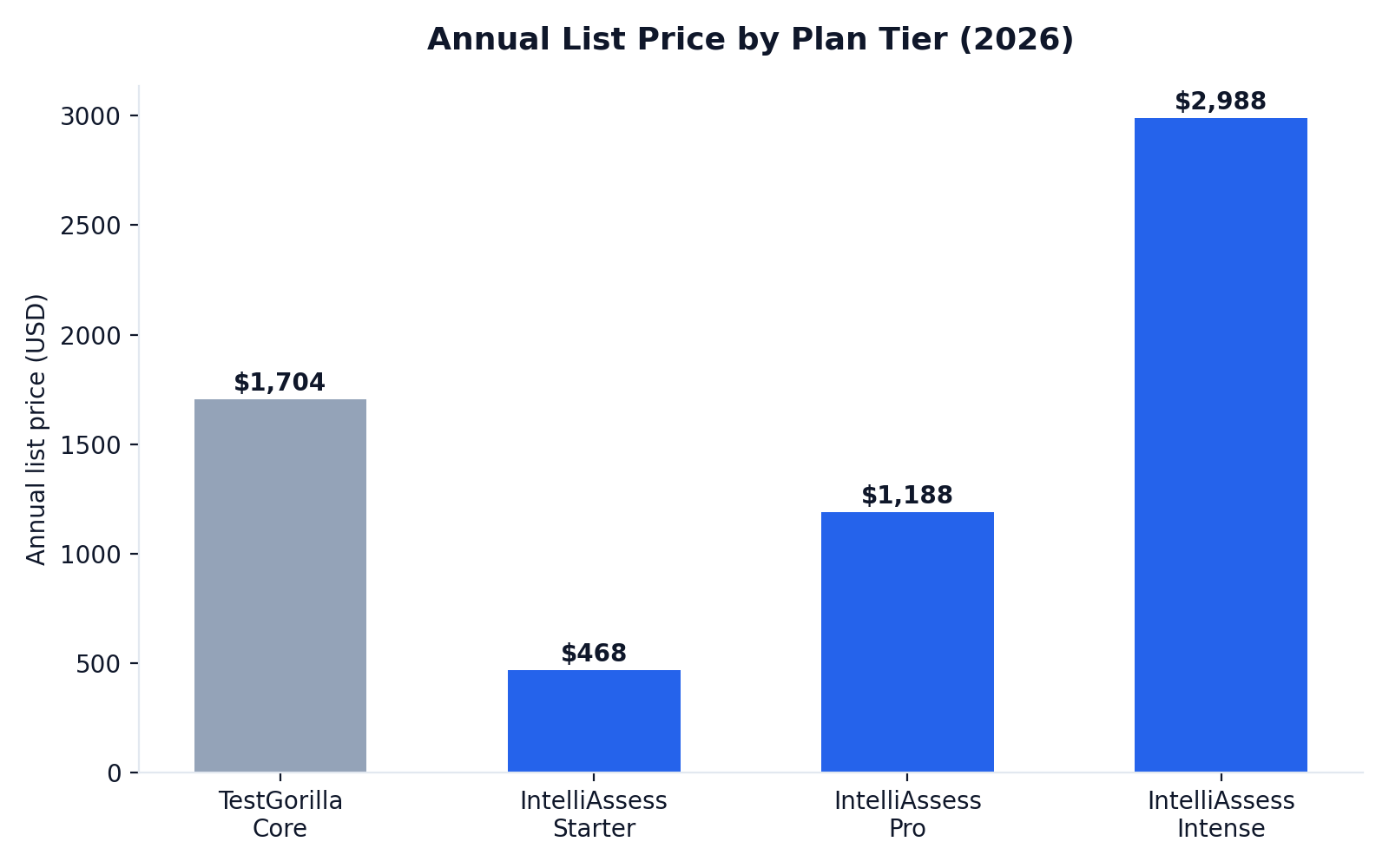
Value verdict: at comparable volume, IntelliAssess is both cheaper and its per-candidate cost is fully calculable at every tier; TestGorilla’s Core tier is competitive on paper but its exact candidate capacity isn’t confirmed by TestGorilla’s own documentation, and Plus scales “with your hiring needs” without a stated candidate cap.
What Does This Actually Cost Per Candidate?
Doing the math on published pricing, rather than just listing plan prices side by side, tells a clearer story — with one caveat worth stating upfront: TestGorilla’s own pricing page doesn’t publish an exact number of credits per tier, so the Core-tier figure below leans on a third-party estimate rather than a company-confirmed number.
Using the third-party-reported figure of 400 credits/year for Core, and full utilization on basic (≤5-test) assessments: $1,704 ÷ 400 ≈ $4.26 per candidate. Use fewer than 400 in a year and the effective cost per candidate rises, since $1,704 is a flat annual charge regardless of how many credits you actually use — at 200 candidates, that’s effectively $8.52 per candidate. Add an AI interview component and the cost per candidate rises further, since interviews consume 1–2 additional credits each. TestGorilla’s Plus tier ($400/month, $4,800/year) is described as scaling “with your hiring needs” but doesn’t publish a fixed candidate cap, so a precise cost-per-candidate figure for Plus isn’t calculable from public information.
IntelliAssess’s cost per student comes out lower and is calculable at every published tier: $2.34 at Starter (200 students), $2.38 at Pro (500 students), and $1.49 at Intense (2,000 students) — a flat monthly fee for the tier’s capacity, not a draw-down credit pool, and no tier requires contacting sales to learn the price.
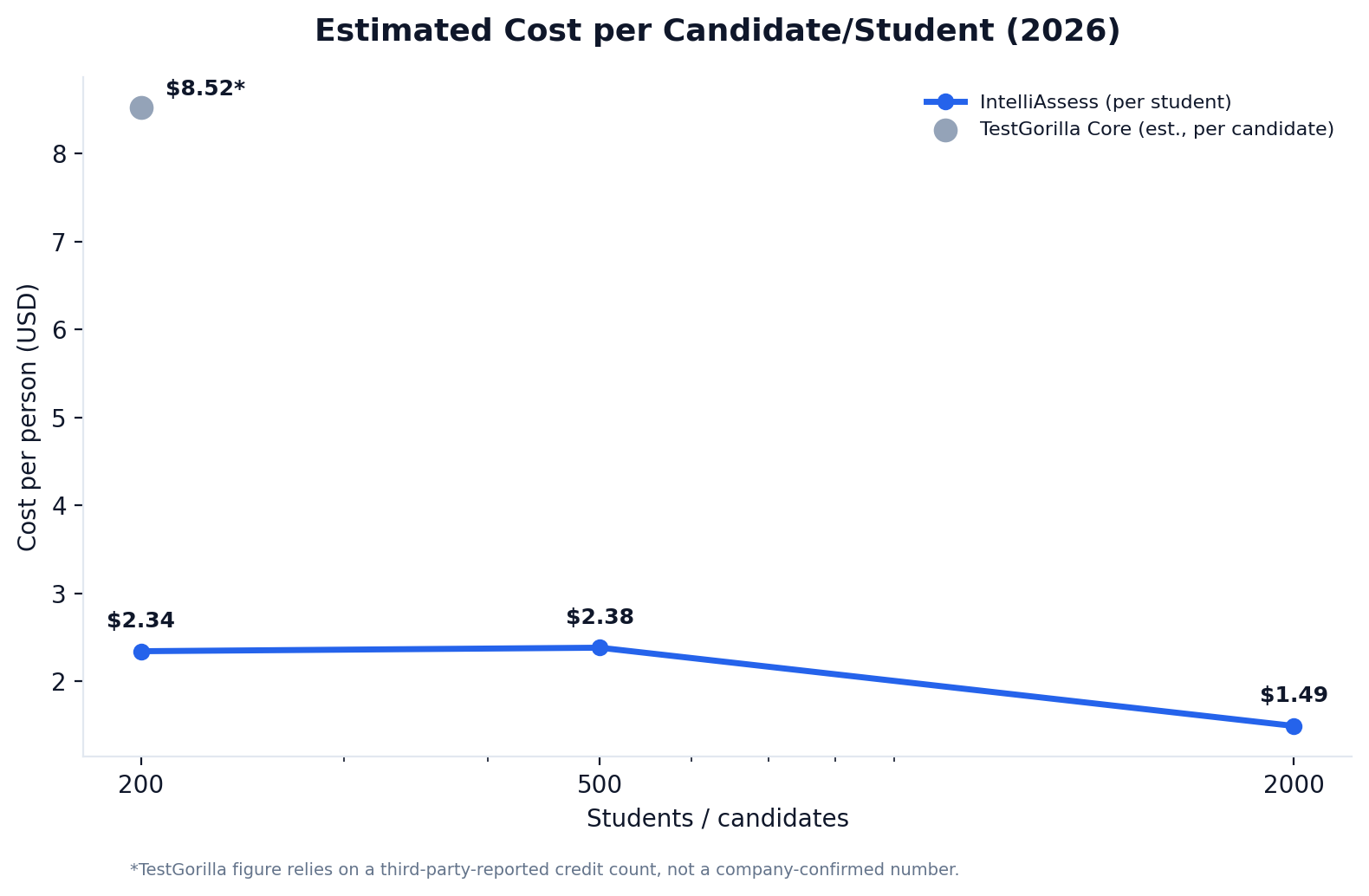
The clearest gap here isn’t just the per-candidate number — it’s calculability. Every IntelliAssess tier lets you work out an exact cost per student from public information alone. TestGorilla’s Core estimate depends on a third-party source, and Plus’s actual candidate capacity isn’t stated anywhere public. IntelliAssess’s Intense tier keeps a published, calculable price all the way to 2,000 students, and BYOK removes even that ceiling for teams with their own AI provider account.
IntelliAssess’s Full Feature Breakdown
Beyond the head-to-head categories above, IntelliAssess’s own feature set goes deeper across six areas: pricing and onboarding, AI model access, question formats, proctoring, exam configuration, and analytics/integrations. These are IntelliAssess’s own published capabilities, not a TestGorilla comparison point — useful context for what “full platform” actually includes.
Pricing, Onboarding & Transparency
- Monthly subscription, no annual contract — cancel anytime
- Self-serve onboarding — instant account creation
- BYOK (Bring Your Own API Key) — connect a custom OpenAI or Gemini key
- Transparent public pricing — full pricing listed upfront
AI Models, Generation & Intelligence
- All-in-one multi-model access — GPT-4o, Gemini, and Groq
- Inter-model operations — generate in GPT, grade in Gemini
- RAG document upload (PDF/Docs scan) — up to 4K GPT / 6K Gemini scans
- Verified prompt library
- Conversational AI agent interview
Question Types & Assessment Formats
- MCQ, multi-select & true/false
- Descriptive & essay auto-grading — AI rubric scoring
- Coding compilers & sandboxes
- Pre-built skill test library — AI dynamic pool
- Psychometric & behavioral modules
Proctoring, Security & Integrity
- Continuous video proctoring — continuous stream
- Voice/audio proctoring
- Browser lockdown / tab-switch tracking
- Candidate ID verification
Exam Configuration & Candidate Experience
- Question & option reshuffling
- PIN/passcode-protected exams
- Live setup helper / human-in-the-loop support — live chat setup
Analytics, ATS Ecosystem & Security Compliance
- AI performance feedback & transcripts — automated analysis
- ATS integrations (Workday, SAP, etc.) — webhooks & APIs
- Role-based access control (RBAC)
Which Platform Fits Your Team?
If your assessment content needs to reflect your own material — a syllabus, a specific job description, an internal skills framework — choose IntelliAssess. If you need a single generic test for a common role today and don’t want to touch a prompt, TestGorilla’s library gets you there faster.
Recruiting teams hiring for specialized or role-specific positions: Choose IntelliAssess. Uploading the actual job description grounds the questions in what the role needs, and rubric-based grading handles case-study or written responses TestGorilla can only plagiarism-check.
HR teams doing high-volume, generic screening: TestGorilla’s pre-validated library is a reasonable fit if every hire is being tested on the same standardized, non-specific skill — but confirm the actual candidate capacity of whichever tier you’re quoted, since neither Core’s nor Plus’s exact candidate ceiling is stated on TestGorilla’s own pricing page.
Educators and course instructors: Choose IntelliAssess. Document-grounded generation from a syllabus and AI rubric grading for essay-style answers directly address academic grading workload in a way TestGorilla, built for hiring, doesn’t attempt to.
Teams already paying for their own OpenAI/Gemini/Groq access: IntelliAssess’s BYOK option is the clearest cost lever in this comparison — it’s worth checking before defaulting to either platform’s standard tier.
Frequently Asked Questions
What is the best alternative to TestGorilla?
IntelliAssess is the strongest alternative for teams that need assessment content grounded in their own material rather than a pre-built library, plus native rubric-based grading for open-ended responses — two capabilities TestGorilla doesn’t offer at any tier.
Is TestGorilla worth the price?
For generic, high-volume screening on its Core tier ($1,704/year, no true monthly billing), it’s a reasonable, if inflexible, cost — though the exact candidate capacity behind that price isn’t confirmed on TestGorilla’s own pricing page. Its Plus tier ($4,800/year) publishes a price but not a fixed candidate cap, and only the top Enterprise tier requires contacting sales.
Does TestGorilla offer AI-generated custom tests?
No — TestGorilla’s model is a pre-built library of 350+ tests with a 100+ item question bank each, not generation from user-supplied material. IntelliAssess generates questions from an uploaded document or a text prompt instead.
How does TestGorilla proctoring work?
TestGorilla uses webcam monitoring, IP address logging, randomized question order, and plagiarism detection on written responses. It does not offer live, one-on-one human proctoring — all monitoring is automated and reviewed after the exam.
The Verdict
| Category | Winner |
|---|---|
| Content Creation | IntelliAssess |
| Grading (open-ended) | IntelliAssess |
| Proctoring Depth | IntelliAssess |
| Pricing Transparency | IntelliAssess |
| Cost per Candidate (at comparable volume) | IntelliAssess |
| Speed for Generic, Zero-Customization Screening | TestGorilla |
| Overall | IntelliAssess — for any team whose content needs to reflect their own material |
TestGorilla remains a reasonable choice if your hiring is entirely generic and you’ll never need to touch a prompt or upload a document. For everyone else — recruiters hiring for specific roles, educators grading against their own syllabus, or any team that’s hit the point where TestGorilla’s pricing goes quiet — IntelliAssess’s document-grounded generation, rubric-based grading, and transparent BYOK pricing are the more defensible choice on the facts.
Ready to see the difference on your own content? Try IntelliAssess with your syllabus or job description.


 Sep 02, 2026
