
CodeSignal vs IntelliAssess: a certified score or your own codebase?

By Motasem Aldiab, Technology Consultant and Trainer - Cloud, DevOps, Java, Data Science
Contents21
- The short answer
- CodeSignal vs IntelliAssess at a glance
- What CodeSignal is
- What IntelliAssess is
- Certified scores and proved tasks: two kinds of fairness
- The AI interviewer question
- AI in the test, side by side
- Integrity, check by check
- The candidate's side
- What the reviewer sees
- Hiring beyond engineering
- When a question leaks
- One hire, two ways: a backend developer for a payments team
- Security reviews and procurement
- Pricing
- Where CodeSignal is better
- Where IntelliAssess is better
- Using both together
- Questions to ask before choosing
- Choose CodeSignal if
- Choose IntelliAssess if
Key takeaways
- 1CodeSignal Build is $79 a month billed annually for 60 credits, with AI proctoring and ID checks.
- 2Its Certified Assessments are validated by I-O psychologists, 2,800 hours of research each.
- 3Its AI Interviewer screens many roles; IntelliAssess has no interviewer.
- 4IntelliAssess builds the test from your public repo and proves the grading, in beta.
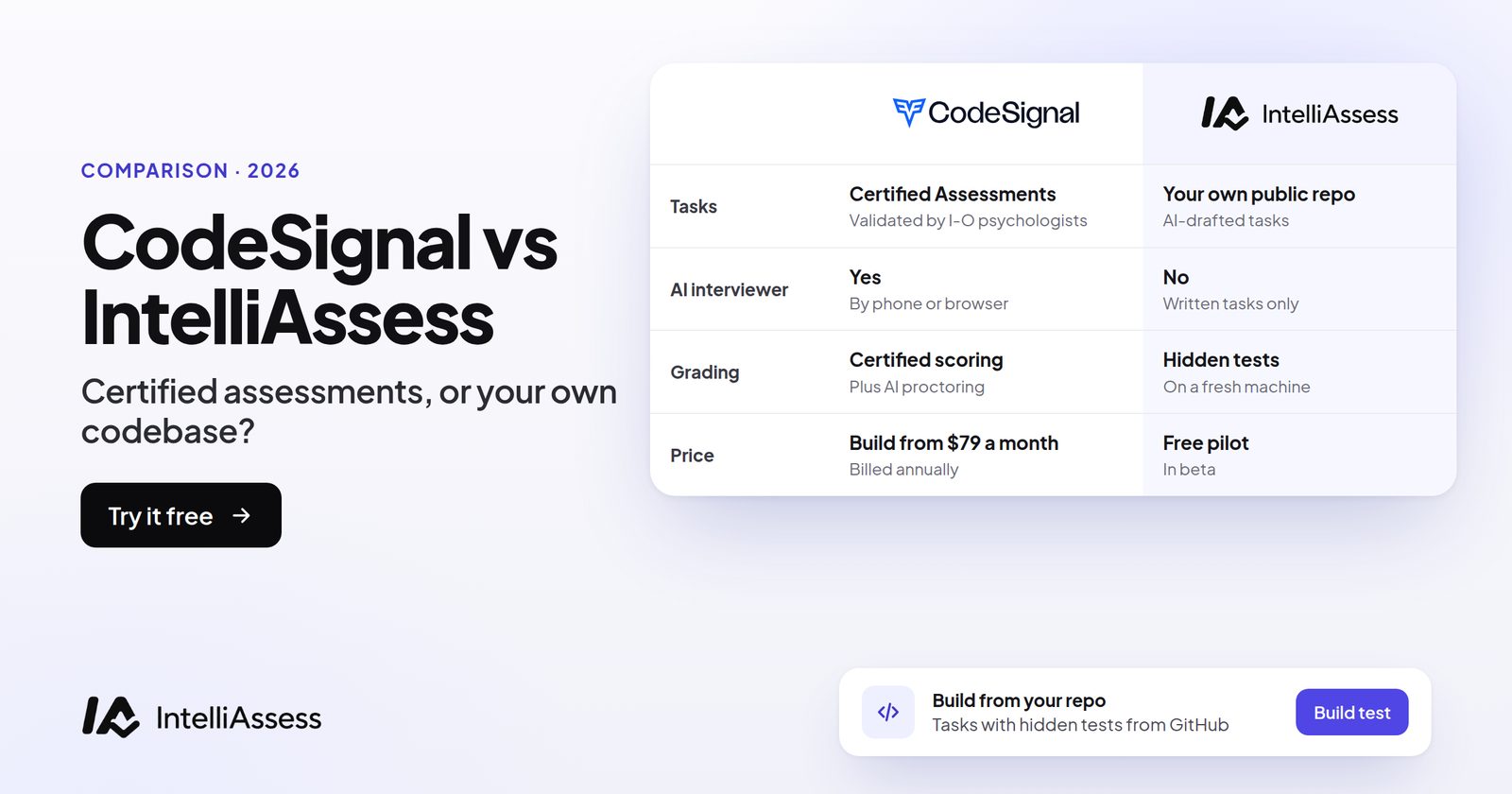
CodeSignal vs IntelliAssess compares one of the broadest skills assessment platforms, with Certified Assessments validated by I-O psychologists, AI interviewers, live coding interviews and simulations for business roles, with a younger coding product, in beta, that turns your own repository into the test. CodeSignal starts at $79 a month billed annually for 60 candidates, with AI proctoring and ID verification on its first plan. IntelliAssess plants bugs in a project you choose, proves the grading works before anyone sits the test, and grades on a fresh machine with hidden tests, on a free pilot. CodeSignal is the broader, more mature product; IntelliAssess answers one question it does not: how does this person work in our code?
The short answer
Choose CodeSignal if you want validated, ready-made assessments for many technical and business roles, an AI interviewer for first-round screening, live coding interviews, ATS integrations and security certifications, with published prices. Choose IntelliAssess if you want final-stage candidates to fix real bugs in your own Node.js or Python project, proof that each test grades correctly before you send it, and ID and webcam checks, and you can work from a public repository on a beta pilot.
CodeSignal vs IntelliAssess at a glance
| CodeSignal | IntelliAssess (beta) | |
|---|---|---|
| Where tasks come from | Certified Assessments and a question library (2,000 questions on Build); 39 programming languages | Your own public GitHub repository, with AI-planted bugs and hidden tests |
| Why the test is fair | Written by subject experts, validated by I-O psychologists, 2,800 hours of research each | Each task proved before publishing: reference fix passes, wrong fixes fail, another AI model can solve it |
| AI for candidates | Agentic assessments with Claude and Codex (per its pricing page); Cosmo assistant; or AI limited or off | The assistant you allow, with a spend limit; every prompt in the report, never scored |
| AI interviewer | Yes, typically 15 minutes, with a scored report and transcript | No |
| Live interviews | Cloud IDE with video, audio, chat and whiteboard | Watch-only live view |
| Integrity | AI proctoring and ID verification on Build; Suspicion Score; question rotation | ID and face match, webcam, microphone, browser lock |
| Beyond engineering | Go-to-market assessments and sales, CS and marketing AI interviewers (Grow) | Coding only in this product; non-coding tests are a separate product |
| ATS and SSO | Basic ATS on Grow; enterprise ATS, SSO and SCIM on Pro | Not yet |
| Security | SOC 2 Type II, GDPR, CCPA; FedRAMP listed | No certifications listed |
| Price | Build $79 a month billed annually (60 credits); Grow $479 (420); Pro custom | Free pilot in beta; no published price |
What CodeSignal is
CodeSignal covers hiring and learning. For hiring, its Certified Assessments are "written by subject matter experts and validated by IO psychologists, each backed by 2,800 hours of research and testing", and include its General Coding Assessment (general programming and algorithms, debugging, and requirement implementation). Question rotation "provides thousands of variations", and you can select pre-built certified assessments with no question writing. Candidates work in a full IDE where they can build, run and test code.
On AI, CodeSignal lets you "enable full AI assistance to mirror on-the-job workflows, or limit AI to syntax and documentation help", with Cosmo, its integrated assistant. Its pricing page lists "Agentic Assessments with Claude & Codex" on Build and Grow, and its agentic assessments page says you can choose which large language models power them, with AI skills assessments such as AI-assisted coding, applied AI and MCP and agentic systems, typically 20 to 30 minutes for AI literacy and 60 to 90 for advanced technical ones.
Its AI Interviewer runs structured interviews, typically 15 minutes, that probe with follow-up questions and produce an overall score, skill evaluation and transcript. CodeSignal says the AI does not decide who gets hired, and that its I/O psychologists tune the AI's ratings against your reviewers'. Live interviews run in a shared technical workspace. CodeSignal names customers including UnitedHealth Group, Brex and Instacart, and lists SOC 2 Type II, GDPR and CCPA on every plan.
What IntelliAssess is
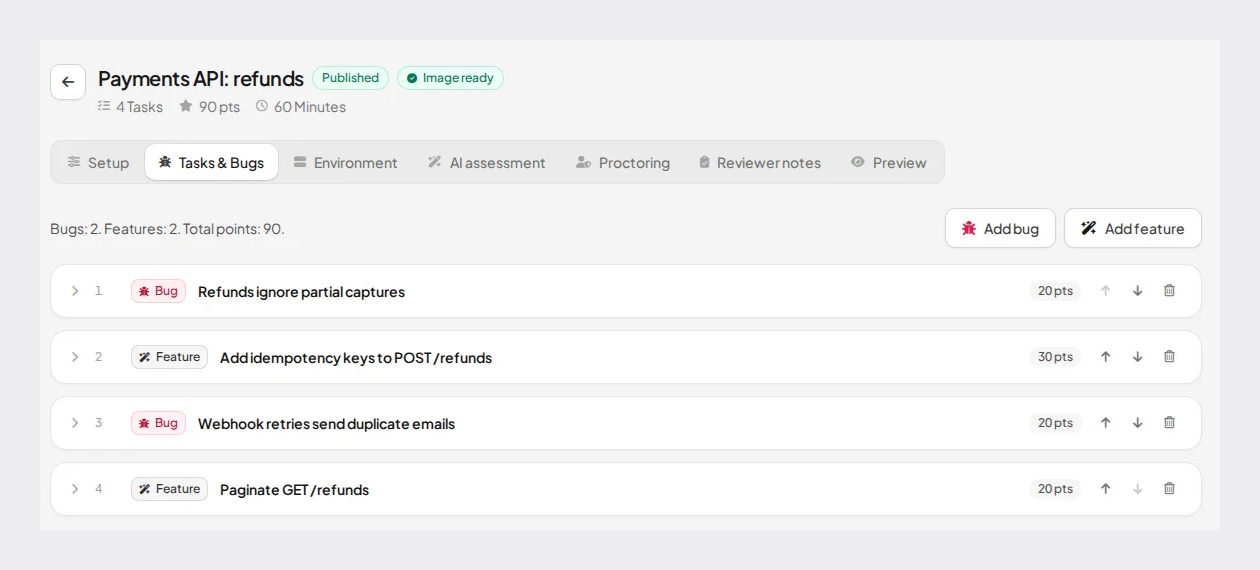
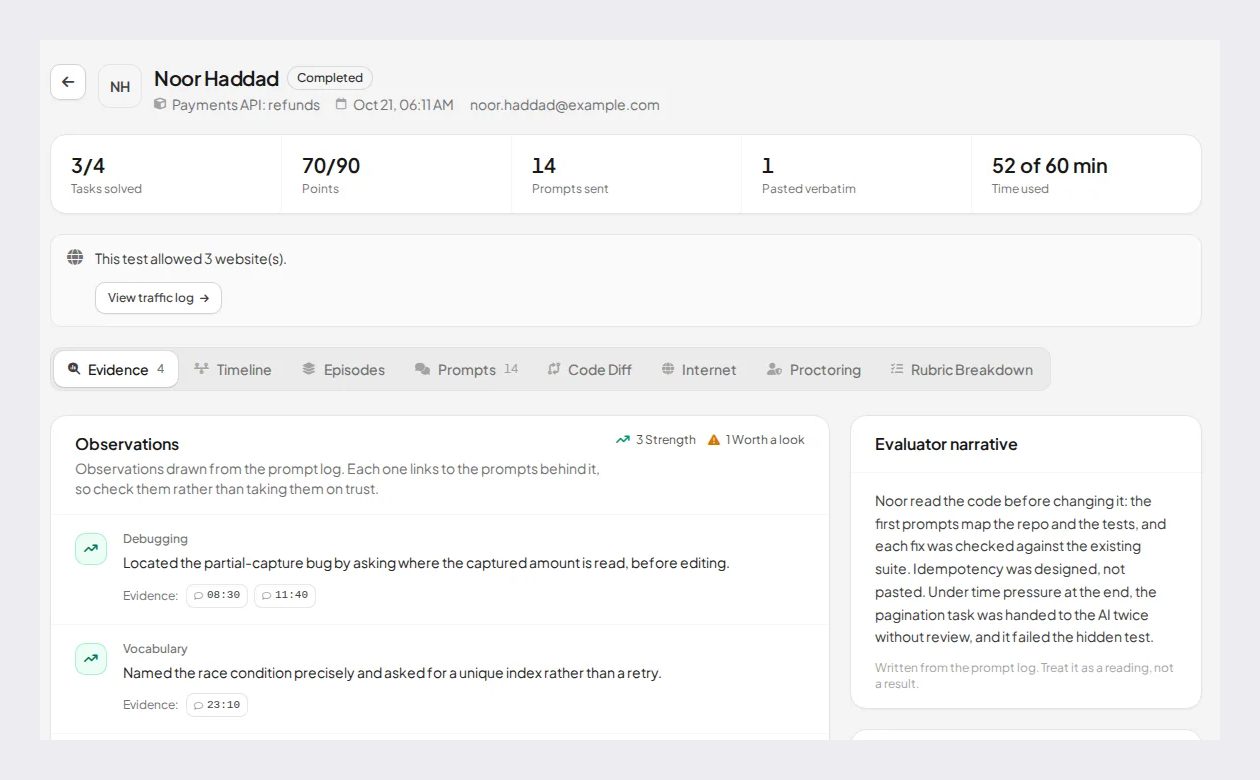
IntelliAssess's coding product is in beta. You give it a public GitHub repository and describe the role. It installs the project on a practice machine, drafts tasks (planted bugs and small features) with hidden tests, and will not publish until the grading is proved: the reference fix passes, each bug fails only its own task, a variation of each bug is caught, two wrong fixes fail, and a different AI model can solve the task from what the candidate sees.
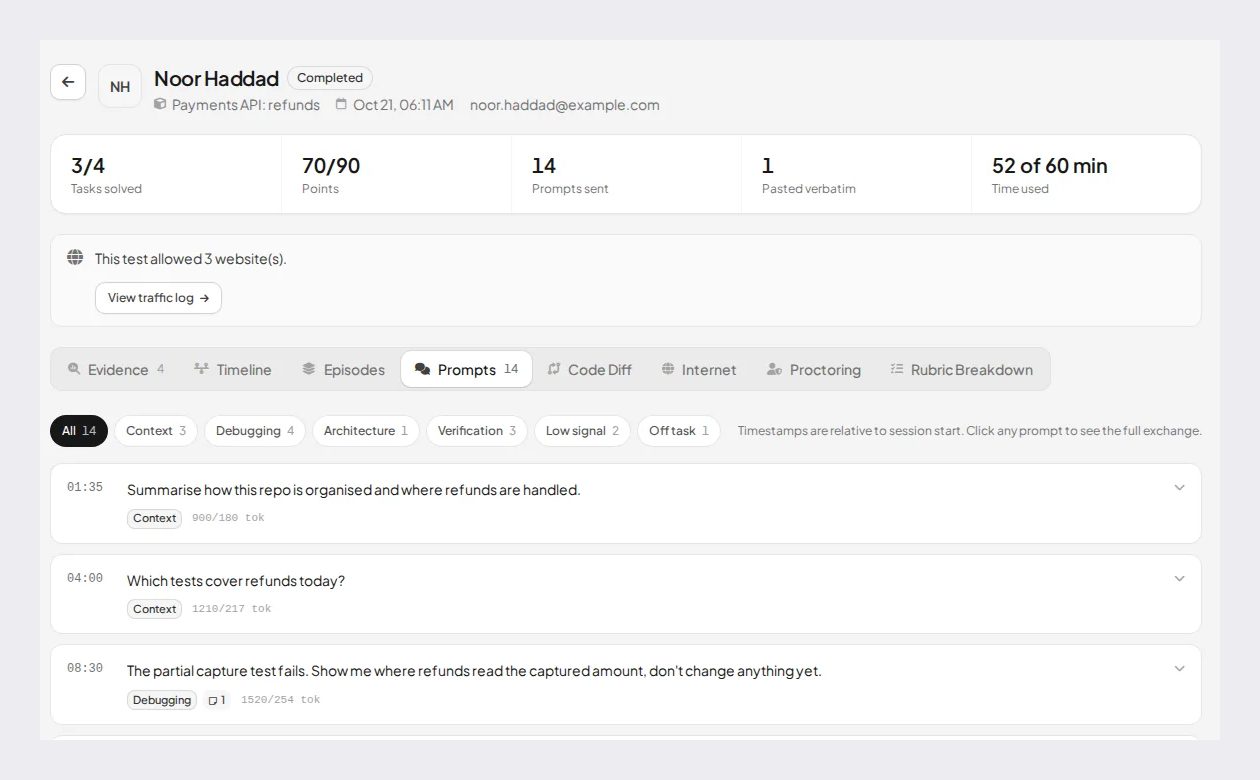
Candidates get VS Code in the browser on their own cloud machine, the AI assistant you choose with a spend limit, and internet off, limited to package stores, or open to sites you allow. Their files are graded on a fresh machine with hidden tests they never see. The scorecard shows points per task, rules followed or broken, the diff and every prompt, with observations linked to the prompts behind them, plus the proctoring report.
What it does not have: private repositories, AI-made tasks outside Node.js and Python, a live interview editor, an AI interviewer, business-role assessments in this product, ATS integration, a large library, a validation study, security certifications on its pages, or a release out of beta.
Certified scores and proved tasks: two kinds of fairness
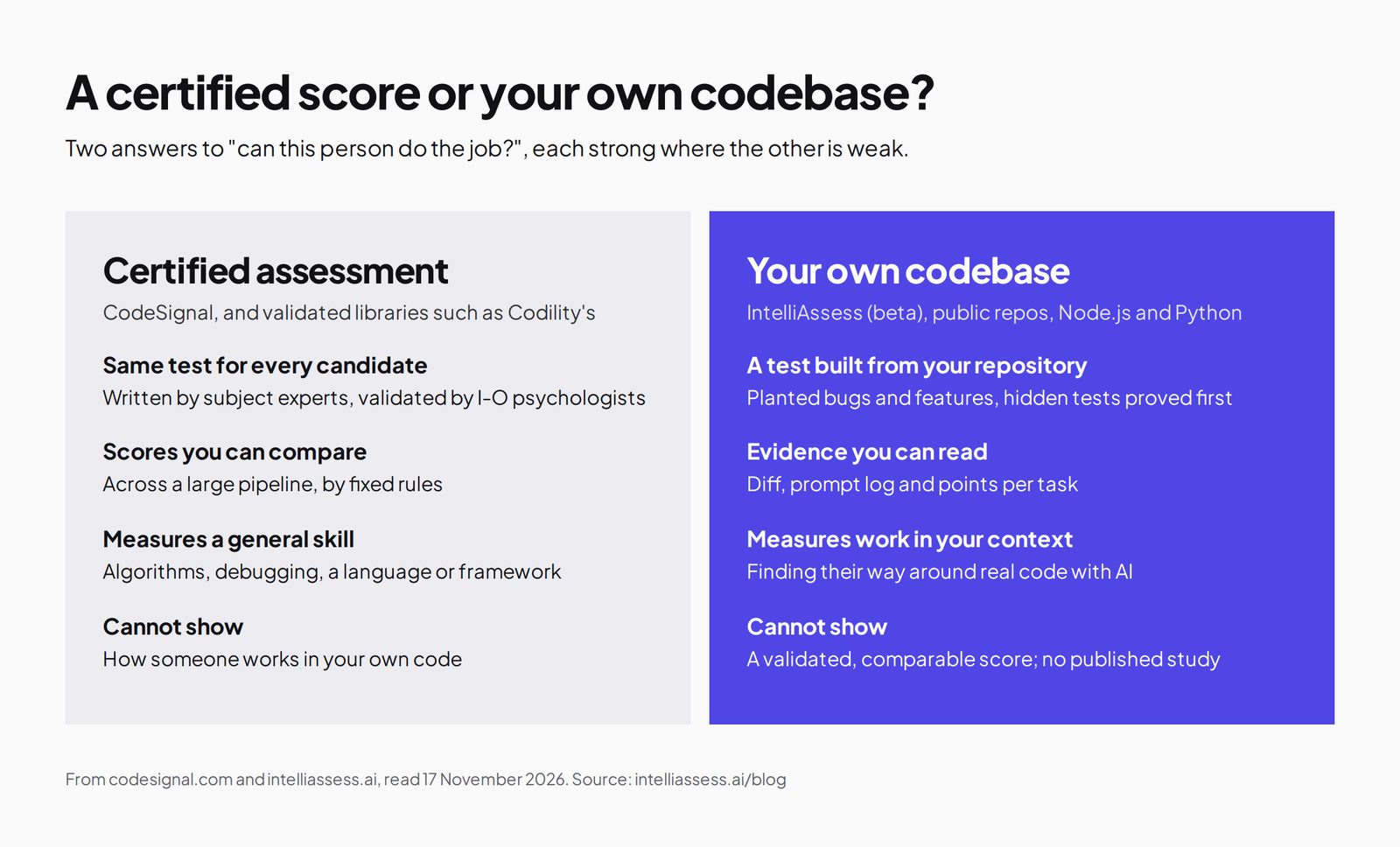
CodeSignal's answer is psychometric. Certified Assessments are validated by I-O psychologists, each backed by 2,800 hours of research and testing, and its Pro plan adds bias audits and local I-O validation studies. Because every candidate sits the same certified assessment, scores line up across a pipeline and you can set a consistent bar. These are CodeSignal's own claims; ask for the validation evidence if you need to show it to a compliance team.
IntelliAssess's answer is mechanical. For each task in your repository, it proves the test grades what it claims: the correct fix passes, wrong fixes fail, the bug is caught in a variation, and the instructions are enough for another model to solve it. That shows the grading of a specific task is correct. It does not show the task predicts job performance or treats groups of candidates equally; IntelliAssess has no published study of either.
If you need comparable, defensible scores across hundreds of candidates, CodeSignal is far stronger. If you need to know how two or three finalists work in your code, IntelliAssess shows it directly.
The AI interviewer question
CodeSignal's AI Interviewer is the clearest difference between the two products. It can screen applicants for sales, finance, marketing, accounting, recruiting, BDR and product roles on its interviewer page, with engineering interviewers listed on the Build plan, so a recruiting team can put every applicant through a short structured conversation before a person spends time on them. CodeSignal says it validates the AI's ratings against your reviewers and runs an adverse impact study on the pilot. IntelliAssess has nothing comparable: it starts later in the process, once you know who you want to test in depth.
If your bottleneck is too many applicants for too few interviewers, CodeSignal's interviewer addresses it and IntelliAssess does not.
AI in the test, side by side
Both allow AI and record it. CodeSignal lets you choose full assistance, limited help, or none, with Cosmo or agentic tools, and choose which models power agentic assessments for security and governance reasons. IntelliAssess gives candidates the assistant you choose, with a spend limit, and shows every prompt with its time and category in the scorecard. The prompts never change the score; points come only from hidden tests.
Integrity, check by check
| Check | CodeSignal | IntelliAssess (beta) |
|---|---|---|
| Identity | ID verification with a government photo ID, from Build | ID photo, selfie, liveness check and face match |
| Proctoring | AI proctoring recording video, audio and screen, with human review | Webcam and microphone checks; watch-only live view |
| Copying and fraud | Suspicion Score from signals such as solution similarity and copy-paste; advanced fraud prevention on Pro | Not described; tasks come from your repository |
| Leaked questions | Question rotation with thousands of variations | A new challenge can be built from the same code and proved again |
| Decision | Flags for a person to review | Report per candidate for a person to review |
The candidate's side
On CodeSignal, a candidate may first meet the AI Interviewer for a short structured conversation, then sit a certified assessment in CodeSignal's IDE, where they can build, run and test their code, with AI assistance if you enabled it. With AI proctoring on, video, audio and screen are recorded, and on Build they verify their identity with a government photo ID. Strong candidates may then join a live interview with your engineers. It is a familiar, well-supported route through a large hiring funnel.
On IntelliAssess, a candidate opens the invite, completes an ID and selfie check with face match, and lands in VS Code in the browser with your project already installed on a cloud machine of their own. They read the task list, run the code, ask the assistant questions and fix things. Because the codebase is real, the first minutes go on reading it, which is part of what the test is meant to observe; tell candidates that in the invitation so they budget their time.
What the reviewer sees
CodeSignal gives scores on certified assessments that are comparable across candidates, the AI Interviewer's report with an overall score, skill evaluation, key insights and a transcript, proctoring results and fraud flags, and, on Grow and Pro, results in your ATS. It is built for recruiters and hiring managers moving many candidates through a funnel.
IntelliAssess gives one scorecard per candidate: points per task from the hidden tests, rules followed or broken, the code diff, every AI prompt with its time and category, observations linked to the prompts behind them, and the proctoring report. It is built for a hiring manager reading two or three finalists closely.
Hiring beyond engineering
CodeSignal is not only a coding platform. Its Grow plan adds go-to-market assessments and sales, customer success and marketing AI interviewers, and its AI Interviewer page names agents for finance, accounting, recruiting and BDR roles, plus custom agents. A company that wants one vendor for engineering and business hiring will find that in CodeSignal. IntelliAssess's coding product covers engineering only. Its separate pre-employment tests build tests for other roles from your own job documents, with written answers graded by rubric, but they are a different product with no AI interviewer.
When a question leaks
Any question sent to thousands of candidates eventually appears online. CodeSignal answers this with question rotation that "provides thousands of variations", so two candidates rarely see the same version, while its certified assessments keep scores comparable. IntelliAssess avoids shared questions altogether: the challenge lives in your repository, and you can build a new one from the same code with different bugs, proved again before it is published. The trade-off is comparability. Two CodeSignal variants of a certified assessment are designed to measure the same thing on the same scale; two IntelliAssess challenges built from your code are not calibrated against each other, so compare candidates who sat the same challenge, and keep each challenge for one hiring round at a time.
One hire, two ways: a backend developer for a payments team
On CodeSignal, you would send applicants a certified backend assessment, perhaps with AI assistance enabled, and use AI proctoring and ID verification from the Build plan. Strong candidates could then join a live interview in CodeSignal's workspace. Every candidate sits a comparable assessment, so you can set one bar across the pipeline, and on Grow or Pro the results flow into your ATS.
On IntelliAssess, you would turn a trimmed public copy of your payments service into the test: "refunds ignore partial captures" and "webhook retries send duplicate emails" as planted bugs, idempotency keys and pagination as features. Candidates have an hour with the AI assistant you allow. The report shows which tasks passed the hidden tests, the diff, and exactly what they asked the AI along the way.
A team could reasonably use CodeSignal to screen and IntelliAssess for the final step.
Security reviews and procurement
CodeSignal says every plan includes SOC 2 Type II, GDPR and CCPA compliance and encryption at rest and in transit, offers its SOC 2 report on request, and shows a FedRAMP listing; custom data processing agreements, SSO, SCIM and audit logs are on Pro. IntelliAssess's pages list no security certifications; it stores identity and evidence photos encrypted and opens them only through short-lived links. If your procurement requires SOC 2 from every vendor that handles candidate data, CodeSignal clears it today and IntelliAssess does not, so raise it with us before a pilot.
Pricing
CodeSignal's Build plan is $79 a month billed annually ($948 a year) or $99 monthly, with 60 credits a year or 5 a month. Grow is $479 a month billed annually ($5,748) or $599 monthly, with 420 credits a year or 35 a month. Pro is custom. Annual billing saves 20%. A credit is used when a candidate starts an assessment, AI interview or live interview, and extra credits are $20, billed on your next cycle. That is $15.80 a candidate on Build and about $13.69 on Grow when the included credits are used.
| Candidates a year | Cheapest CodeSignal route | Yearly cost |
|---|---|---|
| 40 | Build | $948 |
| 150 | Build + 90 extra credits at $20 | $2,748 |
| 400 | Grow (420 credits) | $5,748 |
IntelliAssess's coding product is a free pilot while in beta. Its non-coding pre-employment tests use the published plans on our pricing page, from $39 a month. For other tools' prices, see CodeSignal alternatives.
Where CodeSignal is better
- Certified, comparable assessments validated by I-O psychologists.
- An AI interviewer for first-round screening across many roles.
- Breadth: 39 programming languages, AI skills assessments and business-role simulations.
- Live interviews, ATS integrations and SSO.
- Security: SOC 2 Type II, GDPR, CCPA and a FedRAMP listing; a mature product.
Where IntelliAssess is better
- Your own code: the test is your repository, not a certified assessment other companies also send.
- A proved test: it will not publish until wrong fixes fail and the reference fix passes.
- Grading you can reproduce: hidden tests on a fresh machine the candidate never touched.
- Cost during the beta: a free pilot.
Using both together
CodeSignal and IntelliAssess sit at different stages. Use CodeSignal's AI interviewer and certified assessments to screen many applicants on a consistent bar, then give the two or three strongest an IntelliAssess exercise in a trimmed copy of your own service. CodeSignal's credits are only used when a candidate starts, so a smaller final stage costs nothing extra there. IntelliAssess's report does not flow into your ATS, so attach it to the candidate's record by hand.
Questions to ask before choosing
- Is our bottleneck screening many applicants, or judging a few finalists well?
- Do we need comparable scores we can defend across a pipeline?
- Do we hire for business roles as well as engineering?
- Which languages do we hire for? Outside Node.js and Python, IntelliAssess needs our own tasks.
- Can we publish a trimmed public copy of the code we want candidates to work in?
- Does procurement require SOC 2, ATS or SSO, and on which CodeSignal plan?
Choose CodeSignal if
- You want validated, ready-made assessments for many technical and business roles.
- An AI interviewer would take the first screening round off your team.
- You run live coding interviews and want them on the same platform.
- Your ATS must be connected, or security reviews require SOC 2.
Choose IntelliAssess if
- You want finalists tested on your own codebase, not a certified assessment.
- You want every task's grading proved before the test goes out.
- You want to read exactly how candidates used AI, prompt by prompt.
- You can work from a public repository and join a beta pilot.
Comparing more tools? See CodeSignal alternatives, Codility vs IntelliAssess, or every comparison.
Frequently asked questions
Is IntelliAssess an alternative to CodeSignal?
For one job, yes: testing finalists on your own repository with AI allowed. CodeSignal is stronger on certified assessments, AI interviewers, live interviews, business roles and integrations, and IntelliAssess's coding product is in beta.
How much does CodeSignal cost?
On 17 November 2026, Build was $79 a month billed annually ($948) with 60 credits a year; Grow $479 a month billed annually ($5,748) with 420 credits; Pro custom. Extra credits are $20.
Does CodeSignal let candidates use AI?
Yes, if you choose it. You can enable full AI assistance, limit it to syntax and documentation help, or use agentic assessments; its pricing page names Claude and Codex.
Does IntelliAssess have an AI interviewer?
No. IntelliAssess grades the work a candidate submits in your repository; it does not interview them. CodeSignal's AI Interviewer runs short structured interviews with a scored report.
What is a CodeSignal Certified Assessment?
A ready-made assessment written by subject experts and validated by I-O psychologists, each backed by 2,800 hours of research and testing, according to CodeSignal. The General Coding Assessment is one.
Can IntelliAssess test private repositories?
Not yet. Tests are built from public GitHub repositories; a trimmed public copy of a real service works well.
Which is better for high-volume hiring?
CodeSignal: an AI interviewer, certified assessments with comparable scores, and ATS integrations on Grow and Pro. IntelliAssess's coding product is aimed at a few finalists per role.
Is CodeSignal SOC 2 compliant?
Yes. CodeSignal says every plan includes SOC 2 Type II, GDPR and CCPA compliance, and its SOC 2 report is available on request. IntelliAssess's pages list no certifications.
Does IntelliAssess support Java or Go?
Any stack can run in the candidate's machine, but AI-made tasks and hidden tests are built for Node.js and Python today; for other stacks you write the tasks and test commands. CodeSignal lists 39 programming languages.
Keep reading
All articles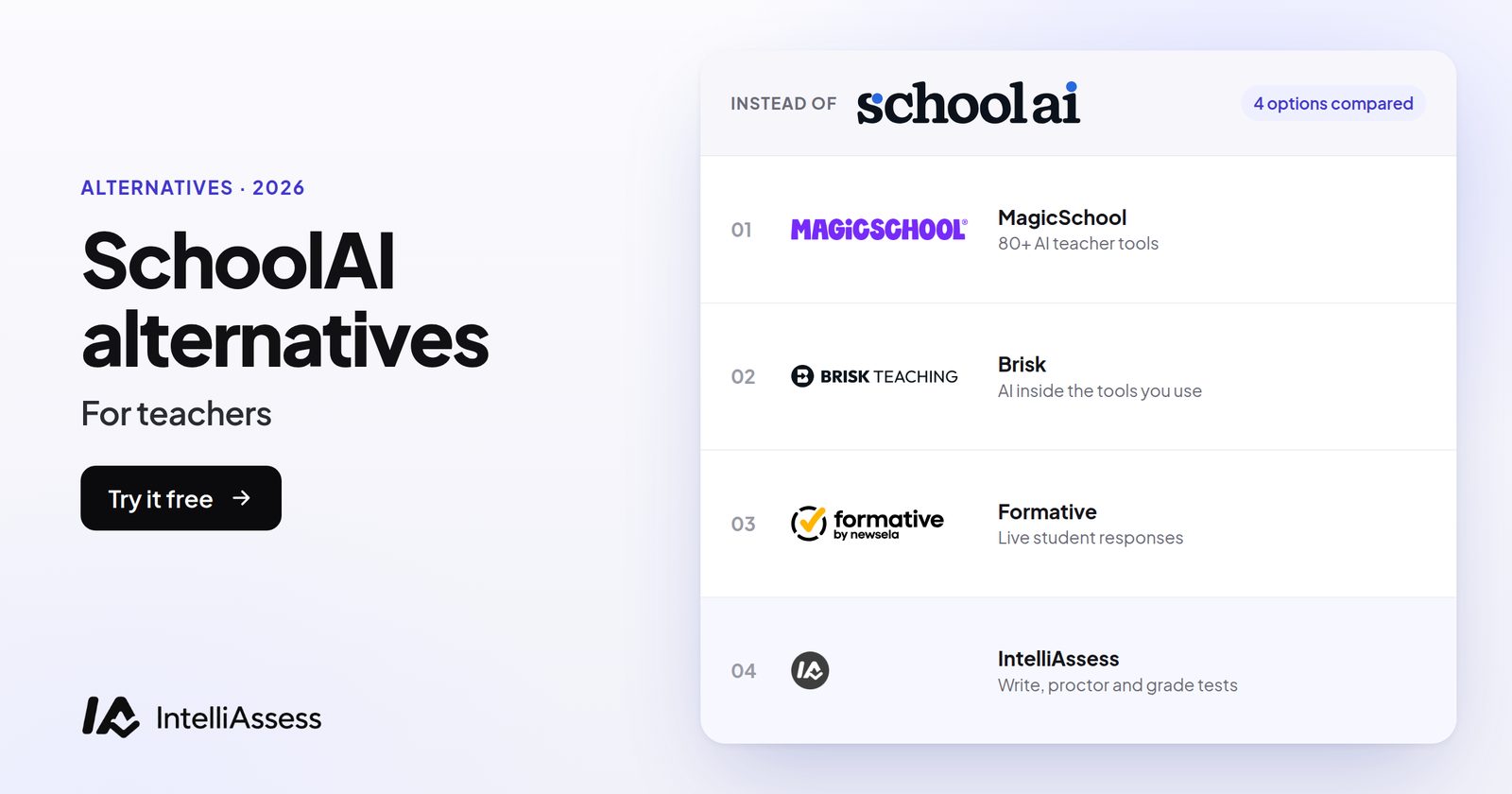
Read next
SchoolAI alternatives: 7 AI tools for teachers and students scored (2026)
Seven AI tools scored on the same nine facts, with SchoolAI as the reference, and what each lets teachers see when students use AI.
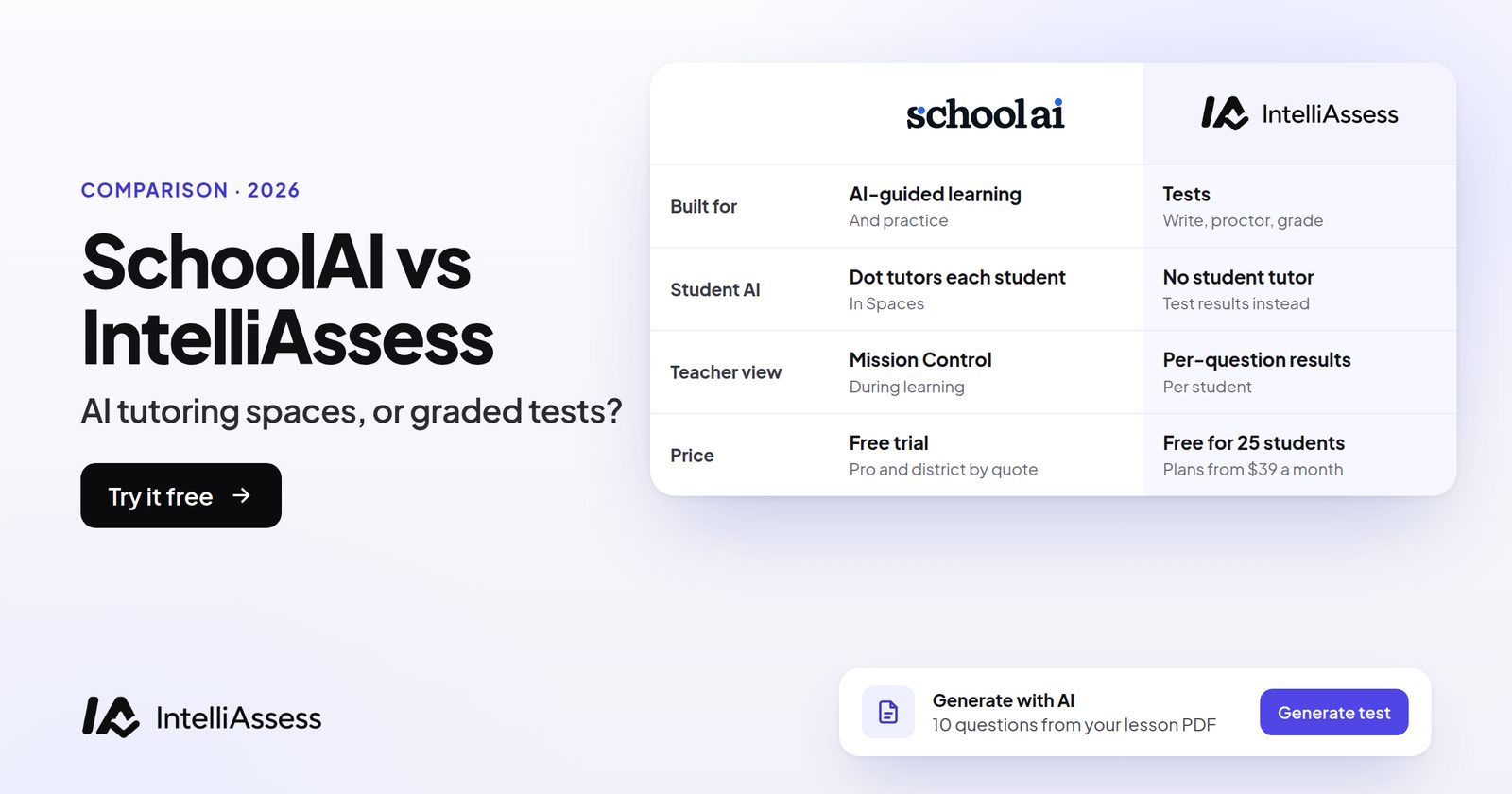
SchoolAI vs IntelliAssess: an AI tutor for students or feedback after a test?
SchoolAI puts students in supervised conversation with AI; IntelliAssess marks their tests and uses AI to help them learn from their own answers.
Motasem Aldiab 12 min read
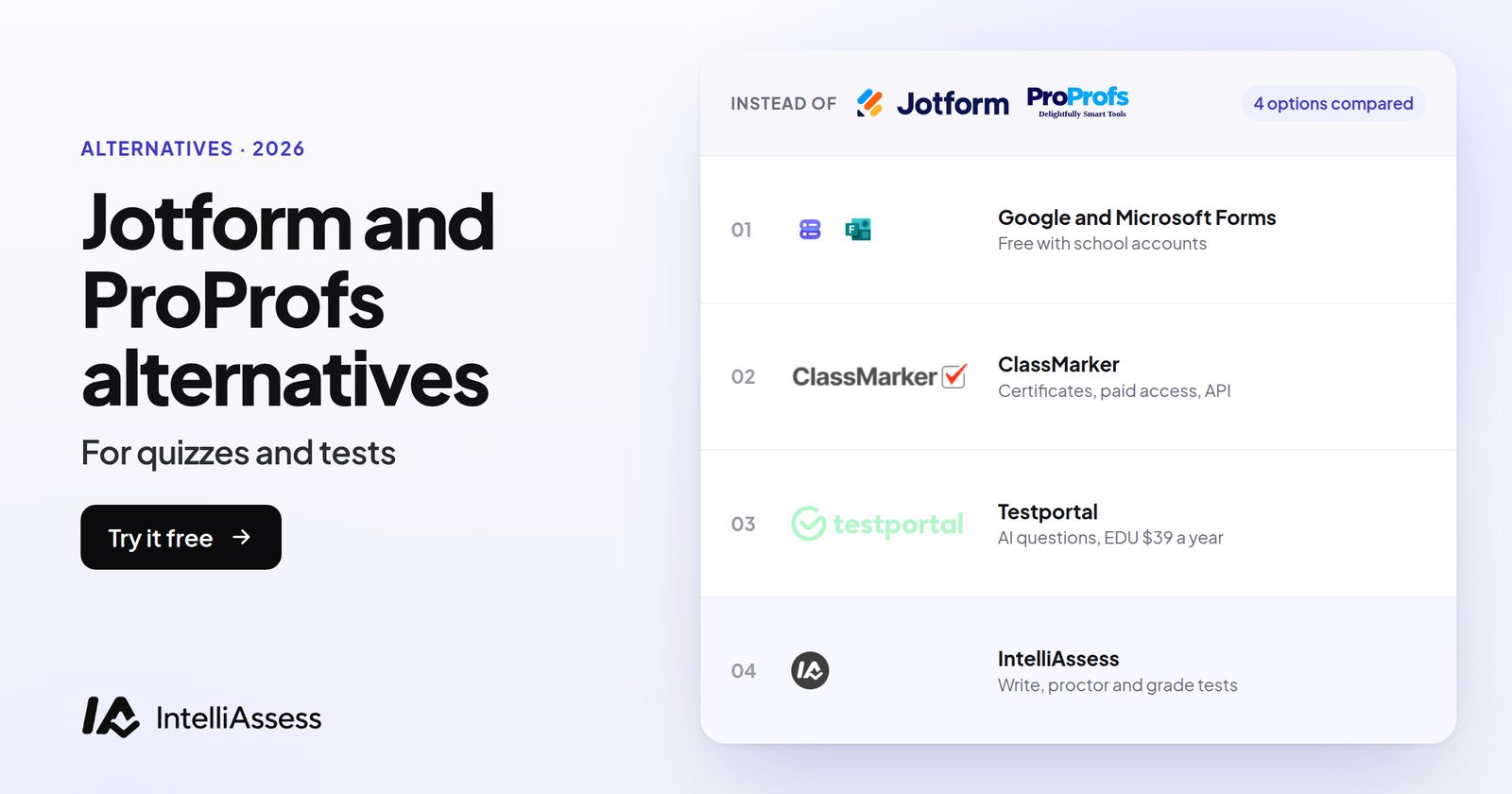
Jotform and ProProfs alternatives for quizzes and exams (2026)
Jotform and ProProfs side by side, then the alternatives by forms, certificates or real exams.
Motasem Aldiab 2 min read