
Codility vs IntelliAssess: validated tasks or your own codebase?

By Motasem Aldiab, Technology Consultant and Trainer - Cloud, DevOps, Java, Data Science
Contents19
- The short answer
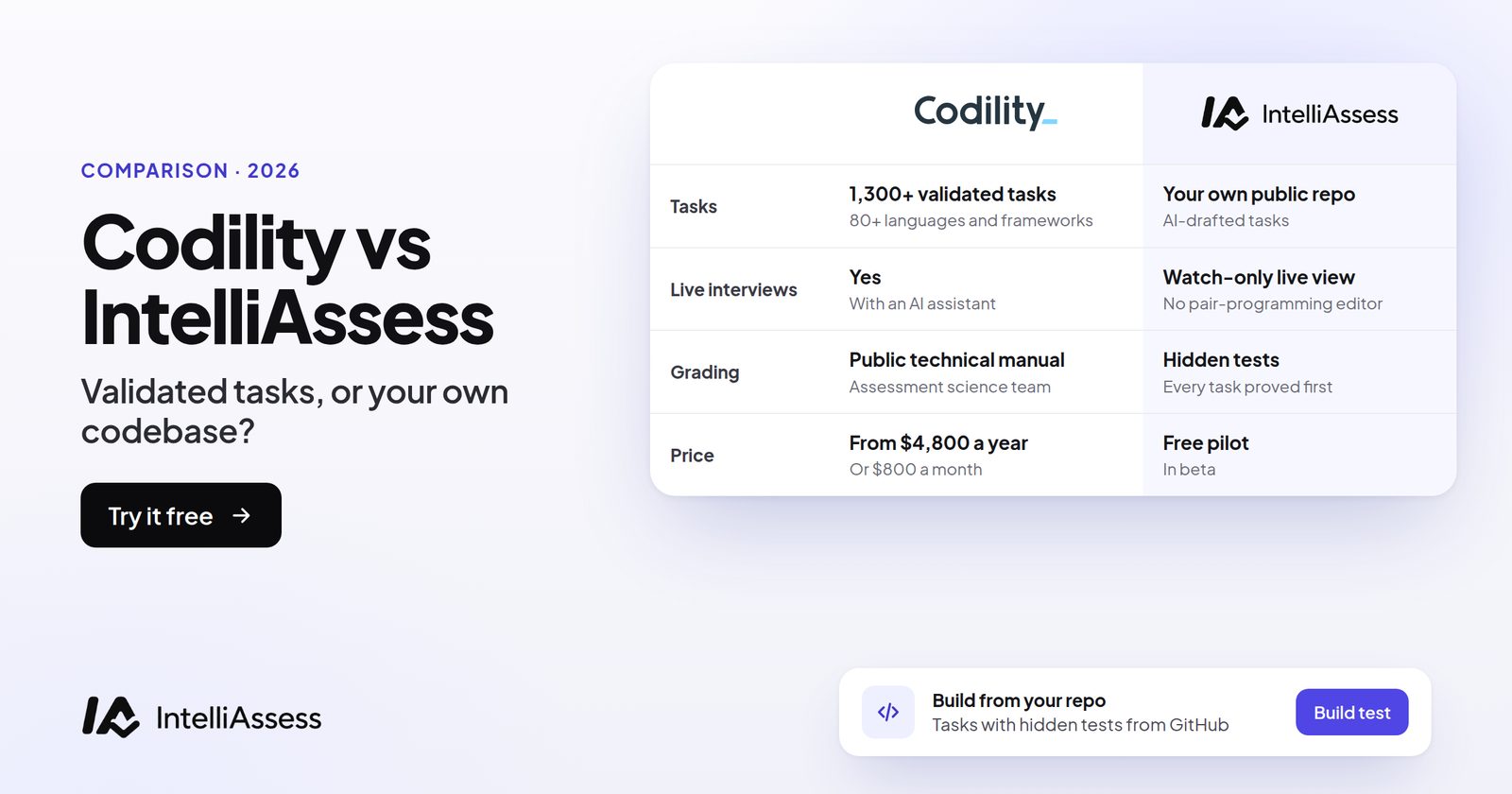
- Codility vs IntelliAssess at a glance
- What Codility is
- What IntelliAssess is
- Two kinds of fairness
- AI in the test, side by side
- Integrity, check by check
- The candidate's side
- What the reviewer sees
- When a task leaks
- One hire, two ways: a backend developer for a payments team
- Security reviews and procurement
- Pricing
- Where Codility is better
- Where IntelliAssess is better
- Using both together
- Questions to ask before choosing
- Choose Codility if
- Choose IntelliAssess if
Key takeaways
- 1Codility offers 1,300+ validated tasks in 80+ languages, with a documented scoring method.
- 2Its online plans start at $4,800 a year for 200 invites, or $800 a month for 25.
- 3Neither has an AI interviewer; ID checks and ATS are Enterprise features on Codility.
- 4IntelliAssess builds the test from your public repo and proves the grading, in beta.
Codility vs IntelliAssess compares an established developer assessment platform, built on 1,300+ validated tasks with a documented scoring method, with a younger coding product, in beta, that turns your own repository into the test. Codility offers take-home screening and live interviews with an AI assistant, Claude Code and Codex in the terminal, and SOC 2 Type II and ISO 27001, from $4,800 a year. IntelliAssess plants bugs in a project you choose, proves the grading works before anyone sits the test, grades on a fresh machine with hidden tests and includes ID and webcam checks, on a free pilot. Codility is the more complete and more defensible product; IntelliAssess answers one question it does not: how does this person work in our code?
The short answer
Choose Codility if you hire developers across many languages and frameworks, want validated tasks with a documented method and fairness evidence, run live coding interviews, need enterprise security and ATS integrations, or need a mature product today. Choose IntelliAssess if you want final-stage candidates to fix real bugs in your own Node.js or Python project, want proof that the test grades correctly before you send it, want ID and webcam checks without an enterprise contract, and can work from a public repository on a beta pilot.
Codility vs IntelliAssess at a glance
| Codility | IntelliAssess (beta) | |
|---|---|---|
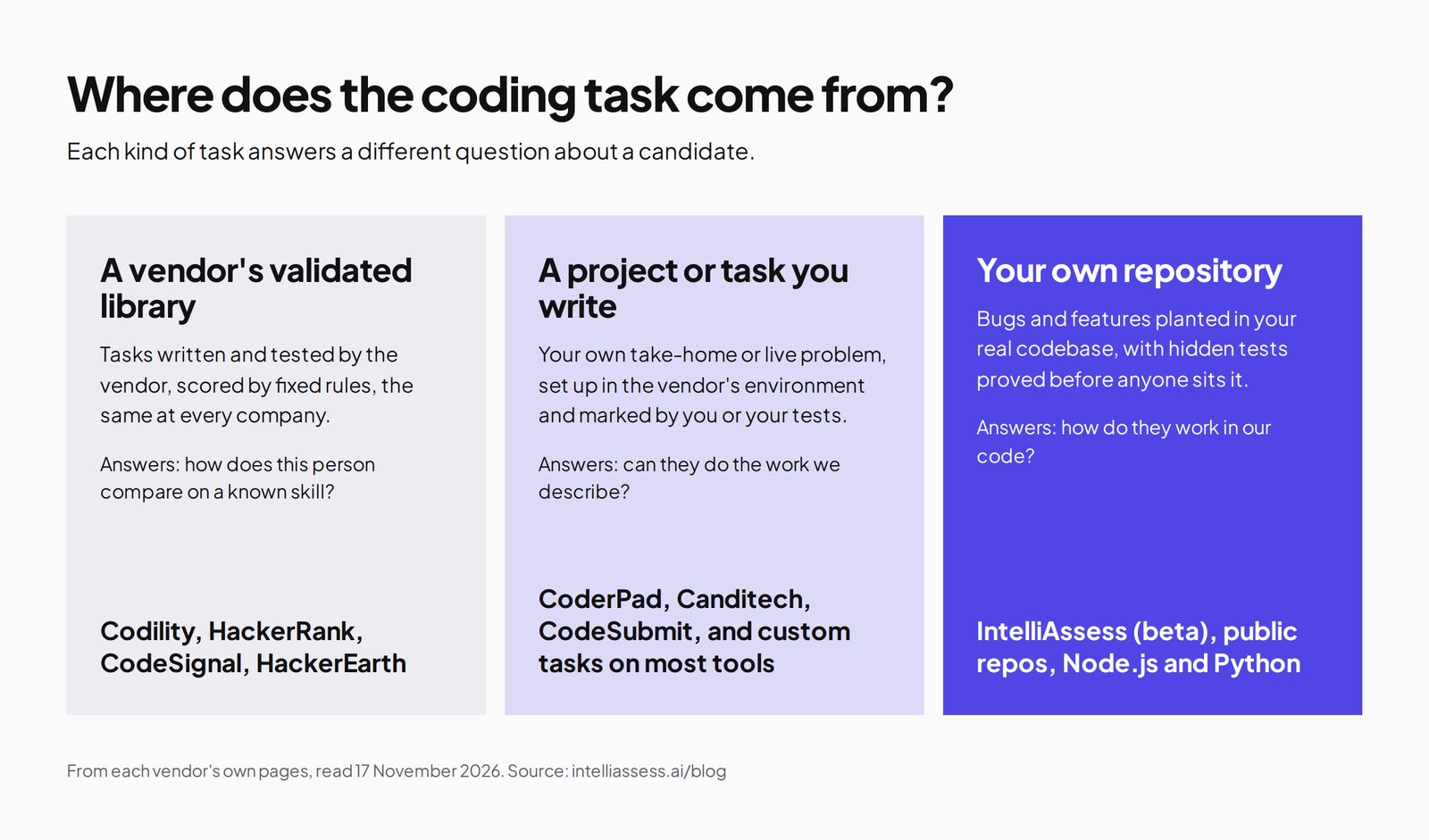
| Where tasks come from | 1,300+ validated tasks in 80+ languages and frameworks, or your own | Your own public GitHub repository, with AI-planted bugs and hidden tests |
| Why the test is fair | Tasks designed by occupational psychologists, a 92-page Technical Manual, adverse impact analysis | Each task proved before publishing: reference fix passes, wrong fixes fail, another AI model can solve it |
| AI for candidates | AI Assistant up to Sonnet class; Claude Code and Codex in the terminal; every prompt, command and code change saved; on or off per task | The assistant you allow, with a spend limit; every prompt in the report, never scored |
| Live interviews | Shared VS Code, terminal and whiteboard; databases and queues on Enterprise | Watch-only live view |
| AI interviewer | No | No |
| Grading | Test cases and fixed rules; one integrity risk rating for human review | Hidden tests on a fresh machine, points per task |
| ID and webcam | Snapshots on online plans; ID verification and video on Enterprise | ID and face match, webcam, microphone, browser lock, included |
| ATS and SSO | 20+ ATS and HR systems, SSO, on Enterprise | Not yet |
| Security | SOC 2 Type II, ISO 27001, GDPR; EU or US hosting on Enterprise | No certifications listed |
| Price | From $4,800 a year (200 invites) or $800 a month (25); Enterprise quoted | Free pilot in beta; no published price |
What Codility is
Codility has two products on every plan. Screen lets you "choose from 1,300+ validated tasks across 80+ languages and frameworks, or add your own", with AI on or off per task and every prompt saved. Selected task types score automatically against fixed rules: coding tasks against test cases, multiple-choice items against a key. Integrity signals, including similarity checks, proctoring and, on Enterprise, ID verification and hidden-app detection, feed "one integrity risk rating for human review", and Codility says "no candidate is rejected automatically". It supports tens of thousands of concurrent sessions for hiring events.
Interview runs live coding "in a shared VS Code environment" with a terminal, services and a collaborative whiteboard; backend tasks can attach a database or message queue. With Claude Code or Codex, "the interviewer and the candidate share one live terminal session". A human interviewer runs the session and scores against a rubric; Codility says plainly that no AI interviewer assesses the candidate. Interview recording and transcripts are Enterprise features.
Codility shows logos of companies including Microsoft, Google, SAP, Deloitte and Zalando under "Trusted by teams at", cites a G2 rating of 4.6 out of 5 from 900+ reviews, and lists SOC 2 Type II and ISO 27001.
What IntelliAssess is
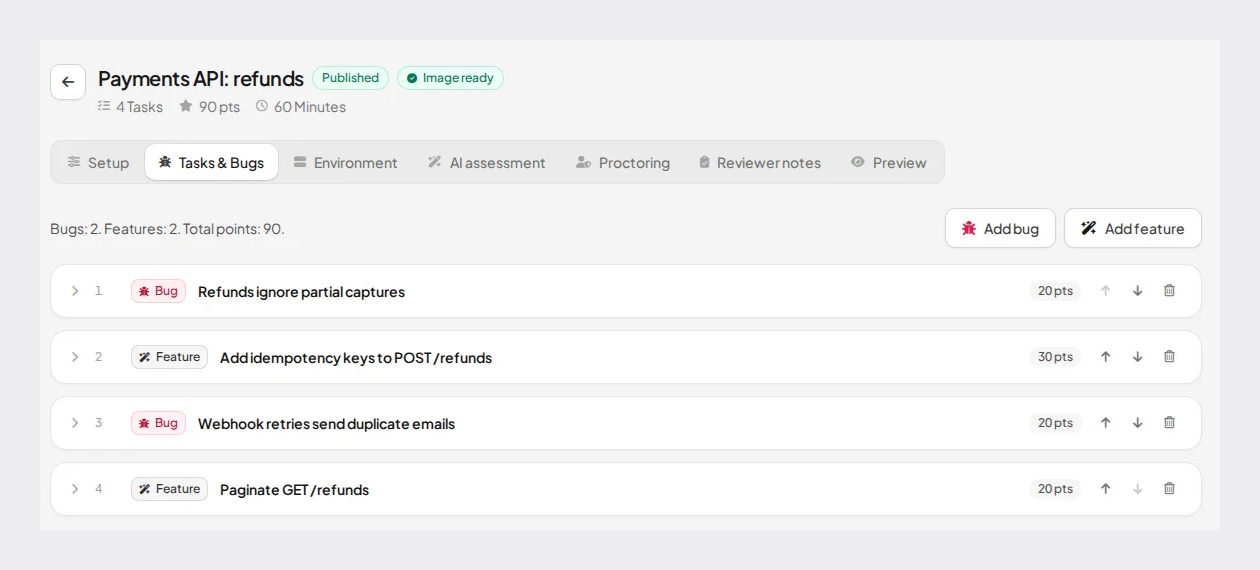
IntelliAssess's coding product is in beta. You give it a public GitHub repository and describe the role. It installs the project on a practice machine, drafts tasks (planted bugs and small features) with hidden tests, and will not publish until the grading is proved: the reference fix passes, each bug fails only its own task, a variation of each bug is caught, two wrong fixes fail, and a different AI model can solve the task from what the candidate sees.
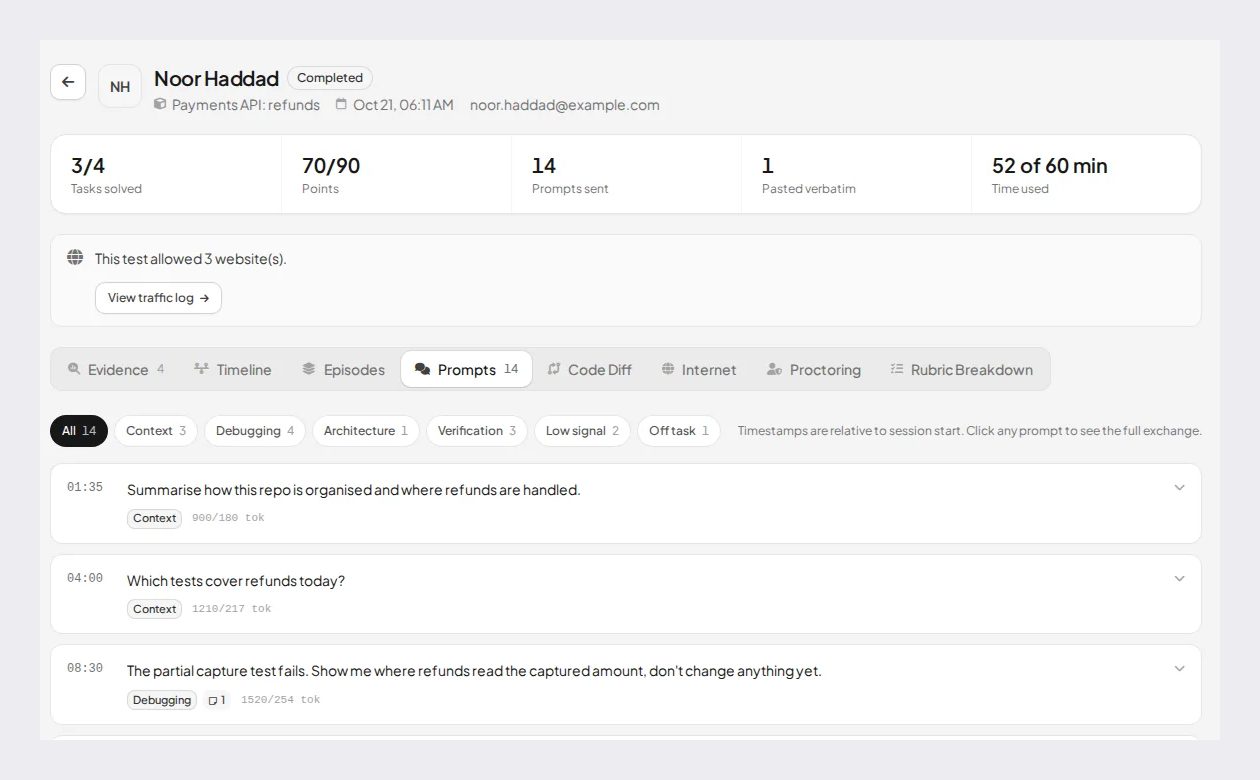
Candidates get VS Code in the browser on their own cloud machine, the AI assistant you choose with a spend limit, and internet off, limited to package stores, or open to sites you allow. When they submit, their files are graded on a fresh machine with hidden tests they never see. The scorecard shows points per task, the rules followed or broken, the code diff and every prompt, with observations linked to the prompts behind them, plus the proctoring report: ID and face match, webcam, microphone, browser lock and a watch-only live view.
What it does not have: private repositories, AI-made tasks outside Node.js and Python, a live interview editor, an AI interviewer, ATS integration, a large library, a published validation study, security certifications on its pages, or a release out of beta.
Two kinds of fairness
Both products answer the question "is this test fair?", in very different ways.
Codility's answer is psychometric. Its assessment science page says occupational psychologists design every task and subject-matter experts review it; a 92-page Technical Manual documents the method and follows the Standards for Educational and Psychological Testing; its Engineering Skills Model covers 30 skills and 180 subskills; reliability is reported with McDonald's omega; and adverse impact ratios meet the EEOC four-fifths threshold at every measured cut score, for the groups measured. It also says a local validation study is needed for a specific pass mark or population. That is evidence you can put in front of a legal or compliance team, from Codility's own work.
IntelliAssess's answer is mechanical. For each task in your repository, it proves the test grades what it claims: the correct fix passes, wrong fixes fail, the bug is caught in a variation, and another model can solve the task from what the candidate sees, so the instructions are sufficient. That shows the grading of a specific task is correct. It does not show that the task predicts job performance, or that it treats groups of candidates equally; IntelliAssess has no published study of either.
If defensibility to regulators or auditors matters, Codility's evidence is far stronger. If the worry is "will this test mark a correct answer wrong?", IntelliAssess's proof is direct and specific to your task.
AI in the test, side by side
Both let candidates use AI, and both record it. Codility sets up Claude Code and Codex in the terminal "before the session starts", so candidates need no API key, saves "every prompt, command and code change", and lets you switch AI on or off per task. Its online plans use models "up to Sonnet class", with frontier models in live interviews on Enterprise. IntelliAssess gives candidates the assistant you choose, with a spend limit you set, records every prompt in the scorecard with a time and category, and never scores the prompts; written observations link to the prompts behind them so a reviewer can check each claim.
The practical difference is in the live interview. In Codility, interviewer and candidate share one terminal session with the agent, which lets you discuss how the candidate is using it as it happens. IntelliAssess has no live editor; you read the prompt log afterwards.
Integrity, check by check
| Check | Codility online plans | Codility Enterprise | IntelliAssess (beta) |
|---|---|---|---|
| Plagiarism or similarity | Included | Included | Not described; tasks come from your repository |
| Proctoring | Snapshots | Video proctoring | Webcam and microphone checks |
| Identity | Not included | ID verification | ID and face match |
| Leaked tasks | Task-leakage protection | Task-leakage protection | Tasks are built for your codebase and can be rebuilt |
| Other apps | Not included | Desktop app flags unauthorised apps | Browser lock; watch-only live view |
| Decision | One integrity risk rating for human review; no automatic rejection | Report per candidate for human review | |
The candidate's side
On Codility, a candidate opens a Screen invite and works on one or more tasks in the browser, in their chosen language, with the AI assistant if the task allows it. For a live interview, the environment "runs in the browser", so nothing is installed, and they share VS Code, a terminal and a whiteboard with the interviewer. On Enterprise, they may be asked to verify their ID or use Codility's desktop app. Codility says 9 in 10 candidates in its own surveys, from 48,000+ responses, feel the content is fair; that is self-reported, not validity evidence.
On IntelliAssess, a candidate opens the invite, completes an ID and selfie check with face match, and lands in VS Code in the browser with the project already installed on a cloud machine of their own. They read the task list, run the code, ask the assistant questions and fix things, much as they would in their first week. Because the codebase is real, the first minutes go on reading it, which is part of what the test is meant to observe; tell candidates that in the invitation so they budget their time.
What the reviewer sees
Codility gives scores against test cases or keys, the saved AI activity, an integrity risk rating built from its signals, and, on Enterprise, a single interview report holding "the transcript, code playback, rubric scores and AI usage", with weighted scoring and premium analytics. Because tasks are shared across candidates, scores are directly comparable across a large pipeline.
IntelliAssess gives one scorecard per candidate: points per task from the hidden tests, the rules followed or broken, the code diff, every AI prompt with its time and category, observations each linked to the prompts behind them, and the proctoring report. It is built for a hiring manager reading two or three final-stage attempts closely rather than for ranking hundreds.
When a task leaks
Any task used often enough ends up online. Codility addresses this with task-leakage protection on every plan and a large, maintained library, so a leaked task can be replaced with a validated equivalent. IntelliAssess avoids shared tasks altogether: the challenge lives in your repository, and you can build a new one from the same code with different bugs, which is proved again before it is published. The trade-off is that a new IntelliAssess challenge is not comparable with the old one in the way two Codility tasks measuring the same skill are designed to be.
One hire, two ways: a backend developer for a payments team
On Codility, you would send a Screen assessment of validated backend tasks in the candidate's language, with AI allowed and the prompts saved, then invite the best to a live Interview in shared VS Code with a database attached (on Enterprise), where they use Claude Code alongside your engineer. You get scores against test cases, an integrity risk rating and, on Enterprise, a recording and transcript. Every candidate sits comparable tasks, so the scores line up across the pipeline.
On IntelliAssess, you would turn a trimmed public copy of your payments service into the test: "refunds ignore partial captures" and "webhook retries send duplicate emails" as planted bugs, idempotency keys and pagination as features. Candidates have an hour with the AI assistant you allow. The report shows which tasks passed the hidden tests, the diff, and exactly what they asked the AI along the way.
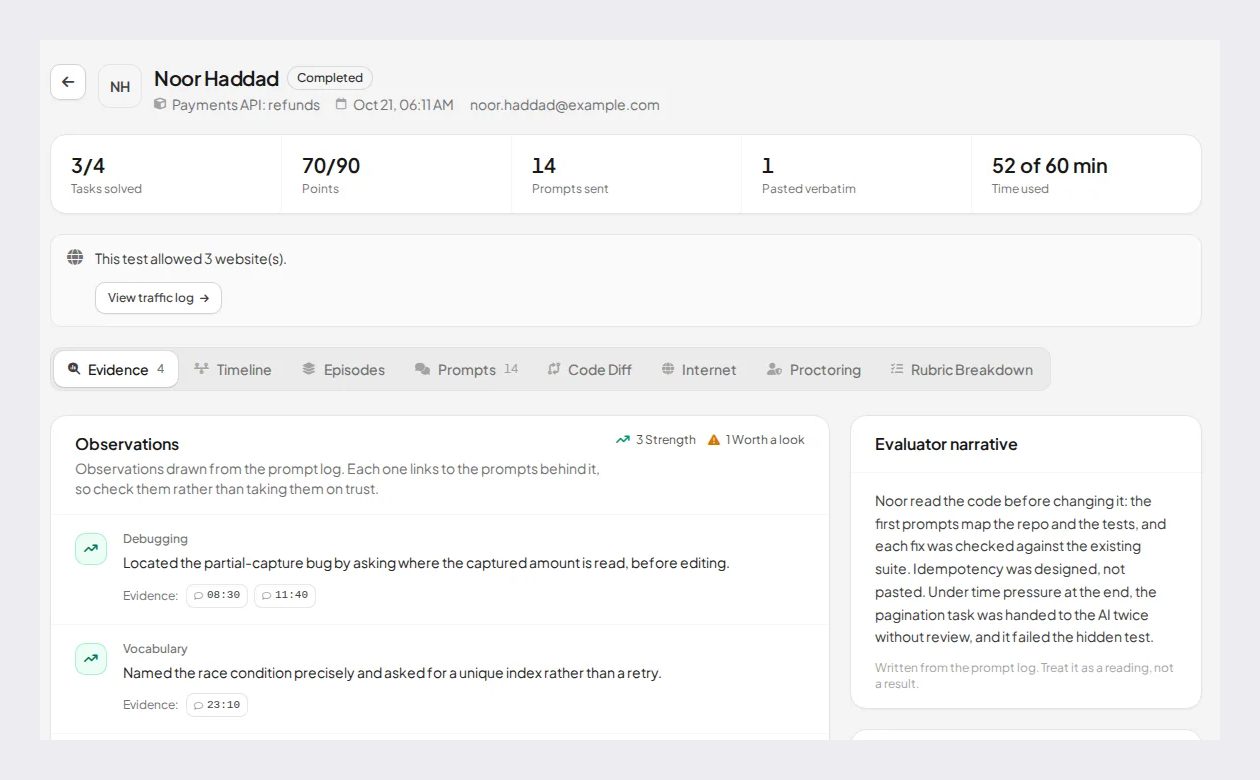
Codility tells you how candidates compare on validated, well-understood problems across a pipeline. IntelliAssess tells you how a few final-stage candidates find their way around your code. A team could reasonably use Codility to screen and IntelliAssess for the last step.
Security reviews and procurement
For many companies, the security review decides before any feature does. Codility lists SOC 2 Type II (audited annually), ISO 27001 and processing in line with GDPR, with documents such as its SOC 2 report and data processing agreement available through its trust centre, and a choice of EU or US hosting on Enterprise. IntelliAssess's pages list no security certifications; it stores identity and evidence photos encrypted and opens them only through short-lived links. If your procurement process requires SOC 2 or ISO 27001 from every vendor that handles candidate data, Codility clears it today and IntelliAssess does not, so raise it with us before a pilot.
Pricing
Codility's online plans start at $4,800 a year, or $800 a month, with packs of 200 to 1,400 invites a year or 25 to 100 a month, five platform users (ten at 1,400 invites) and unlimited collaborators. An invite counts when sent; if the candidate has not started, cancelling within the same billing period returns it to your allowance. If you run out, you move to the next pack. Enterprise is quoted, with a fair-usage limit. At 200 invites a year, the entry plan works out at $24 per candidate.
IntelliAssess's coding product is a free pilot while in beta; tell us how many candidates you test a month and we set it up. Its non-coding pre-employment tests use the published plans on our pricing page, from $39 a month. For the wider market, see the yearly costs in Codility alternatives.
Where Codility is better
- Validated tasks with a documented method, fairness analysis and a public account of how scores are produced.
- Breadth: 1,300+ tasks in 80+ languages and frameworks.
- Live interviews in shared VS Code with a terminal, whiteboard and, on Enterprise, databases and queues.
- Security and integrations: SOC 2 Type II, ISO 27001, SSO and 20+ ATS and HR systems including Workday and SAP SuccessFactors (Enterprise).
- Scale and maturity: tens of thousands of concurrent sessions, and a product out of beta.
Where IntelliAssess is better
- Your own code: the test is your repository, not a task other companies also send.
- A proved test: it will not publish until wrong fixes fail and the reference fix passes.
- Grading you can reproduce: hidden tests on a fresh machine the candidate never touched.
- ID and webcam checks without Enterprise.
- Cost during the beta: a free pilot, against $4,800 a year for Codility's entry plan.
Using both together
Because they answer different questions, the two fit together. Screen everyone with Codility's validated tasks, where consistency and fairness evidence matter most, then give a shortlist of two or three candidates an IntelliAssess exercise in a trimmed copy of your own service. The cost is a second tool and a second report; IntelliAssess's report does not flow into your ATS, so attach it to the candidate's record by hand.
Questions to ask before choosing
- Do we need to show a legal or compliance team how our coding tests were validated?
- Which languages and frameworks do we hire for? Outside Node.js and Python, IntelliAssess needs our own tasks.
- Can we publish a trimmed public copy of the code we want candidates to work in?
- How many candidates sit a coding test each year, and at what stage?
- Do we need live interviews, ID verification, ATS or SSO, and on which Codility plan would we get them?
- Are we comfortable piloting a beta product for final-stage hiring?
Choose Codility if
- You hire across many languages and frameworks and want validated tasks with documented fairness.
- Live coding interviews with AI in a shared terminal are central to your process.
- Security reviews require SOC 2 Type II and ISO 27001, or your ATS must connect.
- You need a mature product at scale.
Choose IntelliAssess if
- You want final-stage candidates to fix real bugs in your own Node.js or Python project.
- You want proof that each test grades correctly before you send it.
- You want ID and webcam checks without an enterprise contract.
- You can work from a public repository and join a free beta pilot.
Comparing more tools? See Codility alternatives, scored on eight published facts, HackerRank vs IntelliAssess, or every comparison.
Frequently asked questions
Is IntelliAssess an alternative to Codility?
For one job, yes: testing candidates on your own codebase with AI allowed. Codility is stronger for validated tasks across 80+ languages, live interviews, enterprise security and integrations, and IntelliAssess's coding product is in beta.
How much does Codility cost?
On 17 November 2026, Codility's online plans started at $4,800 a year for 200 invites or $800 a month for 25 invites, with packs up to 1,400 invites a year. Enterprise is quoted.
Does Codility let candidates use AI?
Yes. Its AI Assistant runs in assessments and live interviews, with Claude Code and Codex in the terminal, every prompt, command and code change saved, and AI on or off per task.
Does Codility have an AI interviewer?
No. A human interviewer runs the session and scores against the rubric. IntelliAssess has no AI interviewer either.
Does IntelliAssess support Java or Go?
Any stack can run in the candidate's machine, but AI-made tasks and hidden tests are built for Node.js and Python today; for other stacks you write the tasks and test commands.
Can IntelliAssess test private repositories?
Not yet. Tests are built from public GitHub repositories; a trimmed public copy of a real service works well.
Has IntelliAssess published a validation study?
No. IntelliAssess proves that each task grades correctly before publishing, but it has not published evidence that its tasks predict job performance or meet adverse-impact thresholds. Codility publishes a Technical Manual and fairness analysis.
Which is better for high-volume hiring?
Codility. It supports tens of thousands of concurrent sessions, scores comparable validated tasks automatically against fixed rules, and connects to 20+ ATS and HR systems on Enterprise. IntelliAssess's coding product is aimed at a few final-stage candidates per role.
Does Codility offer a free trial?
Yes, a two-week team evaluation without a credit card, for teams evaluating it for hiring, started after a short call. IntelliAssess's coding product is a free pilot while in beta.
Keep reading
All articles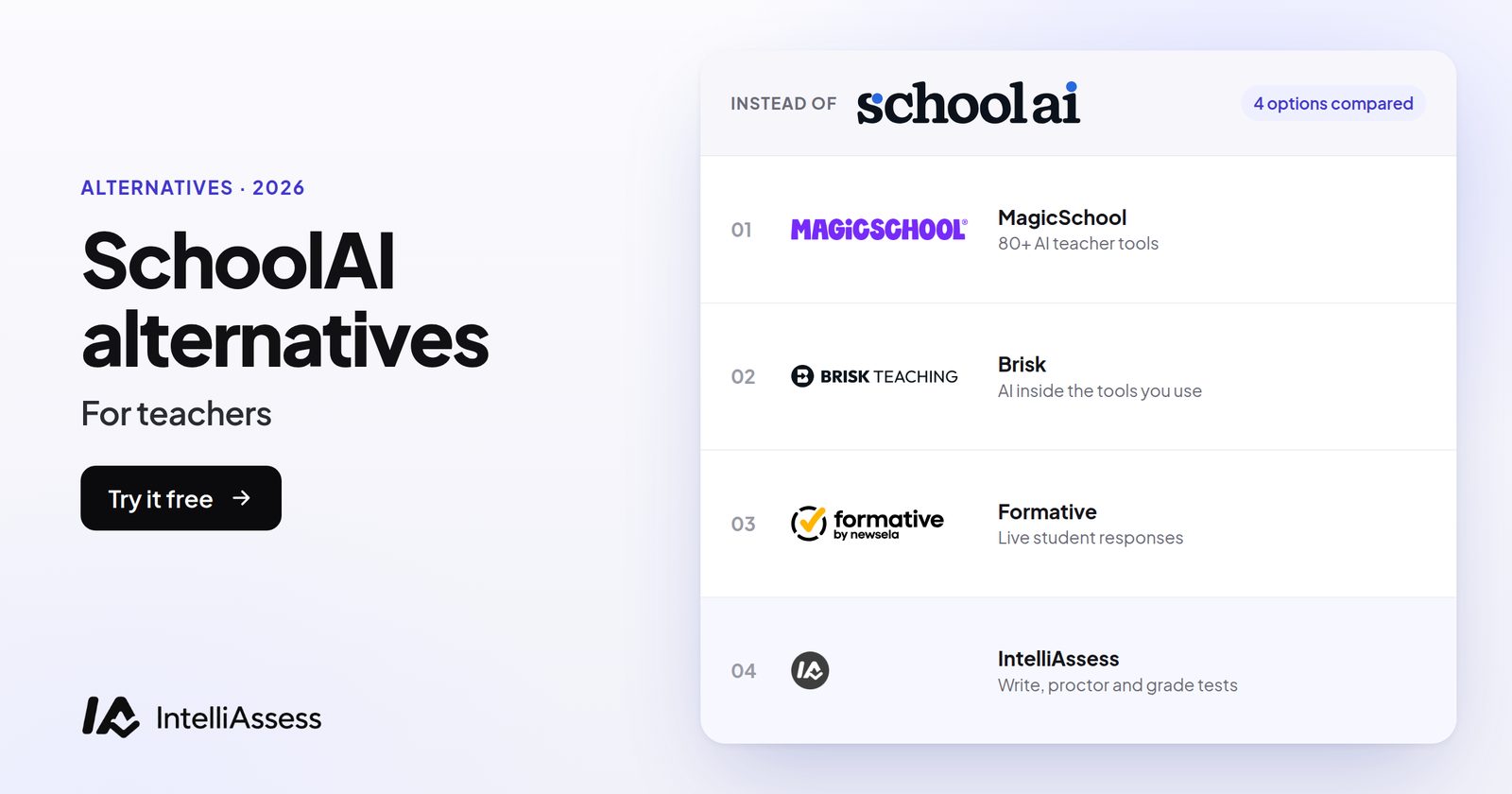
Read next
SchoolAI alternatives: 7 AI tools for teachers and students scored (2026)
Seven AI tools scored on the same nine facts, with SchoolAI as the reference, and what each lets teachers see when students use AI.
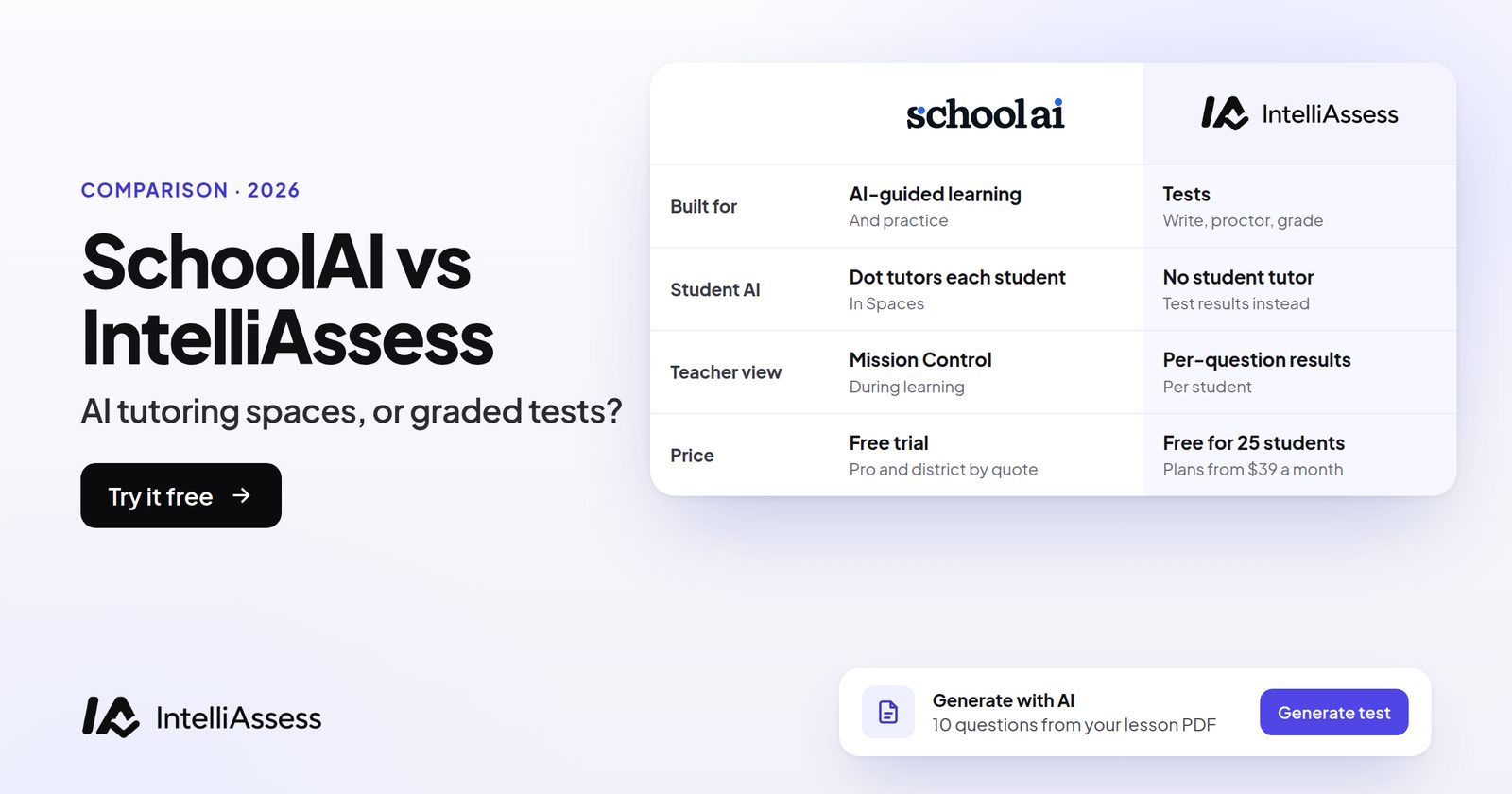
SchoolAI vs IntelliAssess: an AI tutor for students or feedback after a test?
SchoolAI puts students in supervised conversation with AI; IntelliAssess marks their tests and uses AI to help them learn from their own answers.
Motasem Aldiab 12 min read
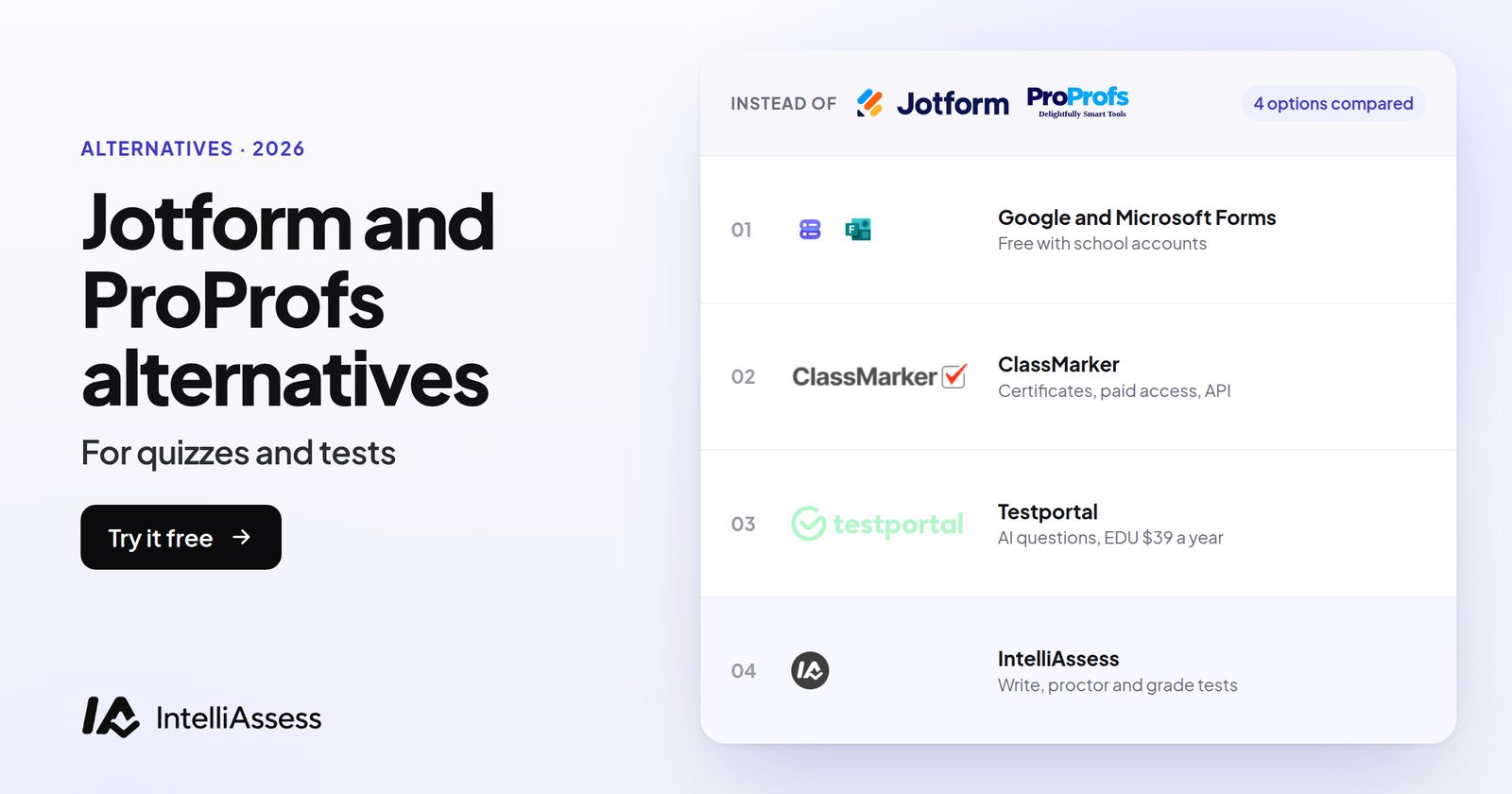
Jotform and ProProfs alternatives for quizzes and exams (2026)
Jotform and ProProfs side by side, then the alternatives by forms, certificates or real exams.
Motasem Aldiab 2 min read