
HackerRank vs IntelliAssess: a question library or your own codebase?

By Motasem Aldiab, Technology Consultant and Trainer - Cloud, DevOps, Java, Data Science
Contents18
- Why this comparison matters in 2026
- The short answer
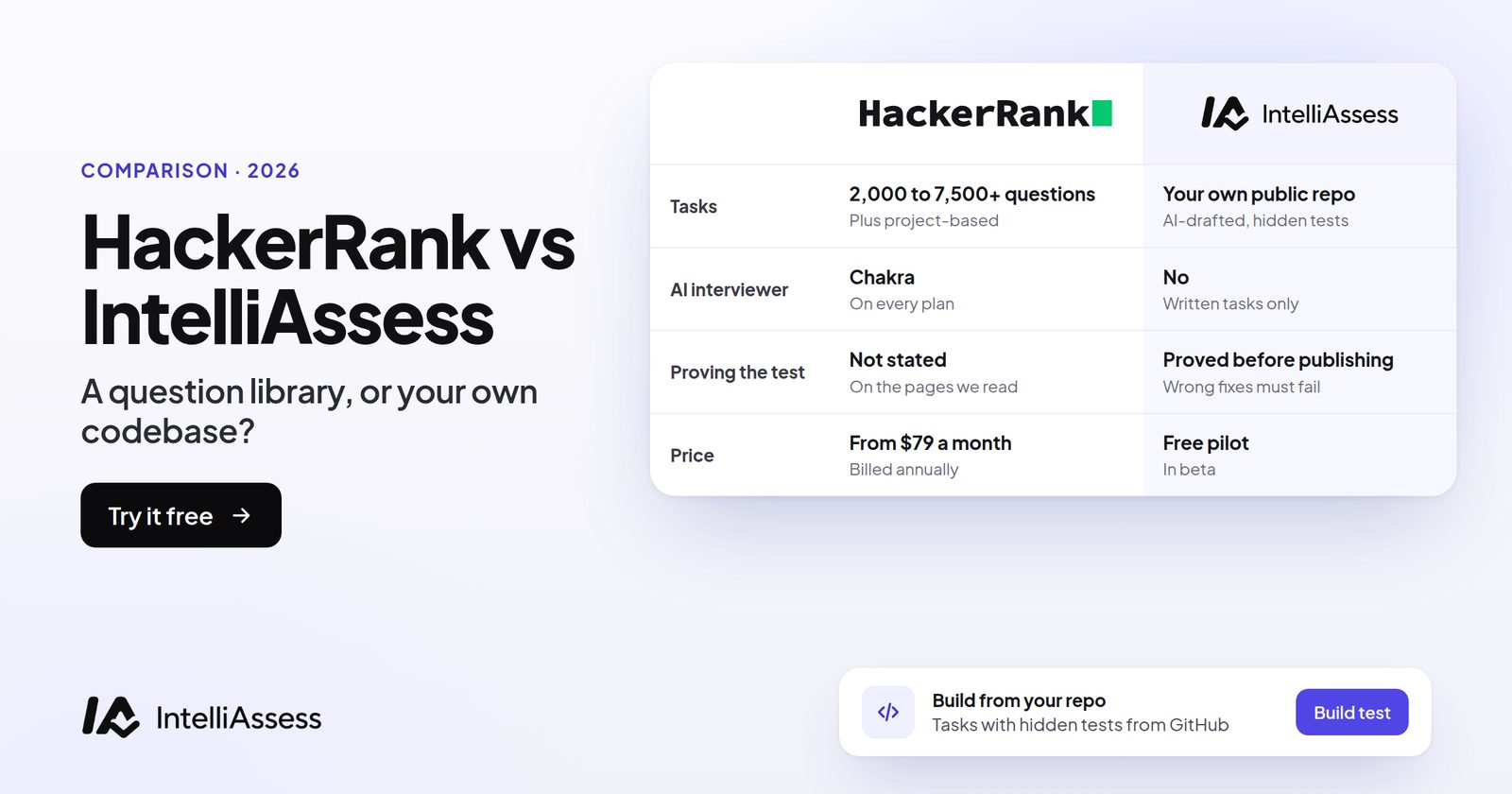
- HackerRank vs IntelliAssess at a glance
- What HackerRank is
- What IntelliAssess is
- What the candidate experiences
- What the reviewer sees afterwards
- Integrity, side by side
- The same hire, two ways: a backend developer for a payments team
- Where HackerRank is better
- Where IntelliAssess is better
- Pricing compared
- What HackerRank costs at three hiring volumes
- Using HackerRank and IntelliAssess together
- Questions to ask before you decide
- What IntelliAssess does not have
- Choose HackerRank if
- Choose IntelliAssess if
Key takeaways
- 1HackerRank Starter is $79 a month billed annually ($948) for 60 candidate attempts a year; extra attempts $20.
- 2Every HackerRank plan includes Chakra (AI interviewer), Screen (AI-assisted take-homes) and Interview (pair programming).
- 3IntelliAssess builds the test from your public GitHub repo and proves the grading before publishing.
- 4IntelliAssess's coding product is in beta: public repos only, no ATS, no pair-programming editor, free pilot.
HackerRank vs IntelliAssess compares the best-known developer hiring platform with a younger coding product, in beta, that turns your own repository into the test. HackerRank gives you an AI interviewer, AI-assisted take-homes, live pair-programming interviews and a library of 2,000 to 7,500+ questions, from $79 a month for 60 candidate attempts a year. IntelliAssess builds tasks inside a real project you choose, proves the grading works before anyone sits the test, lets candidates use the AI assistant you allow, and shows every prompt in the report, on a free pilot while in beta. HackerRank is the stronger, more complete product; IntelliAssess answers one question it does not: how does this person work in our code?
Why this comparison matters in 2026
Coding tests were built for a world where candidates worked alone. That world has gone. In HackerRank's own 2025 Developer Skills Report, based on 13,732 developers in 102 countries, 97% said they use at least one AI assistant, and 76% said AI makes it easier to game technical assessments. Both products in this comparison respond to that, in different ways. HackerRank lets AI into its tests in a controlled form, guarded in take-homes and unguarded in live interviews, and adds an AI interviewer that watches how candidates think. IntelliAssess lets candidates use the assistant you allow and moves the test into a real codebase, where memorised answers to well-known puzzles do not help and the prompt log shows how they worked.
So the question is less "which tool blocks AI better" and more "which tool shows you the skill you are hiring for, with AI in the room". The rest of this page compares the two on that basis.
The short answer
Choose HackerRank if you hire developers at volume across many languages, want live pair-programming interviews or an AI interviewer, need ready questions today, or need ATS integration (from Pro). Choose IntelliAssess if you want candidates to fix real bugs in your own Node.js or Python project, proof that the test grades correctly before you send it, and a prompt-by-prompt record of how they used AI, and you are happy to join a free pilot of a product in beta that works from public repositories.
HackerRank vs IntelliAssess at a glance
| HackerRank | IntelliAssess (beta) | |
|---|---|---|
| Where tests come from | A library of 2,000+ (Starter) to 7,500+ (Enterprise) questions, plus custom and project-based questions | Your own public GitHub repository, with AI-planted bugs and hidden tests |
| Checking the test itself | Leakage protection and certified assessments on Enterprise | Must pass before publishing: reference fix passes, wrong fixes fail, another AI model can solve it |
| AI for candidates | Guarded assistant in Screen; unguarded, agentic mode and choice of model in Interview | The assistant you allow, with a spend limit; every prompt in the report, never scored |
| AI interviewer | Chakra, on every plan | No |
| Live interviews | Pair programming, on every plan | Watch-only live view of the screen |
| Grading | Scores with AI-assisted evaluation | Hidden tests on a fresh machine, points per task |
| Integrity | Proctor mode (webcam, screen), screen-to-interview ID match, locked-down desktop app | ID and face match, webcam, microphone, browser lock, live view |
| Languages | 55+ (per its site, 16 November 2026) | Any stack runs; AI-made tasks for Node.js and Python |
| ATS | Pro and Enterprise | Not yet; invite up to 500 by email |
| Price | From $79 a month billed annually, 60 attempts a year | Free pilot in beta; no published price |
What HackerRank is
Every HackerRank plan includes three products and unlimited users. Chakra is an AI interviewer that "spins up a canvas with a real-world problem", watches how candidates work and evaluates judgment and AI fluency; HackerRank says 500,000+ candidates have been interviewed by it and rate it 4.8 out of 5. Screen runs AI-assisted take-home assessments, where the AI is "a guarded assistant, providing syntax and debugging support". Interview runs live pair-programming sessions, where the AI environment is unguarded and candidates can use agentic mode and choose their model.
On integrity, HackerRank lists a proctor mode using webcam and screen signals, a match between the candidate's face in Screen and in the interview video, and a desktop app that blocks unauthorised applications. Pro adds ATS and calendar integrations and 4,000+ questions; Enterprise adds certified assessments, API and MCP access, leakage protection, 22+ enterprise ATS integrations and 7,500+ questions.
What IntelliAssess is
IntelliAssess's coding product is in beta. You give it a public GitHub repository and describe the role. It installs the project on a practice machine, drafts tasks (planted bugs and small features) with hidden tests, and will not publish until the grading is proved: the reference fix passes, each bug fails only its own task, a variation of each bug is caught, two wrong fixes fail, and a different AI model can solve the task from what the candidate sees.
Candidates get VS Code in the browser on their own cloud machine, the AI assistant you choose with a spend limit, and internet off, limited to package stores, or open to sites you allow. When they submit, their files are graded on a fresh machine with hidden tests they never see. The scorecard shows points per task, the rules followed or broken, the code diff and every prompt, with observations linked to the prompts behind them, plus the proctoring report.
What the candidate experiences
On HackerRank, a candidate usually meets one of three things. A Screen assessment is a timed set of questions in HackerRank's browser IDE, with a guarded assistant that helps with syntax and debugging; if you require it, they install HackerRank's desktop app, which blocks other applications while they work. A Chakra session puts them in front of an AI interviewer that sets a real-world problem on a canvas and talks it through with them. An Interview is a live session with your engineers in a shared editor, where they can use agentic mode and pick their preferred model.
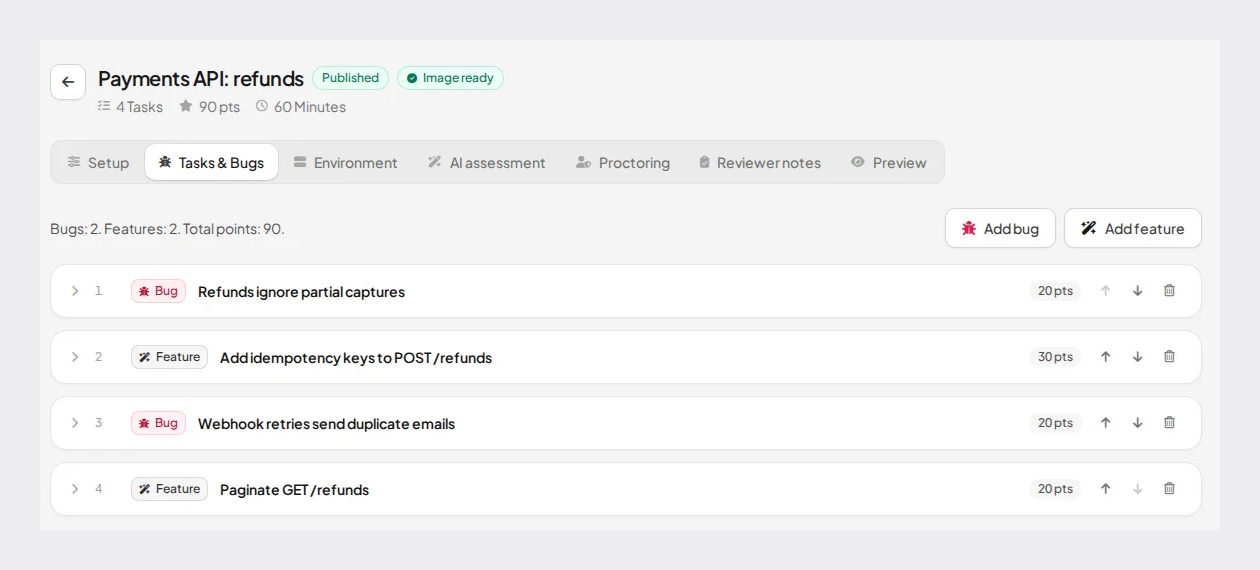
On IntelliAssess, the candidate opens a link, passes an ID and face check, and lands in VS Code in the browser running on a cloud machine of their own, with the project already installed. They see the task list (in the demo above, two bugs and two features worth 90 points), the AI assistant you allowed, with its spend limit, and whatever internet access you set: none, package stores only, or the sites you list. They work as they would on a first week in the job: reading the code, running it, asking the assistant questions, and fixing things. When they submit, nothing about their machine is trusted; their files are copied to a fresh machine and graded there.
What the reviewer sees afterwards
HackerRank gives you scores for each question, with AI-assisted evaluation, replays and integrity reports, and for Chakra an evaluation of judgment and AI fluency. Results flow into your ATS on Pro and Enterprise, so recruiters can move candidates on without opening HackerRank.
IntelliAssess gives you a scorecard with several views of the same attempt:
- Points per task from the hidden tests, so two candidates on the same challenge are directly comparable.
- The code diff, showing exactly what they changed.
- Rules followed or broken, for the instructions you set.
- Every AI prompt with its time and a category such as Context or Debugging, shown as evidence and never scored.
- Observations written by the evaluator, each linked to the prompts behind it, so a reviewer can check the claim rather than trust it.
- The proctoring report: ID and face match, webcam, microphone and browser lock events.
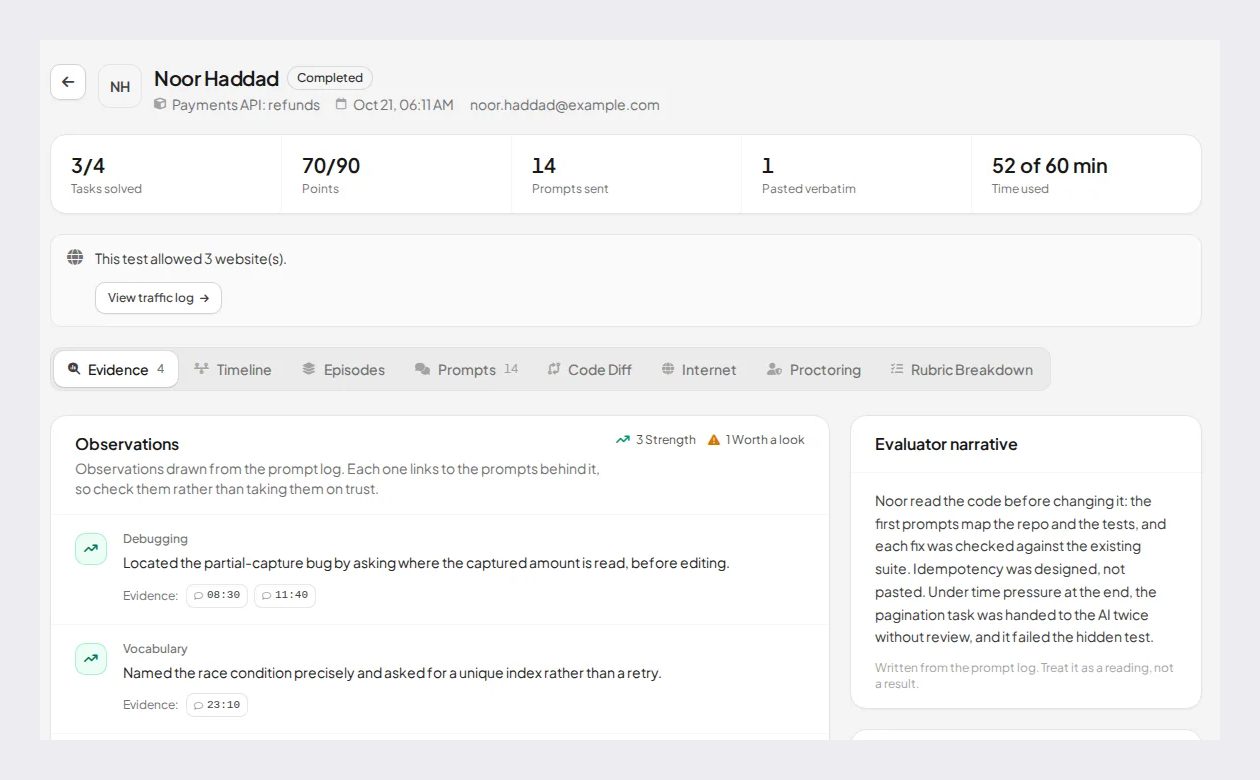
The difference is one of breadth against depth. HackerRank's reports are built to compare many candidates quickly across a funnel. IntelliAssess's scorecard is built for a hiring manager reading a handful of final-stage attempts closely.
Integrity, side by side
| Check | HackerRank | IntelliAssess (beta) |
|---|---|---|
| Identity | Match between the candidate's face in Screen and in the interview video | ID and face match before the test starts |
| Webcam and screen | Proctor mode using webcam and screen signals | Webcam and microphone, plus a watch-only live view of the screen |
| Locking the device | Desktop app that blocks unauthorised applications | Browser lock |
| AI use | Guarded in Screen, unguarded in Interview | Allowed or not, with a spend limit; every prompt recorded |
| Leaked questions | Leakage protection on Enterprise | The test is built from your own repository, and you can build a new one from the same code |
| Trusting the result | AI-assisted evaluation of the submission | Files graded on a fresh machine with hidden tests the candidate never sees |
Neither product claims to make cheating impossible, and no proctoring does. HackerRank's strength is a mature set of checks across a large funnel; IntelliAssess's is that the test itself is hard to look up, because it lives in your code.
The same hire, two ways: a backend developer for a payments team
On HackerRank, you would send a Screen assessment from the library (or write a project question of your own), let the guarded assistant help with syntax and debugging, then invite the best candidates to a live Interview where they can use agentic mode with your engineers watching, or have Chakra run the first conversation. You get scores, replays and integrity reports, and ready questions in 55+ languages (as listed on 16 November 2026).
On IntelliAssess, you would turn a trimmed public copy of your payments service into the test: "refunds ignore partial captures" and "webhook retries send duplicate emails" as planted bugs, idempotency keys and pagination as features. Candidates have 60 minutes with the AI assistant you allow. The report shows which tasks passed the hidden tests and exactly what they asked the AI along the way.
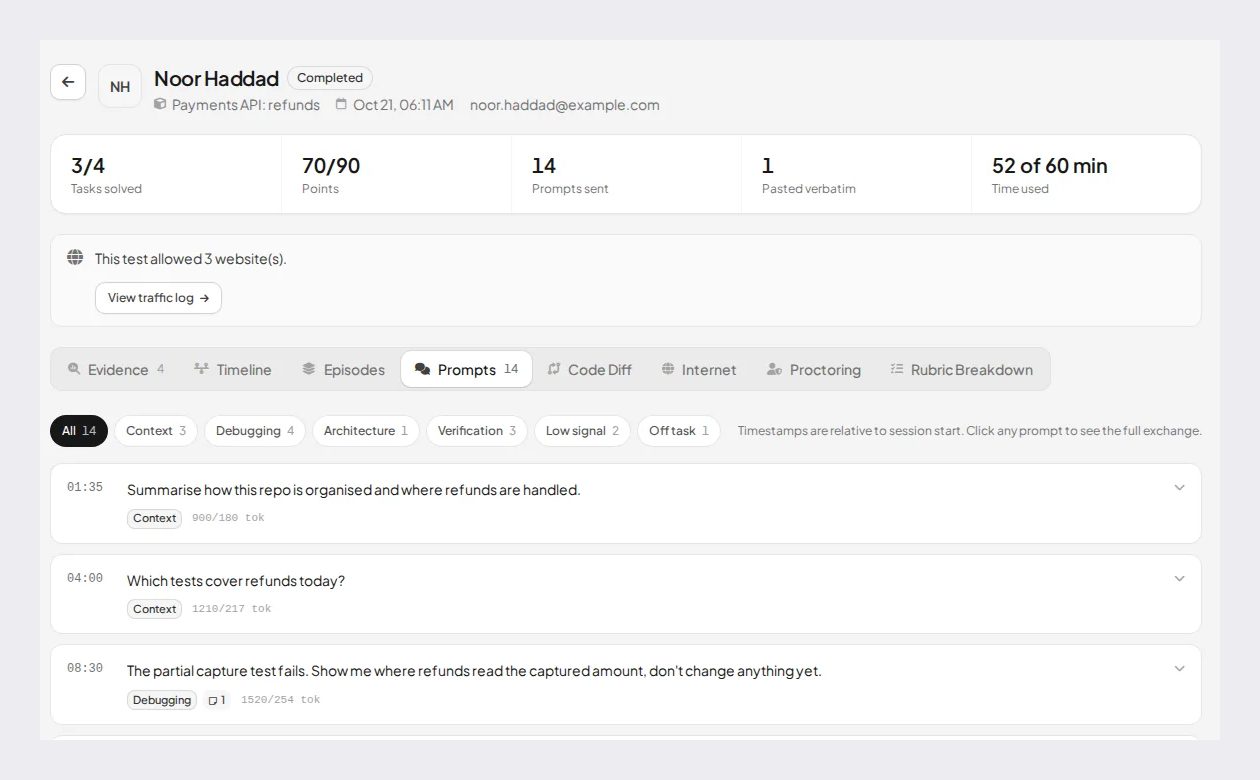
Neither is "right". HackerRank tells you how a candidate does on well-known problems, at volume, with a mature interview workflow. IntelliAssess tells you how they find their way around your code and how they use AI there, for fewer candidates at the final stage.
Where HackerRank is better
- Live interviews. Pair programming on every plan; IntelliAssess's live view is watch-only.
- An AI interviewer. Chakra on every plan; IntelliAssess has none.
- Ready questions. 2,000 to 7,500+ questions and certified assessments; IntelliAssess has a small library.
- Breadth. 55+ languages (listed 16 November 2026); IntelliAssess drafts tasks for Node.js and Python only.
- Integrations and maturity. ATS from Pro, API and MCP on Enterprise, and a product out of beta.
Where IntelliAssess is better
- Your own code. The test is your repository, not a question other companies also send.
- A proved test. It will not publish until the grading has been shown to work, including that wrong fixes fail.
- AI use as evidence. Every prompt is in the report with observations linked to it, and none of it changes the score.
- Grading you can reproduce. Hidden tests on a fresh machine the candidate never touched.
- Cost during the beta. A free pilot, against $948 a year for 60 HackerRank attempts.
Pricing compared
HackerRank publishes three plans (read 17 November 2026): Starter $79 a month billed annually ($948) with 60 candidate attempts a year; Pro $419 a month ($5,028) with 360 attempts; Enterprise custom. Extra attempts are $20 each, or $15 pre-bought on an annual Pro plan, and annual billing saves 20% over monthly. That is $15.80 per candidate on Starter and $13.97 on Pro before overage. For other tools' cost per candidate, see HackerRank alternatives.
IntelliAssess's coding product is a free pilot while in beta: tell us how many candidates you test a month and we set it up. Its non-coding pre-employment tests use the published plans on our pricing page, from $39 a month.
What HackerRank costs at three hiring volumes
The per-candidate price changes with volume, because extra attempts cost more than included ones. Using HackerRank's published prices:
| Candidates a year | Cheapest HackerRank route | Yearly cost | Per candidate |
|---|---|---|---|
| 40 | Starter (60 included) | $948 | $23.70 |
| 150 | Starter + 90 extra at $20 | $2,748 | $18.32 |
| 400 | Pro (360 included) + 40 pre-bought at $15 | $5,628 | $14.07 |
A team that only sends coding tests to its final few candidates for each role may test far fewer people than it screens. That is the situation IntelliAssess's coding product is designed for, and during the beta the pilot is free. Once it has a published price, compare it against your real final-stage volume, not your total applicant count.
Using HackerRank and IntelliAssess together
The two are not mutually exclusive. A common pattern for teams that hire developers at volume is to screen many applicants with a short library assessment, then give a smaller group a deeper exercise. HackerRank can do the first step well and at scale. IntelliAssess can do the second: a take-home in a trimmed copy of your own service, where the scorecard shows what they changed and how they used AI. The cost is a second tool and a second place to read results, since IntelliAssess has no ATS integration yet.
Questions to ask before you decide
- At what stage do you want the coding test? Early screening favours a library and an ATS link; a final-stage exercise favours depth on your own code.
- How many candidates sit it each year? Count only the ones who would actually take it, then price HackerRank's plans and overage at that number.
- What do you want to learn about AI use? Whether a candidate can work without it, how they work with it, or both. HackerRank offers both modes; IntelliAssess focuses on the second.
- Which languages do you hire for? Outside Node.js and Python, IntelliAssess needs you to write the tasks and test commands yourself.
- Can you publish a trimmed copy of your code? IntelliAssess needs a public repository; if you cannot share any code, HackerRank's library and custom questions are the safer route.
- Do you need a product out of beta? If procurement requires a mature, certified product, HackerRank is the answer today.
What IntelliAssess does not have
- Public GitHub repositories only; private repositories are not supported yet.
- AI-drafted tasks for Node.js and Python projects; other stacks need your own tasks and test commands.
- No live pair-programming editor and no AI interviewer.
- No ATS integration; invite up to 500 candidates at once by email.
- A small verified library, not thousands of questions, and no published price yet.
Choose HackerRank if
- You hire many developers across many languages and want questions ready today.
- Live pair-programming interviews or an AI interviewer are part of your process.
- Your ATS must push candidates and pull results automatically.
- You need a mature product with certified assessments.
Choose IntelliAssess if
- You want final-stage candidates to fix real bugs in your own Node.js or Python project.
- You want proof that the test grades correctly before you send it.
- You want to see exactly how candidates used AI, prompt by prompt, without it affecting the score.
- You can work from a public repository and are open to a free pilot of a beta product.
Comparing more tools? See HackerRank alternatives, scored on eight published facts, or every comparison.
Frequently asked questions
Is IntelliAssess an alternative to HackerRank?
For one job, yes: testing candidates on your own codebase with AI allowed. HackerRank remains stronger for live pair-programming interviews, an AI interviewer, a large question library and ATS integrations, and IntelliAssess's coding product is in beta.
How much does HackerRank cost?
On 17 November 2026, Starter was $79 a month billed annually ($948) for 60 candidate attempts a year, Pro $419 a month ($5,028) for 360, and Enterprise custom. Extra attempts were $20 each.
Does HackerRank let candidates use AI?
Yes. In Screen, the AI is a guarded assistant for syntax and debugging; in Interview, it is unguarded, with agentic mode and a choice of model. IntelliAssess lets you allow an AI assistant and records every prompt in the scorecard.
Can IntelliAssess test private repositories?
Not yet. Tests are built from public GitHub repositories; a trimmed public copy of a real service works well.
Does IntelliAssess have an AI interviewer like Chakra?
No. IntelliAssess grades the work with hidden tests and shows how the candidate used AI; it does not interview them.
Which languages does IntelliAssess support?
Any stack can run in the candidate's machine, but AI-drafted tasks are for Node.js and Python projects; for other stacks you write the tasks and test commands.
Is HackerRank worth it for a small team?
At around 40 candidates a year, Starter costs $948, or $23.70 per candidate, and includes Chakra, Screen, Interview and proctoring with unlimited users. If you only need a handful of final-stage exercises on your own code, IntelliAssess's free pilot is worth trying alongside it while it is in beta.
Can candidates look up IntelliAssess tasks online?
The tasks are built inside your own repository, with bugs planted for that challenge and tests the candidate never sees, so there is no shared question bank to look up. You can also build a new challenge from the same code.
Does IntelliAssess penalise candidates for using AI?
No. If you allow an assistant, every prompt is shown in the report as evidence, but prompts never change the score; points come only from the hidden tests.
What does HackerRank's Chakra do?
Chakra is HackerRank's AI interviewer, included on every plan. HackerRank says it sets up a canvas with a real-world problem, watches how the candidate works through it and evaluates judgment and AI fluency, and that more than 500,000 candidates have been interviewed by it. IntelliAssess has no equivalent; it grades the work a candidate submits rather than holding a conversation.
Can HackerRank test candidates on a real project?
Partly. Alongside its library, HackerRank lets you write custom and project-based questions, so you can set a project of your own. What it does not do is build the test from your repository automatically and prove the grading before sending it, which is the part IntelliAssess automates for Node.js and Python projects.
Which is better for hiring at volume?
HackerRank. Unlimited users, ATS integrations from Pro, a large library across 55+ languages and an AI interviewer make it the better fit for screening many applicants. IntelliAssess's coding product is aimed at the final stage, where fewer candidates sit a deeper test.
Keep reading
All articles
Read next
SchoolAI alternatives: 7 AI tools for teachers and students scored (2026)
Seven AI tools scored on the same nine facts, with SchoolAI as the reference, and what each lets teachers see when students use AI.
SchoolAI vs IntelliAssess: an AI tutor for students or feedback after a test?
SchoolAI puts students in supervised conversation with AI; IntelliAssess marks their tests and uses AI to help them learn from their own answers.
Motasem Aldiab 12 min read
Jotform and ProProfs alternatives for quizzes and exams (2026)
Jotform and ProProfs side by side, then the alternatives by forms, certificates or real exams.
Motasem Aldiab 2 min read