
HackerRank alternatives for developer hiring (2026)

By Motasem Aldiab, Technology Consultant and Trainer - Cloud, DevOps, Java, Data Science
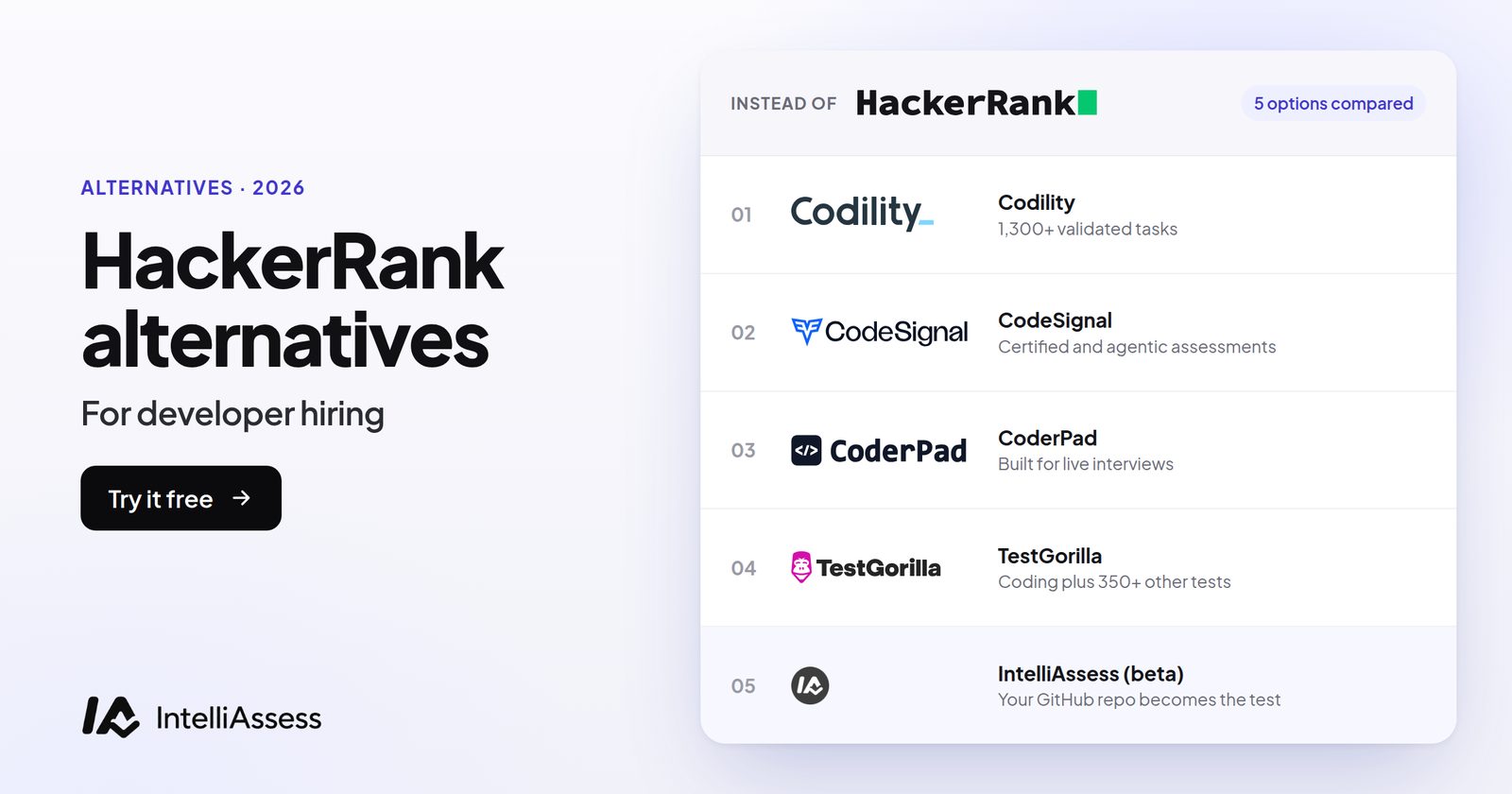
Contents16
- What you get with HackerRank today
- Why teams look for a HackerRank alternative
- The scorecard: 8 HackerRank alternatives on 8 published facts
- 1. CodeSignal: the closest all-round match
- 2. CoderPad: built around the live interview
- 3. Canditech: project take-homes where AI use is the point
- 4. Codility: validated tasks with Claude Code and Codex
- 5. CodeSubmit: take-homes in a Git repository
- 6. IntelliAssess (beta): your own repository becomes the test
- 7. HackerEarth: a big library and a developer community
- What one candidate costs on each entry plan
- What a year costs at three hiring volumes
- When AI is allowed in the test, check what the report shows
- Where IntelliAssess is not the right choice
- How to choose a HackerRank alternative
- Moving from HackerRank in five steps
Key takeaways
- 1Closest all-round match: CodeSignal. Live interviews: CoderPad.
- 2Take-home projects with AI allowed: Canditech or CodeSubmit. Validated tasks: Codility.
- 3Per candidate on entry plans: CodeSignal and HackerRank $15.80, CoderPad $16.00, Codility $24.00.
- 4Tests from your own repository: IntelliAssess, in beta, sixth on the scorecard.
The best HackerRank alternatives in 2026 are CodeSignal for the closest all-round match (AI interviewers, agentic assessments with Claude and Codex, and ID checks from its first plan), CoderPad for live pair-programming interviews, Canditech and CodeSubmit for take-home projects where candidates use AI, and Codility for 1,300+ validated tasks. IntelliAssess, in beta, fits one narrower job: turning your own public repository into the test. Below, eight tools are scored on the same eight published facts, with the cost per candidate on each entry plan.
What you get with HackerRank today
Start with what you would replace. HackerRank's pricing page (read 17 November 2026) says every plan includes Chakra, an AI interviewer; Screen, AI-assisted take-home assessments; Interview, pair-programming interviews; an agentic IDE; and "advanced proctoring features", with unlimited users.
| HackerRank plan | Price | Candidate attempts a year | Library | Adds |
|---|---|---|---|---|
| Starter | $79 a month ($948 billed annually) | 60 | 2,000+ questions | Chakra, Screen, Interview, agentic IDE, proctoring |
| Pro | $419 a month ($5,028 billed annually) | 360 | 4,000+ | ATS and calendar integrations |
| Enterprise | Custom | Custom | 7,500+ | Certified assessments, API and MCP access, leakage protection, 22+ enterprise ATS integrations |
Extra attempts cost $20 each, or $15 if pre-bought on an annual Pro plan; annual billing saves 20%. On AI, HackerRank's AI page describes a guarded assistant in Screen ("syntax and debugging support") and an unguarded environment in Interview where candidates can use agentic mode and "choose their preferred AI model", plus webcam and screen monitoring, a screen-to-interview ID match and a locked-down desktop app. Its Chakra page says 500,000+ candidates have been interviewed by Chakra.
Why teams look for a HackerRank alternative
- AI changed what a coding test measures. In HackerRank's own 2025 Developer Skills Report (13,732 respondents in 102 countries), 97% of developers said they use at least one AI assistant, and 76% said AI makes gaming assessments easier. Teams want tests where AI use is allowed and visible, not banned and hidden.
- Attempts run out. Starter covers 60 candidate attempts a year; past that, each attempt is $20.
- Puzzle questions versus real work. Library questions are the same at every company, and popular ones circulate online. Some teams want candidates working in a real codebase instead.
- Live interviews or take-homes, not both. Some teams only need one and do not want to pay for the other.
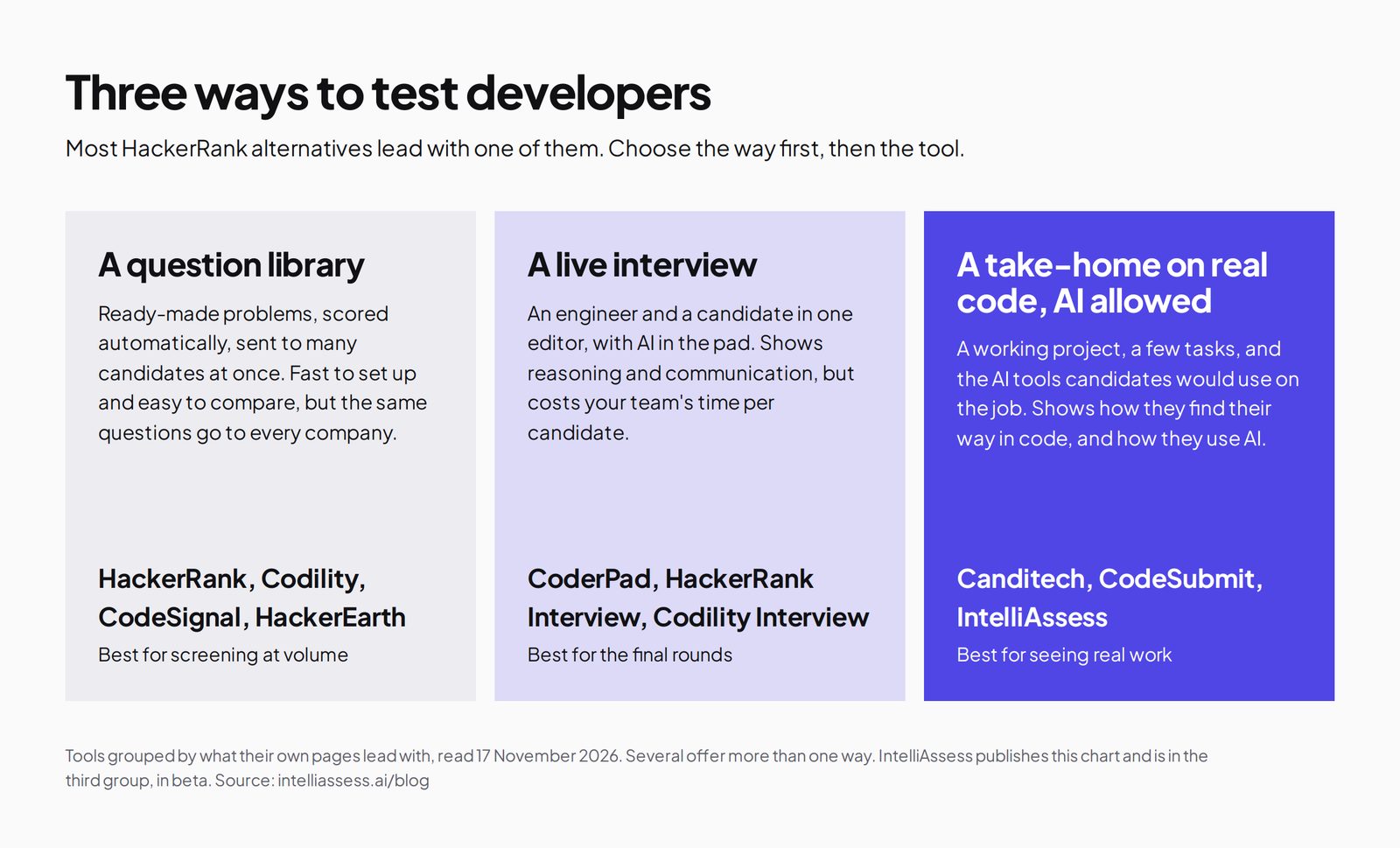
The scorecard: 8 HackerRank alternatives on 8 published facts
Each tool is scored on what HackerRank buyers compare: a published price, AI allowed in the test, live interviews, an AI interviewer, tests built from your own code, a ready-made library, ATS on the entry plan, and ID checks on the entry plan. A tick means the vendor's own page says so on its entry paid plan (or free); a half means on a higher plan, partly, or with a limit; a cross means the page does not say so. Ties go to the tool with a published price, then to the larger library.
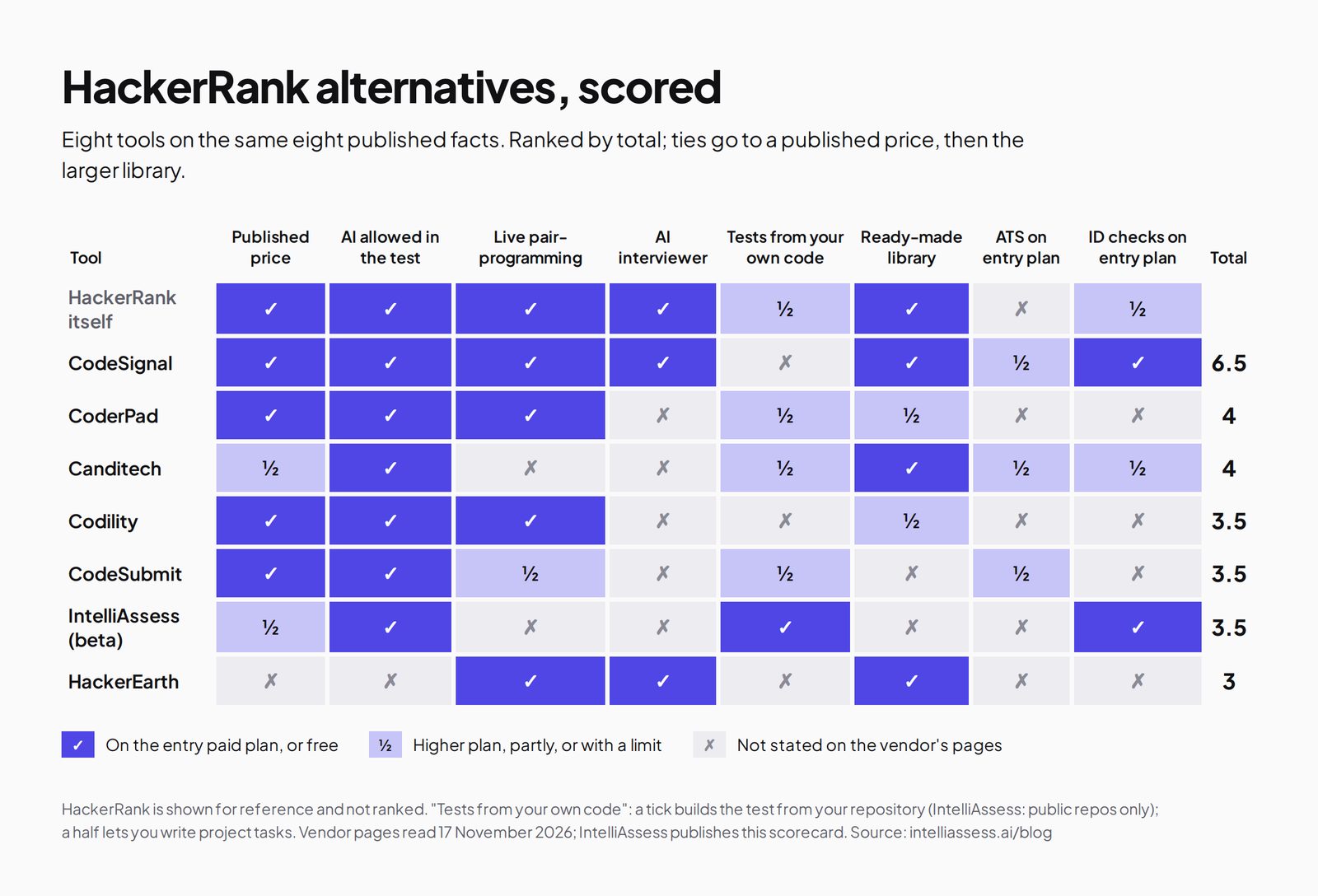
| Tool | Published price | AI allowed in the test | Live pair-programming | AI interviewer | Tests from your own code | Ready-made library | ATS on entry plan | ID checks on entry plan | Total |
|---|---|---|---|---|---|---|---|---|---|
| HackerRank itself | ✓ | ✓ | ✓ | ✓ | ½ | ✓ | ✗ | ½ | |
| 1. CodeSignal | ✓ | ✓ | ✓ | ✓ | ✗ | ✓ | ½ | ✓ | 6.5 |
| 2. CoderPad | ✓ | ✓ | ✓ | ✗ | ½ | ½ | ✗ | ✗ | 4 |
| 3. Canditech | ½ | ✓ | ✗ | ✗ | ½ | ✓ | ½ | ½ | 4 |
| 4. Codility | ✓ | ✓ | ✓ | ✗ | ✗ | ½ | ✗ | ✗ | 3.5 |
| 5. CodeSubmit | ✓ | ✓ | ½ | ✗ | ½ | ✗ | ½ | ✗ | 3.5 |
| 6. IntelliAssess (beta) | ½ | ✓ | ✗ | ✗ | ✓ | ✗ | ✗ | ✓ | 3.5 |
| 7. HackerEarth | ✗ | ✗ | ✓ | ✓ | ✗ | ✓ | ✗ | ✗ | 3 |
"Tests from your own code": a tick means the tool builds the test from your repository (IntelliAssess: public repos only); a half means you can write custom or project-based tasks. IntelliAssess's "published price" is a half because the beta is a free pilot with no published price. HackerEarth's pricing page showed no readable plans to our browser, and its pages we could read did not describe AI use inside tests.
1. CodeSignal: the closest all-round match
Best for: teams that want everything HackerRank does, including AI interviewers, with ID checks on the first plan.
CodeSignal's pricing page lists, on its Build plan, universal and core tech assessments, "Agentic Assessments with Claude & Codex", product, design and engineering AI interviewers, access to 2,000 questions, and "AI Proctoring & ID Verification". Grow adds more agentic assessments, go-to-market assessments, sales, customer success and marketing AI interviewers, and basic ATS integrations; Pro adds advanced fraud prevention and enterprise ATS integrations. A credit is used "when a candidate starts an assessment, AI interview, or live interview, not when you send one."
Price: Build $79 a month billed annually (60 credits a year) or $99 monthly (5 a month); Grow $479 a month billed annually (420 credits) or $599 monthly (35 a month); Pro custom; extra credits $20 each.
Where it falls short: ATS integrations start on Grow, and the tests come from CodeSignal's library rather than your own codebase. See CodeSignal alternatives.
2. CoderPad: built around the live interview
Best for: teams whose process centres on live pair-programming interviews with AI in the pad.
CoderPad's pricing page (updated 13 October 2026) includes AI Assist on every plan, with models up to Sonnet class on Starter and Team and frontier models on Frontier Lite and Enterprise, where Claude Code and Codex run inside the pad. Team adds take-homes and auto-scored screens. Webcam proctoring with AI behaviour analysis and real-time cheating alerts are Enterprise only. Every plan has a free trial without a card.
Price: Starter $80 a month billed annually (60 interviews a year) or $120 monthly (5 a month); Team $400 a month billed annually (360 a year) or $500 monthly (30 a month); Frontier Lite $1,000 a month, annual only (360 a year); Enterprise custom; $30 per extra test or interview.
Where it falls short: no AI interviewer, and proctoring needs Enterprise. See CoderPad alternatives.
3. Canditech: project take-homes where AI use is the point
Best for: teams that want candidates to work through a realistic project with Claude Code, Codex or Cursor, and be judged on how they use them.
Canditech's coding project page describes "a realistic take-home engineering assignment" in an existing multi-file project in VS Code in the browser, with an AI usage policy from unrestricted to controlled ("Yes, and that is the point"), automated test cases for correctness, and AI agents that assess how candidates prompted and validated AI output. Its pricing also lists 500+ pre-built tests and an AI Assessment Builder.
Price: quoted for 100 candidates a year, billed yearly: Team $150 a month (2 assessments), Pro $200 a month (unlimited assessments, ATS, coding questions); Enterprise on request; start free.
Where it falls short: no live pair-programming, prices published only for 100 candidates a year, and webcam snapshots need Enterprise.
4. Codility: validated tasks with Claude Code and Codex
Best for: teams that want defensible, validated tasks and the real AI agents in the terminal.
Codility's pricing page says online plans include an AI Assistant "on models up to Sonnet class, with Claude Code and Codex in the terminal, in assessments and live interviews. Every prompt is saved for review." AI can be switched on or off per task. Online plans include screening, live interviews, plagiarism detection, proctoring with snapshots and task-leakage protection. ID verification, video proctoring, interview recording, ATS integrations and the full library of 1,300+ validated tasks are Enterprise features.
Price: online plans from $4,800 a year (200 invites) or $800 a month (25 invites); an invite counts when sent; Enterprise by quote.
Where it falls short: the highest entry price per candidate here, no AI interviewer, and ID checks and ATS need Enterprise. See Codility alternatives.
5. CodeSubmit: take-homes in a Git repository
Best for: small teams that want take-home challenges in a real repository, with the agents of their choice.
CodeSubmit's site says candidates "work in a repository locally with Git or in CodeSubmit IDE in the browser" and use AI coding tools such as Claude Code or Codex; "your team decides which agents are available." Its pricing lists Greenhouse, Lever and Personio integrations on higher plans and a seven-day trial.
Price: Solo $49 a month (3 candidates a month), Startup $199 (15), Scaleup $299 (30, with take-homes with Codex or Claude and ATS), Business $499 (60), billed monthly; annual saves 20%; Enterprise from $12,000 a year; $20 per candidate over quota.
Where it falls short: no AI interviewer, no published library size, and no ID checks described.
6. IntelliAssess (beta): your own repository becomes the test
Best for: teams that want to see how a candidate works in their actual codebase, with AI allowed and every prompt on record.
IntelliAssess's technical hiring product takes a public GitHub repository, plants bugs in it with AI, writes hidden tests that catch them, and refuses to publish until it has proved the grading works: the reference fix passes, wrong fixes fail, and a different AI model can solve the task from what the candidate sees.
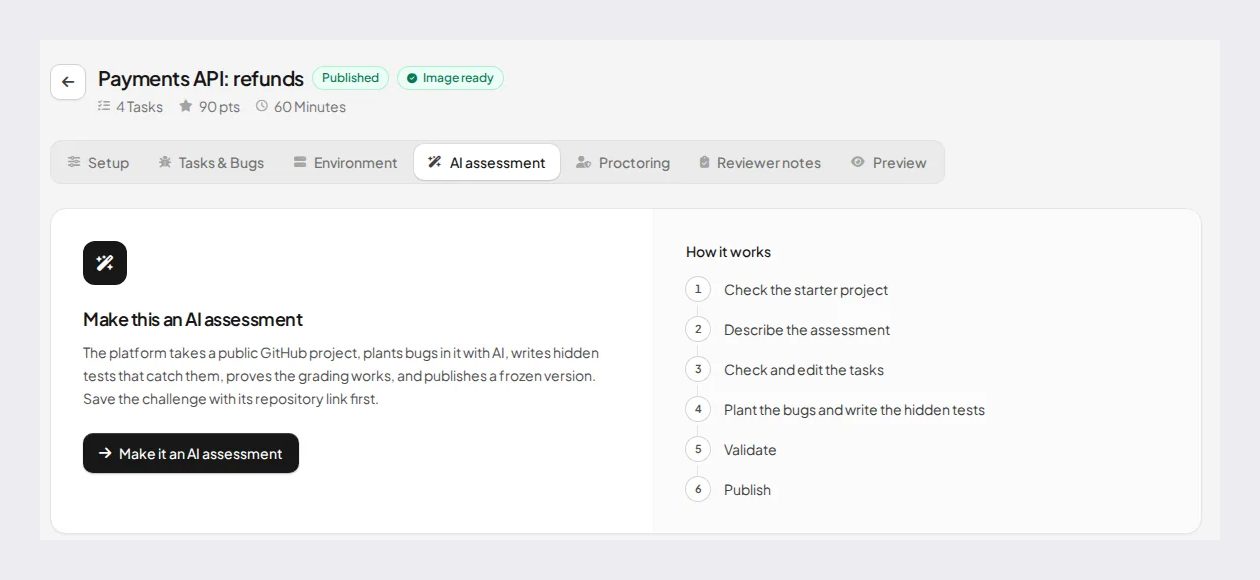
Candidates work in VS Code in the browser on their own cloud machine, with the AI assistant you allow and a spend limit. Their files are graded on a fresh machine they never used. The scorecard shows points per task, the code diff, every AI prompt (as evidence, never scored), observations linked to the prompts behind them, and the proctoring report: ID and face match, webcam, microphone, browser lock and a watch-only live view.
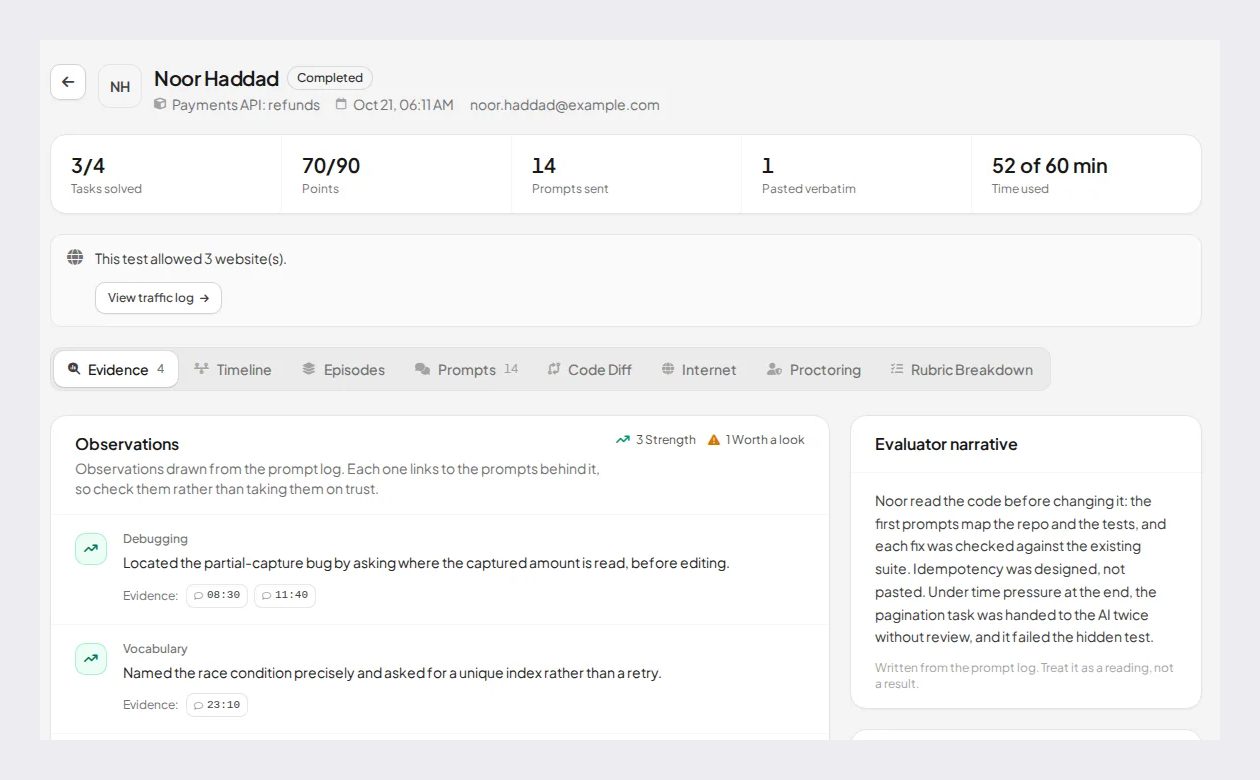
Price: a free pilot while in beta; no price is published yet.
Where it falls short: public repositories only, AI-made tasks for Node.js and Python (other stacks need your own tasks and test commands), no live pair-programming editor, no AI interviewer, no ATS integration, and a small library. See HackerRank vs IntelliAssess.
7. HackerEarth: a big library and a developer community
Best for: teams that also want hackathons and a developer community to hire from.
When we read HackerEarth's pages for our HackerEarth comparison on 16 November 2026, it listed 25,000+ vetted questions, FaceCode live coding interviews with pair programming, an AI Screener and an AI Interviewer, psychometric tests, and hackathons for a community of 10 million+ developers. On 17 November its pricing page showed no readable plans to our browser, so its price is not listed here.
Where it falls short: no published price we could read, and its pages did not describe AI use inside tests. See HackerEarth alternatives.
What one candidate costs on each entry plan
Attempts, credits, invites and interviews are counted differently, but each tool publishes enough to divide its entry plan by what it includes. The figure is the list price per candidate on the cheapest plan, before overage.
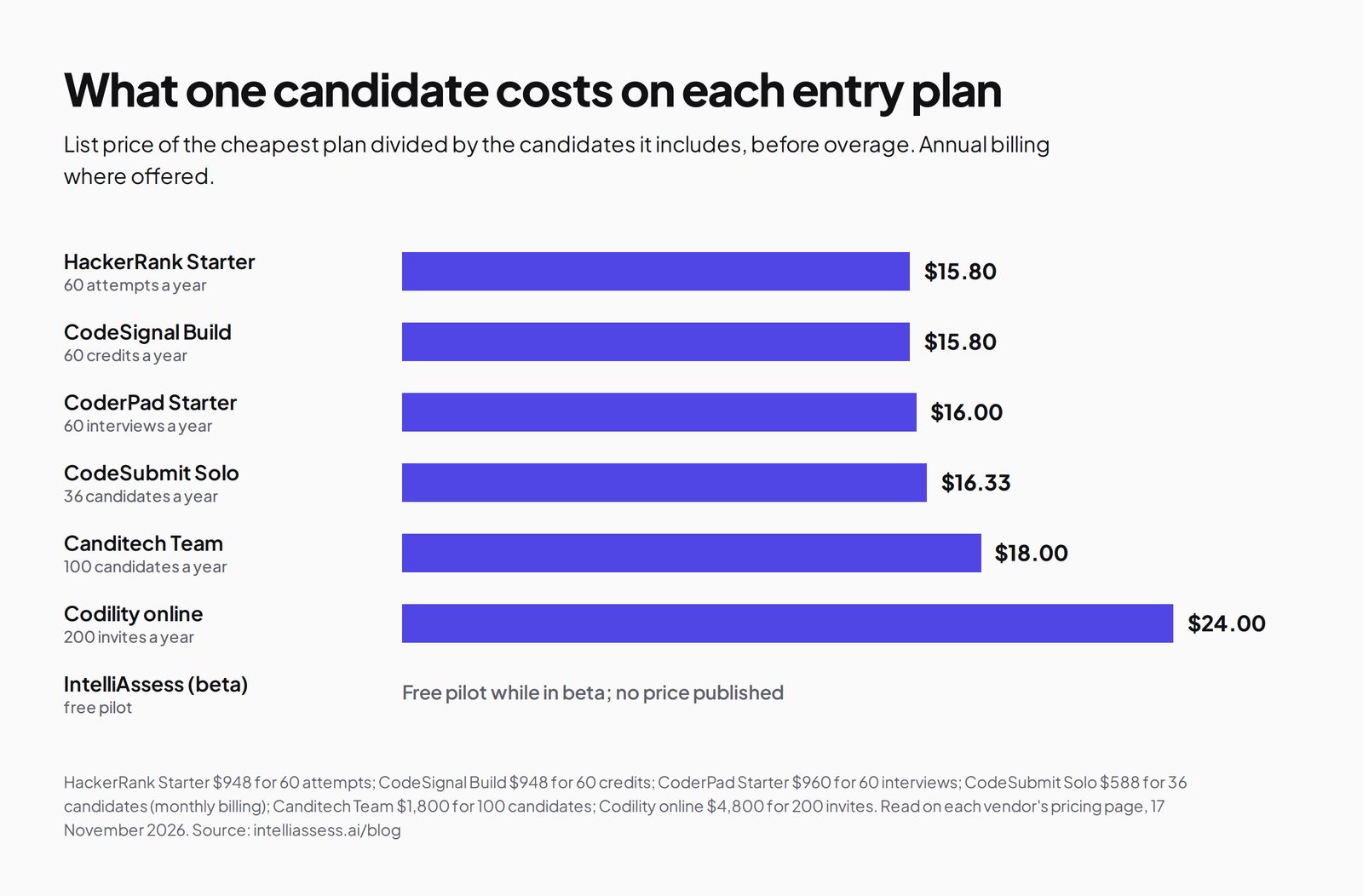
| Tool and entry plan | Price a year | Candidates included | Per candidate | Each extra |
|---|---|---|---|---|
| HackerRank Starter | $948 | 60 attempts | $15.80 | $20 |
| CodeSignal Build | $948 | 60 credits | $15.80 | $20 |
| CoderPad Starter | $960 | 60 interviews | $16.00 | $30 |
| CodeSubmit Solo (monthly) | $588 | 36 candidates | $16.33 | not on Solo |
| Canditech Team | $1,800 | 100 candidates | $18.00 | not stated |
| Codility (online) | $4,800 | 200 invites | $24.00 | next pack |
| IntelliAssess (beta) | Free pilot; no published price | |||
What a year costs at three hiring volumes
Cost per candidate on the entry plan only tells part of the story, because the cheapest plan stops being cheapest once you pass its allowance. Here is the cheapest published route on each tool for three teams, using list prices and the published price of extra candidates. Monthly quotas assume candidates are spread evenly across the year.
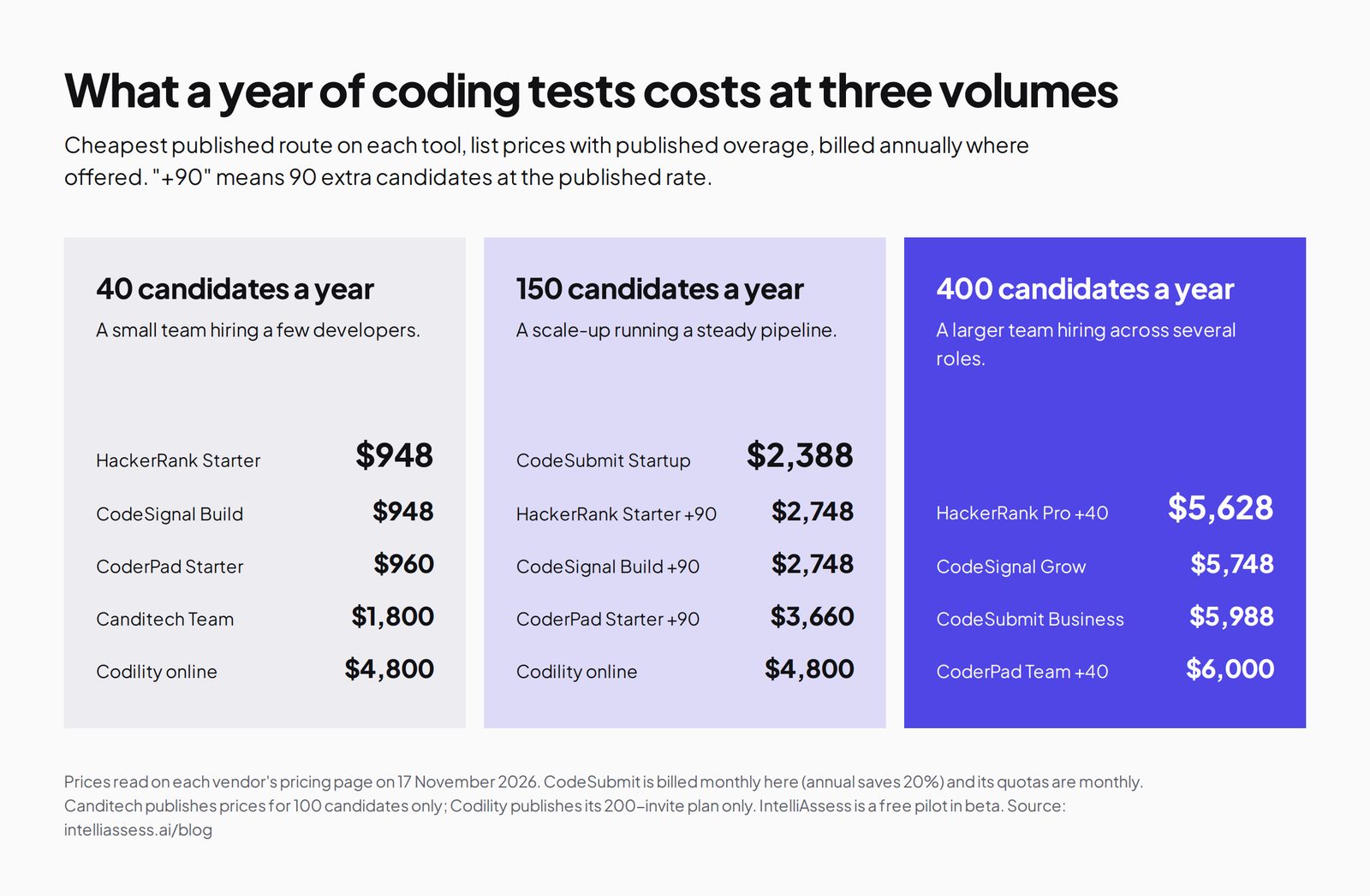
| Tool | 40 candidates | 150 candidates | 400 candidates |
|---|---|---|---|
| HackerRank | $948 (Starter) | $2,748 (Starter + 90 at $20) | $5,628 (Pro + 40 pre-bought at $15) |
| CodeSignal | $948 (Build) | $2,748 (Build + 90 at $20) | $5,748 (Grow, 420 credits) |
| CoderPad | $960 (Starter) | $3,660 (Starter + 90 at $30) | $6,000 (Team + 40 at $30) |
| CodeSubmit | $2,388 (Startup, monthly) | $2,388 (Startup, 15 a month) | $5,988 (Business, 60 a month) |
| Canditech | $1,800 (Team, 100 candidates) | not published | not published |
| Codility | $4,800 (200 invites) | $4,800 (200 invites) | not published |
| IntelliAssess (beta) | Free pilot; no published price | ||
Three things stand out. At low volume, HackerRank, CodeSignal and CoderPad cost almost the same, so choose on features rather than price. In the middle, CodeSubmit's monthly plans undercut the per-attempt overage of the others, if take-homes are all you need. At 400 candidates, HackerRank Pro with pre-bought attempts and CodeSignal Grow are within $120 of each other. Codility's online plan only pays off when you use most of its 200 invites, though a team hiring in one burst can buy single months at $800 for 25. CodeSubmit's annual billing saves another 20% on the figures above.
When AI is allowed in the test, check what the report shows
Almost every tool on this list now lets candidates use AI, which matches what HackerRank's own survey found developers do at work. The difference is in what you see afterwards. Before choosing, ask each vendor to show you a finished report and check five things:
- Can you switch AI on or off per task? Codility says AI can be turned on or off per task; Canditech lets you set a policy from unrestricted to controlled; CodeSubmit lets your team decide which agents are available.
- Is every prompt saved? Codility says "every prompt is saved for review". IntelliAssess records every prompt on the scorecard, as evidence and never as part of the score.
- Is the AI use itself judged? Canditech says its AI agents assess how candidates prompted and validated AI output. IntelliAssess links its written observations to the prompts behind them, so a reviewer can check each claim.
- How is correctness decided? Hidden or automated tests (Canditech, IntelliAssess, and the auto-scored screens on most library tools) give a number you can compare across candidates; a live interview relies on the interviewer's notes.
- Which model did the candidate get? CoderPad and Codility name models up to Sonnet class on entry plans, with frontier models or agents such as Claude Code and Codex on some plans. HackerRank's Interview lets candidates choose their preferred model. A test is only fair if every candidate has the same assistant.
Where IntelliAssess is not the right choice
- Live pair-programming is the core of your process: CoderPad, CodeSignal or HackerRank.
- You want an AI interviewer to screen candidates conversationally: CodeSignal or HackerRank.
- Your code is in a private repository you cannot publish a trimmed copy of.
- Your ATS must send candidates and receive results automatically.
- You need a large library of ready questions in many languages today, or a product out of beta.
How to choose a HackerRank alternative
- Pick the way of testing first. Library screens, live interviews or take-homes on real code; most tools lead with one.
- Decide how AI fits. Allowed and recorded (Codility, CodeSignal, CoderPad, Canditech, CodeSubmit, IntelliAssess), or guarded. Check what the report shows about each prompt.
- Count your candidates. Divide each plan by attempts, credits, invites or interviews at your real volume, and price the overage.
- Check the entry plan. ID checks, ATS and the full library are often one tier up.
- Run one real role. Most tools here offer a trial; test the same role in two and compare what the report tells you.
Moving from HackerRank in five steps
- Check your renewal date. If you are on an annual HackerRank plan (it saves 20% over monthly), time the switch for the end of your term rather than paying for two tools at once.
- List the questions you actually use. Most teams rely on a handful of tests per role. Note the skills each one checks, so you can find or build an equivalent in the new tool rather than copying a library you never used.
- Rebuild one role first. Set up the test for your busiest role in the new tool and send it to a colleague who has passed your old one. If the scores line up, carry on; if not, adjust before candidates see it.
- Run both for one hiring round. Send half the round through each tool and compare how long reviewers spend on each report and how well the results predicted interview performance.
- Reconnect your ATS last. Check which plan the integration needs (CodeSignal Grow, Canditech Pro, CodeSubmit Scaleup and up, Codility Enterprise) before you commit.
Hiring for non-technical roles as well? See TestGorilla alternatives, or browse every comparison.
Frequently asked questions
What is the best alternative to HackerRank?
For the closest all-round match, CodeSignal: AI interviewers, agentic assessments with Claude and Codex, and ID checks from its first plan. For live interviews, CoderPad. For take-home projects with AI, Canditech or CodeSubmit. For validated tasks, Codility. For tests built from your own repository, IntelliAssess, in beta.
Which HackerRank alternative is cheapest?
Per candidate on entry plans, CodeSignal Build matches HackerRank Starter at $15.80, CoderPad Starter is $16.00 and CodeSubmit Solo $16.33; Codility's online plans work out at $24.00 per invite. CodeSubmit Solo has the lowest yearly total, $588 for 36 candidates.
Which HackerRank alternatives let candidates use AI?
Codility (Claude Code and Codex in the terminal, every prompt saved), CodeSignal (agentic assessments with Claude and Codex), CoderPad (AI Assist in every pad, Claude Code and Codex on higher plans), Canditech and CodeSubmit (agents in take-home projects) and IntelliAssess (the assistant you allow, every prompt recorded and never scored).
Is there a HackerRank alternative that tests on my own codebase?
IntelliAssess builds the test from your own public GitHub repository and proves the grading before publishing, in beta. Canditech, CodeSubmit and CoderPad let you set project-based tasks of your own.
How much does HackerRank cost in 2026?
On 17 November 2026, Starter was $79 a month billed annually ($948) for 60 candidate attempts a year, Pro $419 a month ($5,028) for 360, and Enterprise custom, with extra attempts at $20.
Which HackerRank alternative has an AI interviewer?
CodeSignal lists AI interviewers on every plan, and HackerEarth listed an AI Interviewer when we read it on 16 November 2026. HackerRank's own Chakra is included on every HackerRank plan.
Is CodeSignal better than HackerRank?
On the published facts they are close: both start at $79 a month billed annually for 60 candidates a year, both include an AI interviewer and both allow AI in tests. CodeSignal lists AI proctoring and ID verification on its first plan, while HackerRank's entry plan lists "advanced proctoring features" and keeps its largest library and certified assessments for Enterprise. Try the same role in both before deciding.
Can I use IntelliAssess alongside HackerRank?
Yes. Some teams keep a library tool for early screening and use IntelliAssess for a later take-home on their own code, where the scorecard shows the diff and every AI prompt. IntelliAssess has no ATS integration yet, so results are read in IntelliAssess itself.
Which HackerRank alternative is best for a small team?
At around 40 candidates a year, HackerRank Starter, CodeSignal Build and CoderPad Starter all cost about $950 to $960, so pick on whether you mainly run screens, AI interviews or live interviews. If you only need occasional take-homes, CodeSubmit Solo costs $588 a year for three candidates a month.
Keep reading
All articles
Read next
SchoolAI alternatives: 7 AI tools for teachers and students scored (2026)
Seven AI tools scored on the same nine facts, with SchoolAI as the reference, and what each lets teachers see when students use AI.
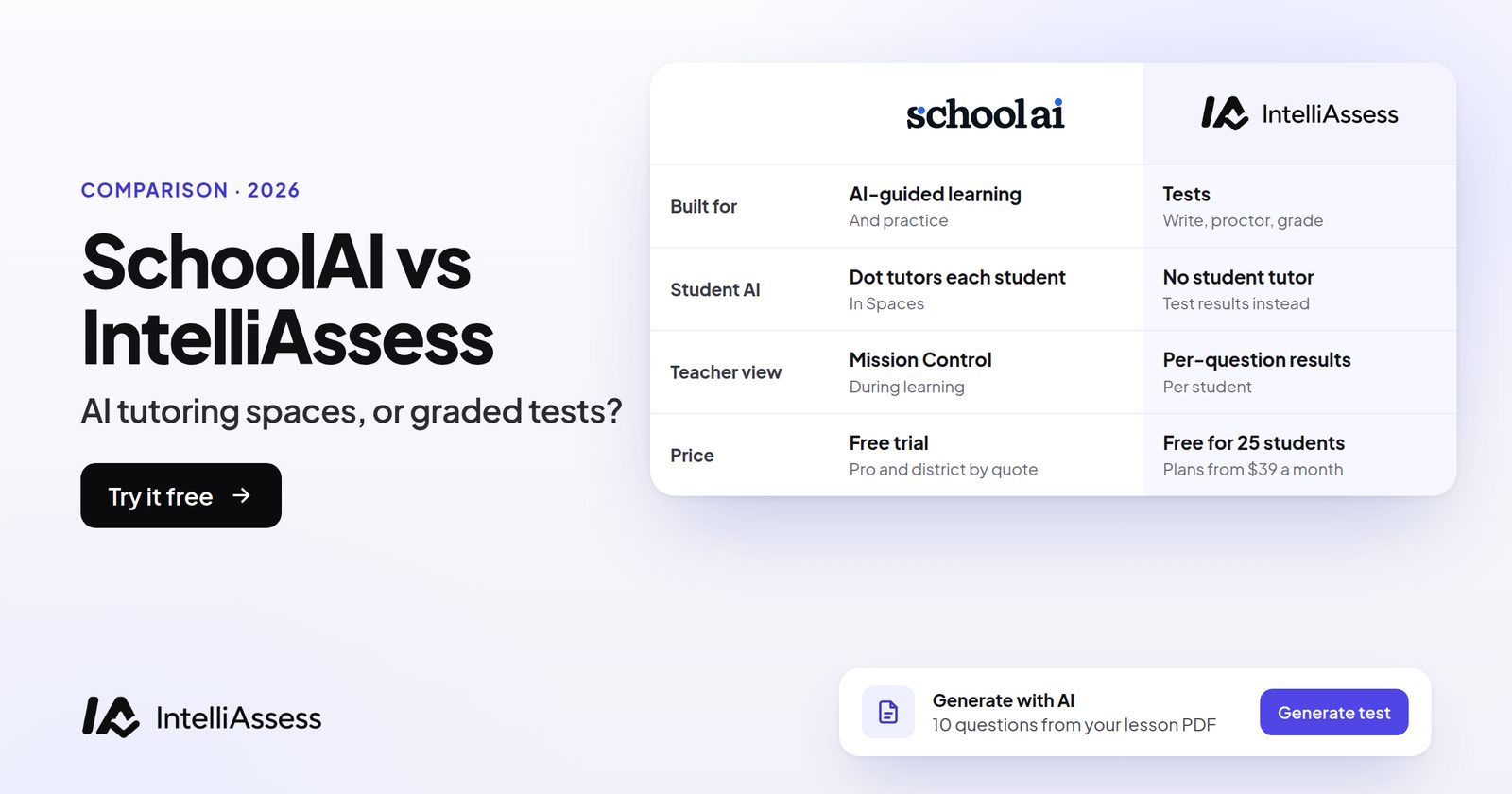
SchoolAI vs IntelliAssess: an AI tutor for students or feedback after a test?
SchoolAI puts students in supervised conversation with AI; IntelliAssess marks their tests and uses AI to help them learn from their own answers.
Motasem Aldiab 12 min read
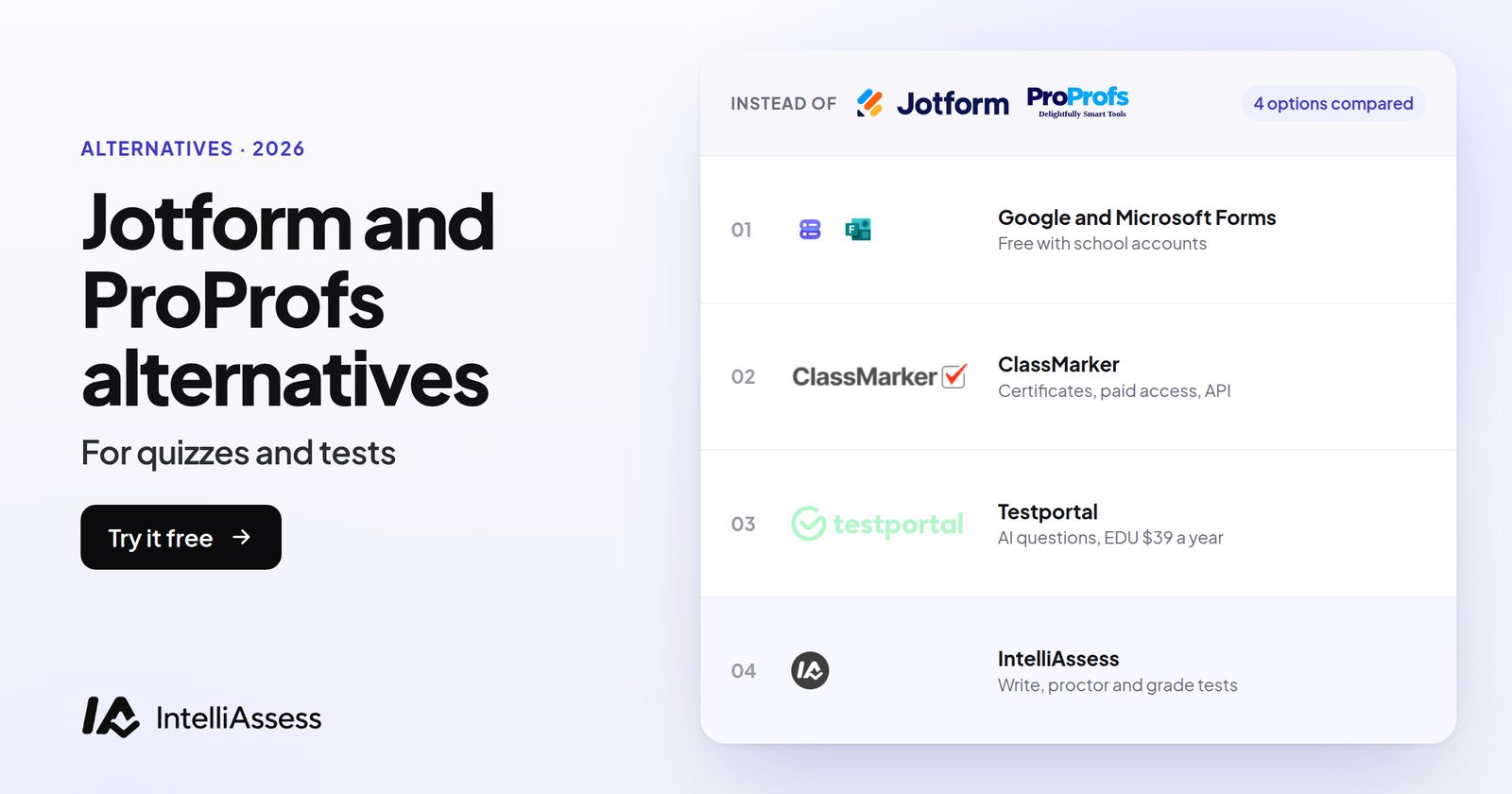
Jotform and ProProfs alternatives for quizzes and exams (2026)
Jotform and ProProfs side by side, then the alternatives by forms, certificates or real exams.
Motasem Aldiab 2 min read