
Microsoft Forms vs IntelliAssess: who scores the written answers?

By Motasem Aldiab, Technology Consultant and Trainer - Cloud, DevOps, Java, Data Science
Contents26
- The short answer
- Microsoft Forms vs IntelliAssess at a glance
- What Microsoft Forms does well
- Who scores the written answer?
- One unit test, two ways
- What Copilot adds, and what it does not
- Where Microsoft Forms stops
- What IntelliAssess adds
- Feature by feature
- Question types
- Writing the questions
- Delivering the test
- Security
- Marking
- Feedback to students
- Results and analytics
- Privacy
- The student's side
- Teachers working together
- Where Microsoft Forms is better
- Where IntelliAssess is better
- Using both together
- Questions to ask before switching
- Pricing
- Choose Microsoft Forms if
- Choose IntelliAssess if
Key takeaways
- 1Teach writes Forms quizzes from lesson files without a paid Copilot licence; Copilot in Forms needs one.
- 2Teams Assignments can create rubrics with AI and suggest feedback you confirm; you still score the work.
- 3IntelliAssess's AI scores each rubric criterion with a reason, and adds ID and webcam proctoring.
- 4IntelliAssess has no Microsoft Teams integration; it publishes to Google Classroom.
Microsoft Forms vs IntelliAssess is the comparison schools on Microsoft 365 make first, because Forms is already in their accounts. Forms builds quizzes with answer keys and points and runs inside Teams Assignments, where Microsoft's AI now drafts rubrics and suggests feedback, and Teach writes quizzes from your lesson files at no extra cost. IntelliAssess is for when a quiz becomes a real test: its AI scores each written answer against your rubric, and it checks identity and webcam for exams at home. The catch is plain: IntelliAssess does not connect to Teams.
The short answer
Keep Microsoft Forms for quizzes inside Teams, especially if they are mostly choice questions and Teach writes what you need. Add IntelliAssess when scoring essays and short answers takes your evenings, when students sit tests at home and you need to know who took them, or when you teach in Arabic, and you can run those tests outside Teams.
Microsoft Forms vs IntelliAssess at a glance
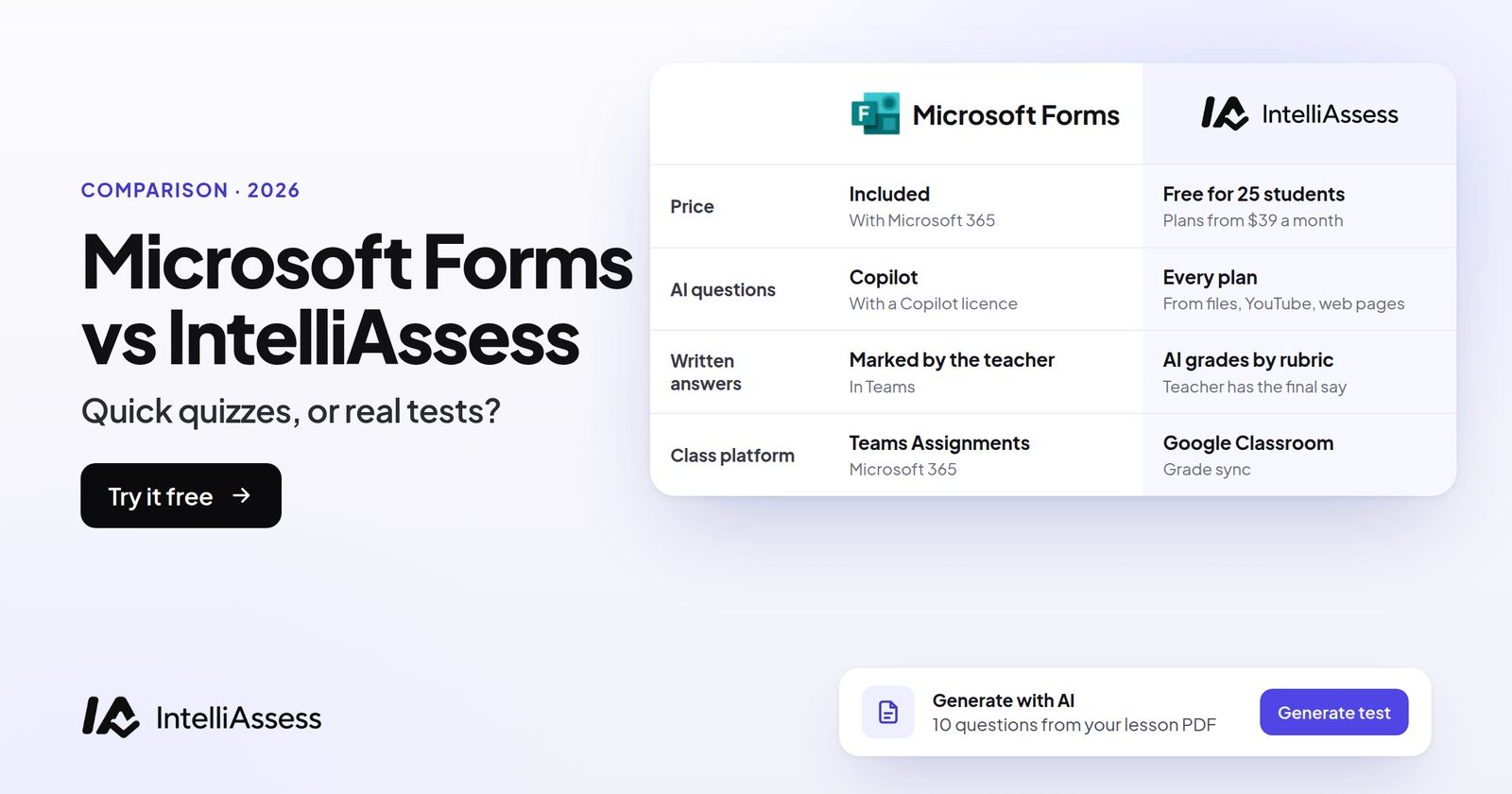
| Microsoft Forms (with Teams Assignments) | IntelliAssess | |
|---|---|---|
| Price | Included with Microsoft 365 | Free for 25 students; Starter $39 a month for 200 |
| AI quiz from your lesson files | Teach, for staff with Microsoft 365 for Education, no paid Copilot licence | Every plan, from PDF, Word, PowerPoint, YouTube or a web page |
| AI inside the quiz editor | Copilot in Forms, with a Copilot licence ($18 per user per month for education) | Included |
| Choice questions | Scored from the answer key | Scored at hand-in |
| Written answers | You score them; Assignments' AI can draft a rubric and suggest feedback you confirm | AI scores each rubric criterion with a reason; you can change any score (from Starter) |
| Exam security | No identity or webcam checks described | ID, selfie and liveness check, webcam, microphone, screen and browser checks (from Starter) |
| Class platform | Microsoft Teams | Google Classroom; no Teams integration |
| Arabic | Not compared here | Questions, rubrics and feedback in Arabic, right to left |
What Microsoft Forms does well
- It is already there. Forms comes with Microsoft 365, including school accounts, and works in any browser.
- Answer keys and points. Per Microsoft's quiz help, you mark the correct answer or answers, give each question points and can add a message students see when they choose an answer.
- Teams Assignments. Assign a quiz in a class team and students submit without leaving Teams; choice questions are scored and you review written answers and return the quiz.
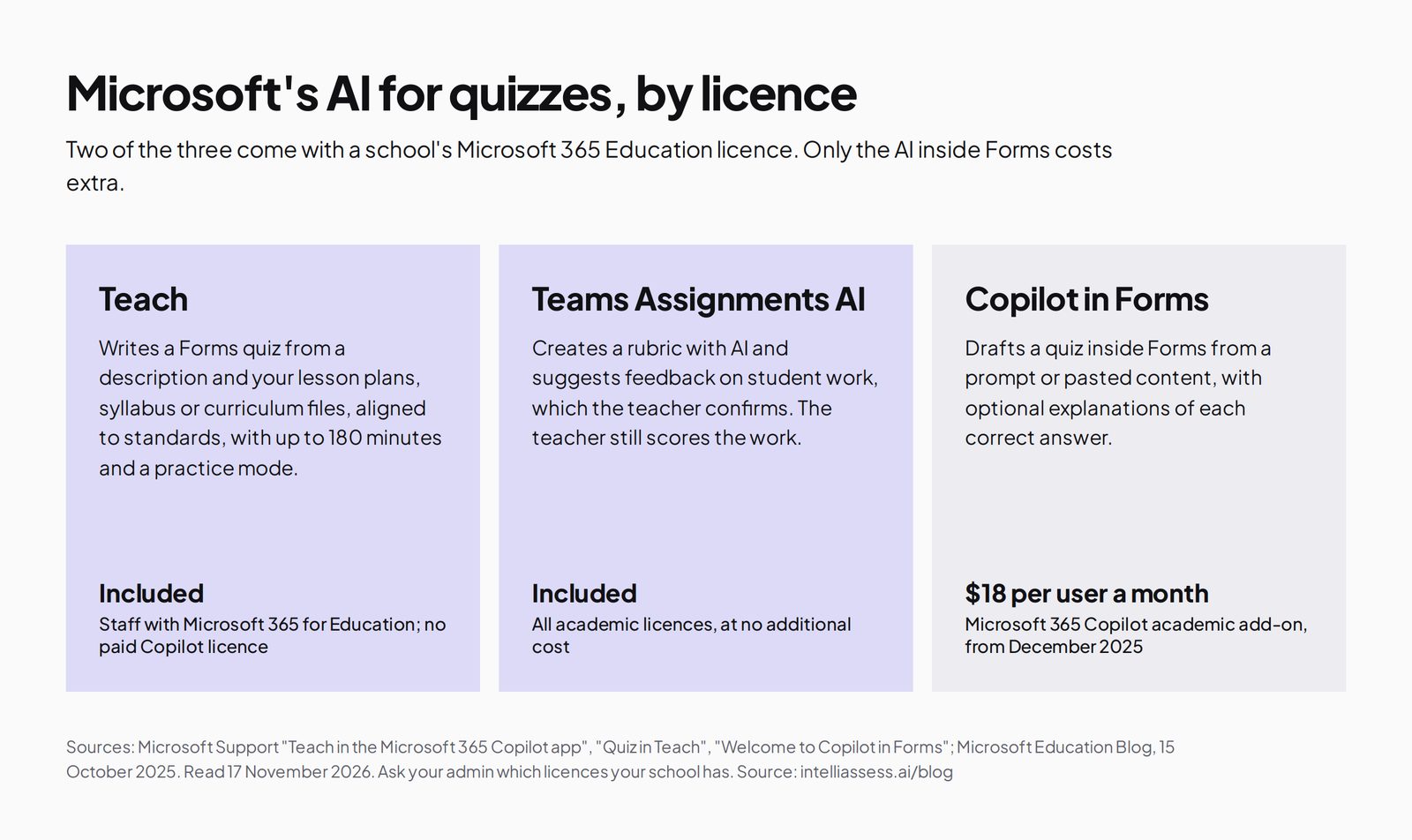
- Rubrics and feedback with AI, at no extra cost. Teams Assignments can create a rubric with AI, and suggest feedback on student work that "the educator must confirm", included with academic licences per Microsoft's October 2025 announcement.
- Quizzes from lesson files. Teach builds a Forms quiz from your lesson plans or syllabus, aligned to standards, with a practice mode where students can reveal answers and retry.
Who scores the written answer?
This is now the real difference. Both tools use AI around written answers, but in different places.
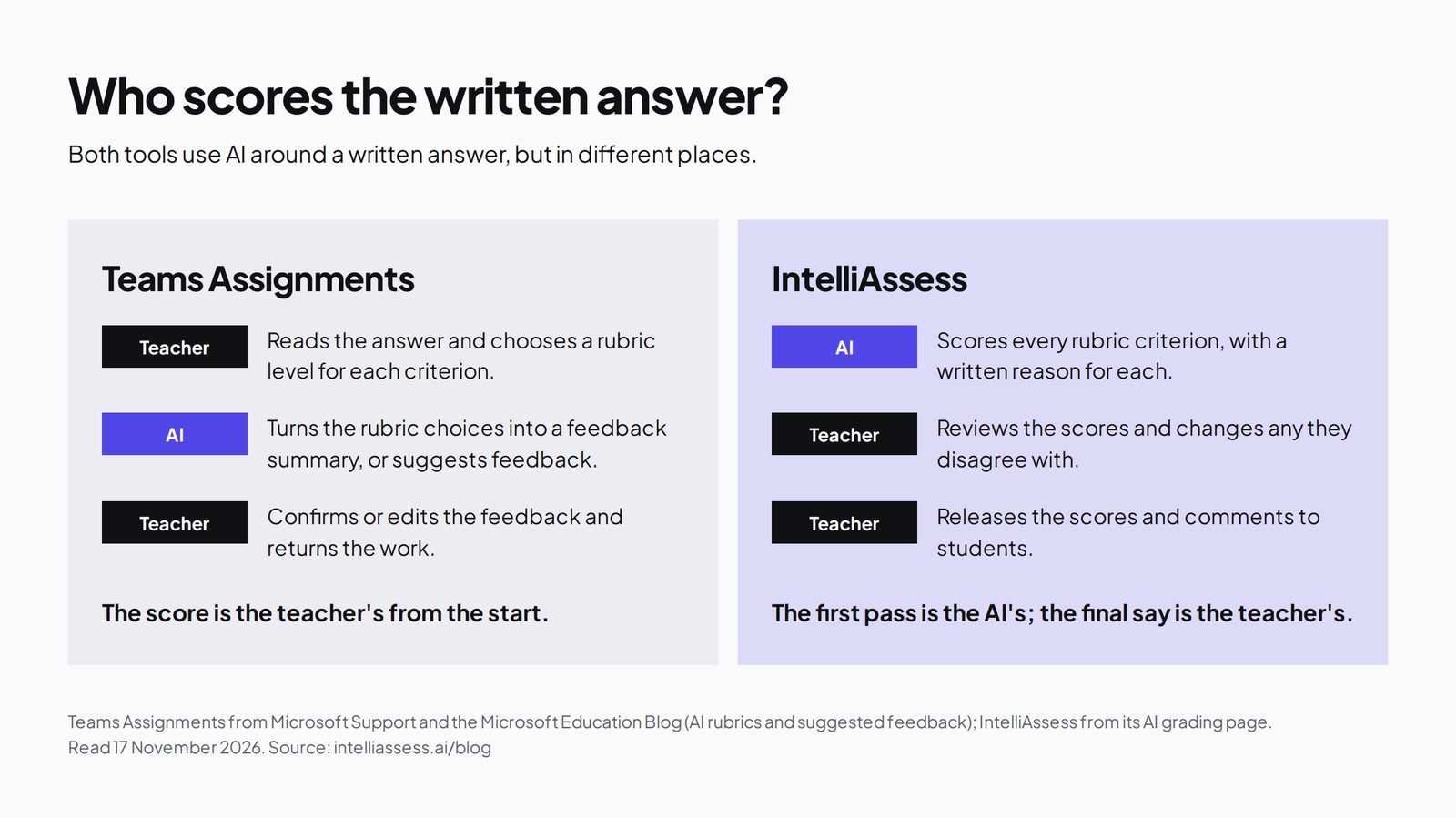
In Teams Assignments, you read each answer and choose the rubric level for each criterion. AI can then turn your rubric choices into a feedback summary, or suggest feedback for you to confirm. The score is yours from the start.
In IntelliAssess, AI reads each answer and scores every criterion of its rubric, with a written reason per criterion. You review the scores, change any you disagree with, and release them. The first pass is the AI's; the final say is yours.
For a class of 28 with two short essays each, that is 56 answers to score by hand in Teams, against 56 AI-scored answers to review in IntelliAssess. Which is better depends on how much you trust a first pass you then check, and whether the time saved matters more than staying in Teams.
One unit test, two ways
Take a history teacher with a class of 28 setting an end-of-unit test: ten choice questions and two short essays, with some students sitting it at home because of a school trip.
In Microsoft Forms and Teams, the teacher asks Teach for a quiz from the unit plan, edits the questions in Forms, and assigns it in Teams. Choice questions are marked from the answer key as students submit. For the 56 essays, the teacher opens each one in Assignments, picks a rubric level for each criterion and lets AI turn those choices into a feedback summary, confirming it before returning the work. The students at home take the quiz on trust: nothing checks who is typing or whether notes are open.
In IntelliAssess, the teacher uploads the same unit plan and slides, picks the question mix, and has a rubric drafted for each essay question. The test is shared by link in the Teams class with proctoring switched on, which matters most for the students at home: an ID and selfie check at the start, then webcam, microphone, screen and browser. When students hand in, choice questions are marked and the AI scores all 56 essays against each rubric criterion with a reason. The teacher reads through the scores, changes the ones they disagree with, checks the proctoring reports for the home group, and releases results. Then they copy the final marks into the Teams gradebook.
The trade is clear. Forms keeps everything in Teams and the teacher scores every essay. IntelliAssess moves the test outside Teams, gives the teacher a first pass to check instead of a blank rubric, and adds checks for the students at home.
What Copilot adds, and what it does not
A school considering the $18 a month Copilot add-on partly for Forms should know what it changes. Microsoft's Copilot in Forms help describes drafting a quiz inside Forms from a prompt, with optional answer explanations. That overlaps with Teach, which staff already get from their lesson files without the add-on. Neither, on the pages we read, scores written answers or adds identity or webcam checks. So if those are your gaps, Copilot does not close them, and an IntelliAssess Starter plan at $39 a month for 200 students is the closer fit. If question writing inside Forms is your only gap, try Teach first.
Where Microsoft Forms stops
- AI scoring. Assignments' AI drafts rubrics and feedback; the pages we read do not describe AI scoring written answers.
- Exams at home. The Forms and Teams quiz pages we read describe no webcam, microphone or identity checks.
- AI inside Forms. Copilot in Forms needs a Copilot licence, though Teach does not.
What IntelliAssess adds
IntelliAssess's AI quiz generator writes a test from a topic, your PDF, Word or PowerPoint files, a YouTube video or a web page, across eight question types including written answers with a marking rubric (which the rubric generator can draft), and checks every answer key in a second pass. AI grading scores each written answer against every criterion, with a comment per criterion. For exams at home, online proctoring checks identity with an ID photo, selfie and liveness check, then watches webcam, microphone, screen and browser, with a report per student.
What it does not do: connect to Microsoft Teams, import Microsoft Forms quizzes, lock the device, or run proctored tests on phones and tablets. It publishes to Google Classroom instead, so in a Teams school you share a test by link and record grades yourself.
Feature by feature
Question types
Microsoft Forms is a survey tool as well as a quiz tool, so it offers formats such as choice, text, rating, date, ranking, Likert and file upload, and in a quiz you mark the correct answer or answers and give each question points. IntelliAssess covers multiple choice, multi-select with partial credit, true or false, fill in the blanks, short answer and written (descriptive) answers with a rubric, and can mix them in one test on paid plans. It has no rating scales, rankings or file-upload answers, so it is not a survey tool.
Writing the questions
Microsoft Forms leaves question writing to you, to Teach in the Microsoft 365 Copilot app (from a description and your lesson plans, unit plans, syllabus or curriculum files, at no extra cost for staff), or to Copilot in Forms with a paid Copilot licence. IntelliAssess generates from a topic, up to 20 PDF, Word or PowerPoint files, a YouTube video or a web page on every plan, checks each answer key a second time, and drafts a rubric for written questions. You can save any question to your own library, use a verified library of ready questions, or import CSV, a PDF exam or Google Forms quizzes, but not Microsoft Forms quizzes.
Delivering the test
Microsoft Forms shares by link or, more often in schools, as a Teams assignment, so students open it from the class team they already use. IntelliAssess shares by link or publishes to Google Classroom, and on paid plans adds an exam timer, a scheduled start, shuffled questions and options, PIN-protected tests and a choice of one attempt, a set number or unlimited attempts. In a Teams school, you post the IntelliAssess link in the class team yourself.
Security
Microsoft Forms pages we read describe no identity, webcam or device lockdown for quizzes. IntelliAssess checks identity before the test (ID photo, selfie with head turns, liveness check, face match) and watches webcam, microphone, screen and browser during it, from Starter. You decide whether each event warns the student, ends the test or is only recorded, and you get a report per attempt with an integrity score and a timeline. A flag is evidence for you to review, not a verdict. Neither tool locks the device.
Marking
Microsoft Forms marks choice questions from the answer key and leaves written answers to you; in Teams Assignments you choose the rubric level for each criterion, and AI can turn your choices into feedback. IntelliAssess marks choice questions at hand-in and scores each written answer against every rubric criterion, with a comment you can change. A written question with no rubric is left "not evaluated" rather than scored zero, and ungraded answers are kept out of averages until they are marked.
Feedback to students
Microsoft Forms lets you add a message students see when they choose an answer, and Teams Assignments returns your score and feedback, with AI-suggested feedback you confirm first. Teach's practice mode lets students reveal answers and try again. IntelliAssess shows students their marks and rubric comments when you release them, and on Learning-purpose quizzes (on the Pro plan and up) can give each student AI notes per question and a short study plan with links, built from the final marks. Exam results are never shown to other students.
Results and analytics
Microsoft Forms shows a summary of responses per question, and results can be opened in Excel; Teams Assignments keeps grades in the class gradebook. IntelliAssess analytics show completion, average and median score, pass rate, time taken, a question map sorted hardest first, results by topic, difficulty and question type, proctoring events, results by student group, and PDF reports per test, per student and per submission.
Privacy
Microsoft Forms runs under your school's Microsoft 365 agreement, which your IT team already manages. IntelliAssess stores identity and evidence photos encrypted, opened only through short-lived links, and saves location only if you switch that check on. Our pages do not list certifications or data location; if your district needs them, ask us before you buy.
The student's side
Microsoft Forms is familiar to students in Microsoft schools and signs them in with their school account inside Teams. IntelliAssess students open the test from a link or from Classroom; schools can also add students by email, or by nickname and PIN for younger students without email. Students get a progress page with their scores over time, results by question type and rubric criterion, and a PDF of their own results. Proctored tests need a laptop or desktop with a webcam, which rules out phones and tablets for those tests.
Teachers working together
Microsoft Forms lets you share a form with colleagues to collaborate on it, and Teams classes can have several teachers. IntelliAssess has team workspaces on the Pro plan and up, with five roles (Viewer, TA or grader, Teacher, Admin and Owner), shared question-library categories and an activity feed showing who changed what. A TA can review AI scores and change grades without being able to delete the test.
Where Microsoft Forms is better
- Already paid for, with nothing new for students or IT.
- Inside Teams, so assignments, grades and feedback stay where students already are.
- Any device, including phones and tablets.
- Surveys as well as quizzes, with rating, ranking and Likert questions and results in Excel.
- Free AI question writing for staff through Teach, from your own lesson files.
Where IntelliAssess is better
- Written answers scored for you against a rubric, with a reason per criterion you can change.
- Identity and webcam checks for tests sat at home on personal laptops.
- Tests from more sources, including YouTube videos and web pages, on every plan.
- Deeper analytics, from a question map to results by topic and student group.
- Arabic questions, rubrics and feedback, right to left.
Using both together
You do not have to replace Forms to use IntelliAssess. A practical way is to split the work:
- Forms for daily checks: exit tickets, homework quizzes and anything an answer key marks, assigned in Teams.
- IntelliAssess for the tests that matter: end-of-unit tests with written answers, and exams sat at home where you need to know who took them.
- One place for students to start: post the IntelliAssess link as a Teams assignment or channel message, so students still begin in Teams. Because there is no Teams grade sync, enter the final marks in your Teams gradebook yourself.
Questions to ask before switching
- Does our Microsoft 365 licence include Teach for staff, and has IT switched it on?
- Do any teachers already have a Copilot licence, so Copilot in Forms is available?
- How many hours a week go on marking written answers?
- Do students sit tests at home on their own laptops, or in class on school devices?
- Are teachers willing to work outside Teams for some tests?
- Does our district need specific privacy terms or certifications from a new tool?
Pricing
Microsoft Forms comes with Microsoft 365 accounts, including school accounts, and Teach and Assignments' AI rubrics and feedback are included with academic licences. Copilot in Forms needs the Microsoft 365 Copilot add-on, which Microsoft priced at $18 per user per month for education from December 2025.
IntelliAssess publishes its prices: Free for 25 students, Starter $39 a month for 200, Pro $99 for 500 and Intensive $249 for 2,000, with yearly billing at ten months. AI question writing is on every plan; AI grading of written answers and proctoring start on Starter.
Choose Microsoft Forms if
- Your school runs on Teams and teachers need everything inside Assignments.
- Your quizzes are mostly choice questions an answer key can mark.
- Teach already writes the quizzes you need, and you are happy to score written answers yourself.
- Students take quizzes on phones or tablets.
Choose IntelliAssess if
- Scoring short answers and essays takes your evenings and you want an AI first pass you can check.
- Students sit tests at home and you need to know who took them.
- You can share tests by link outside Teams, or your school also uses Google Classroom.
- You teach in Arabic and want questions, rubrics and feedback in Arabic.
Comparing more tools? See Microsoft Forms alternatives, scored on seven published facts, or every comparison. For departments, see IntelliAssess for schools.
Frequently asked questions
Is IntelliAssess a Microsoft Forms alternative?
Yes, for tests rather than quick quizzes: AI scoring of written answers against a rubric and identity and webcam proctoring. It works with Google Classroom, not Microsoft Teams.
Can Microsoft Forms grade essays with AI?
Not on its own. In Teams Assignments, AI can create a rubric and suggest feedback that you confirm, but you score the work. IntelliAssess's AI scores each criterion and you can change any score.
Does Microsoft Forms have AI quiz generation?
Yes. Teach generates a Forms quiz from your lesson files for staff with Microsoft 365 for Education, without a paid Copilot licence. Copilot inside Forms needs a Copilot licence.
Does IntelliAssess work with Microsoft Teams?
No. IntelliAssess has no Teams integration; you share tests by link. It publishes to Google Classroom and syncs grades there.
Can Microsoft Forms stop cheating in exams at home?
The Forms and Teams quiz pages we read describe no webcam, microphone or identity checks. IntelliAssess adds those on any laptop or desktop.
How much does Copilot in Forms cost for schools?
Microsoft priced the Microsoft 365 Copilot academic add-on at $18 per user per month from December 2025. Teach and Assignments' AI rubric and feedback tools are included with academic licences.
Can I import Microsoft Forms quizzes into IntelliAssess?
No. IntelliAssess imports Google Forms quizzes, CSV files and PDF exams, but not Microsoft Forms. Upload the lesson files the quiz was based on and it will write a new test you can edit.
Can students take IntelliAssess tests on an iPad?
Unproctored tests open by link in a browser. Proctored tests need a laptop or desktop with a webcam, so phones and tablets are not supported for those.
How do I get IntelliAssess grades into Teams?
There is no automatic sync. Enter the final marks in the Teams gradebook yourself, or download the PDF reports per test or per student to keep alongside them.
Is IntelliAssess harder for students than Microsoft Forms?
For an unproctored test, students open a link and answer, much as in Forms. Proctored tests add an ID and selfie check before starting and need a laptop or desktop with a webcam, so tell students in advance and let them try a practice test first.
Can I keep my rubrics from Teams Assignments?
There is no import from Teams. You can type your criteria into IntelliAssess or have its rubric generator draft one and edit it to match the rubric you already use.
Keep reading
All articles
Read next
SchoolAI alternatives: 7 AI tools for teachers and students scored (2026)
Seven AI tools scored on the same nine facts, with SchoolAI as the reference, and what each lets teachers see when students use AI.
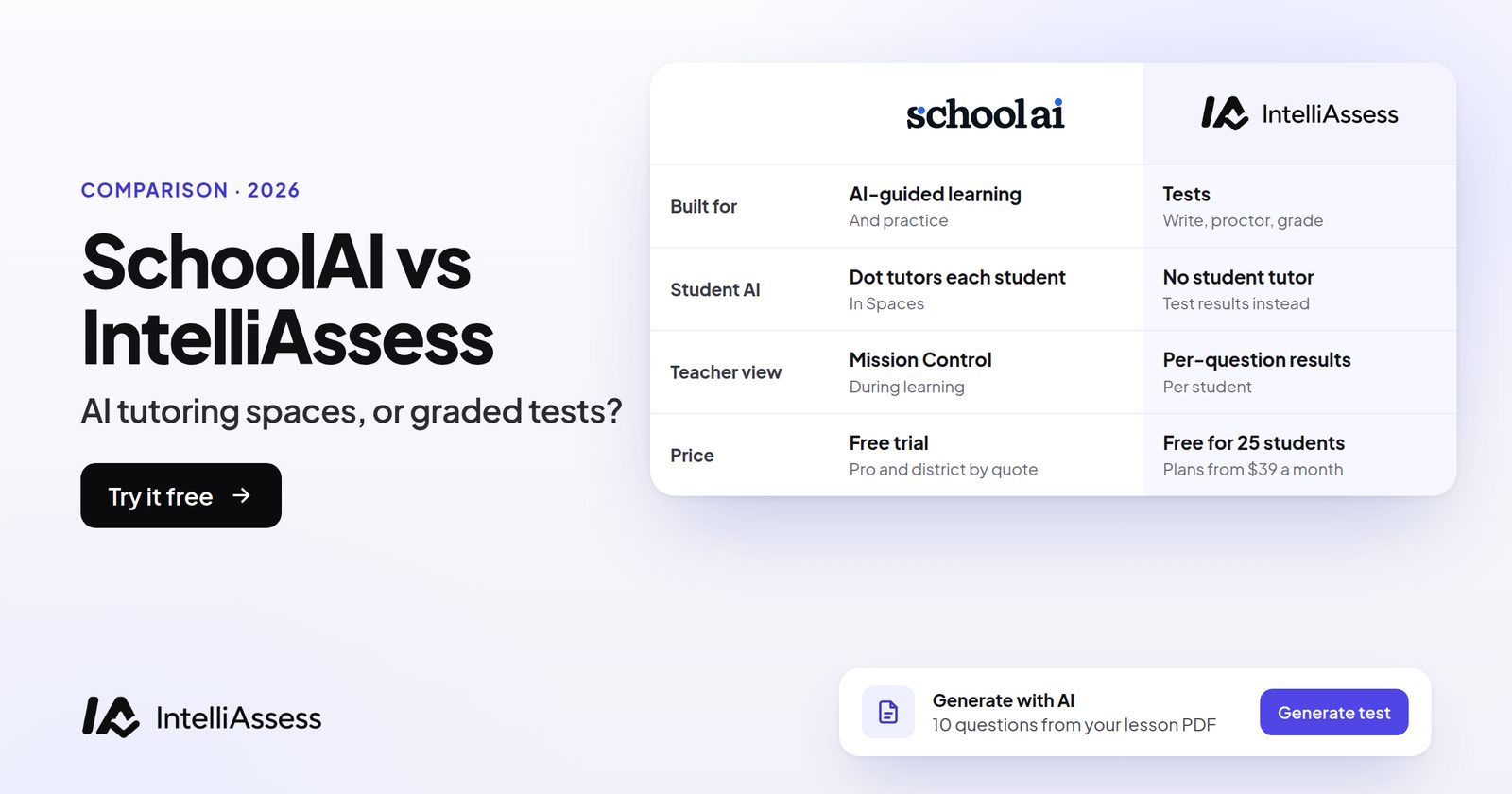
SchoolAI vs IntelliAssess: an AI tutor for students or feedback after a test?
SchoolAI puts students in supervised conversation with AI; IntelliAssess marks their tests and uses AI to help them learn from their own answers.
Motasem Aldiab 12 min read
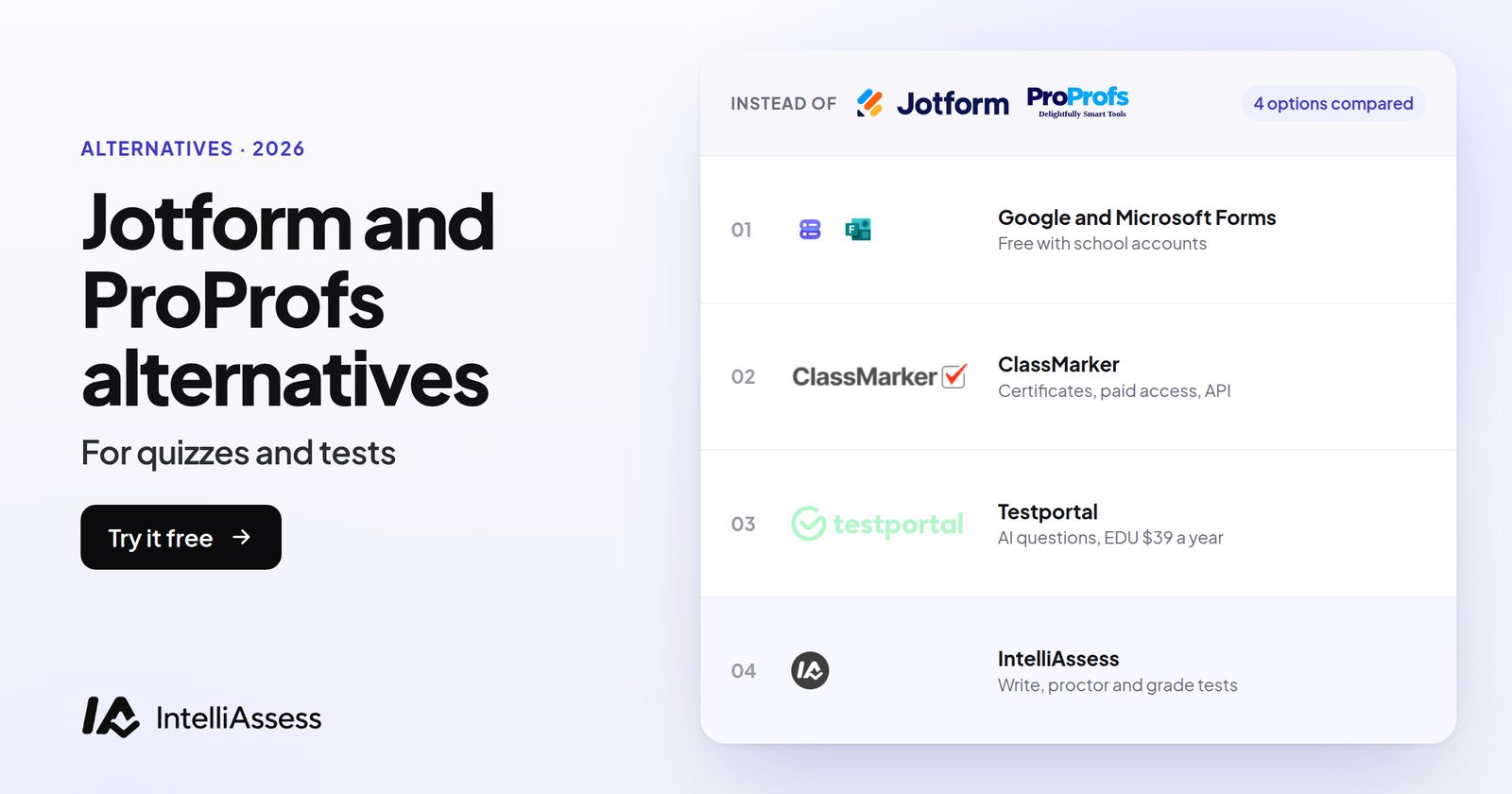
Jotform and ProProfs alternatives for quizzes and exams (2026)
Jotform and ProProfs side by side, then the alternatives by forms, certificates or real exams.
Motasem Aldiab 2 min read