
CoGrader vs IntelliAssess: an essay grader or a whole-test platform?

By Motasem Aldiab, Technology Consultant and Trainer - Cloud, DevOps, Java, Data Science
Contents25
- The short answer
- Why the two are compared at all
- CoGrader vs IntelliAssess at a glance
- What CoGrader is
- What IntelliAssess is
- Feature by feature
- Rubrics
- Getting the writing in
- Feedback to students
- Integrity
- Building the test
- Results
- Languages
- One term, two ways
- Two kinds of trust
- How far to trust the AI score
- A closer look at CoGrader's accuracy study
- What students see
- Getting consistent AI scores in IntelliAssess
- Student data
- Pricing
- The cost over a school year
- Questions to ask before choosing
- Choose CoGrader if
- Choose IntelliAssess if
Key takeaways
- 1CoGrader is free for 150 submissions a month; Individual is $15 a month billed annually.
- 2CoGrader reads handwriting and offers 500+ state-standard rubrics; IntelliAssess does neither.
- 3CoGrader's own report, not peer reviewed, finds 98.3% of scores within one point of Texas raters.
- 4IntelliAssess writes and proctors the test too, and scores written answers inside it.
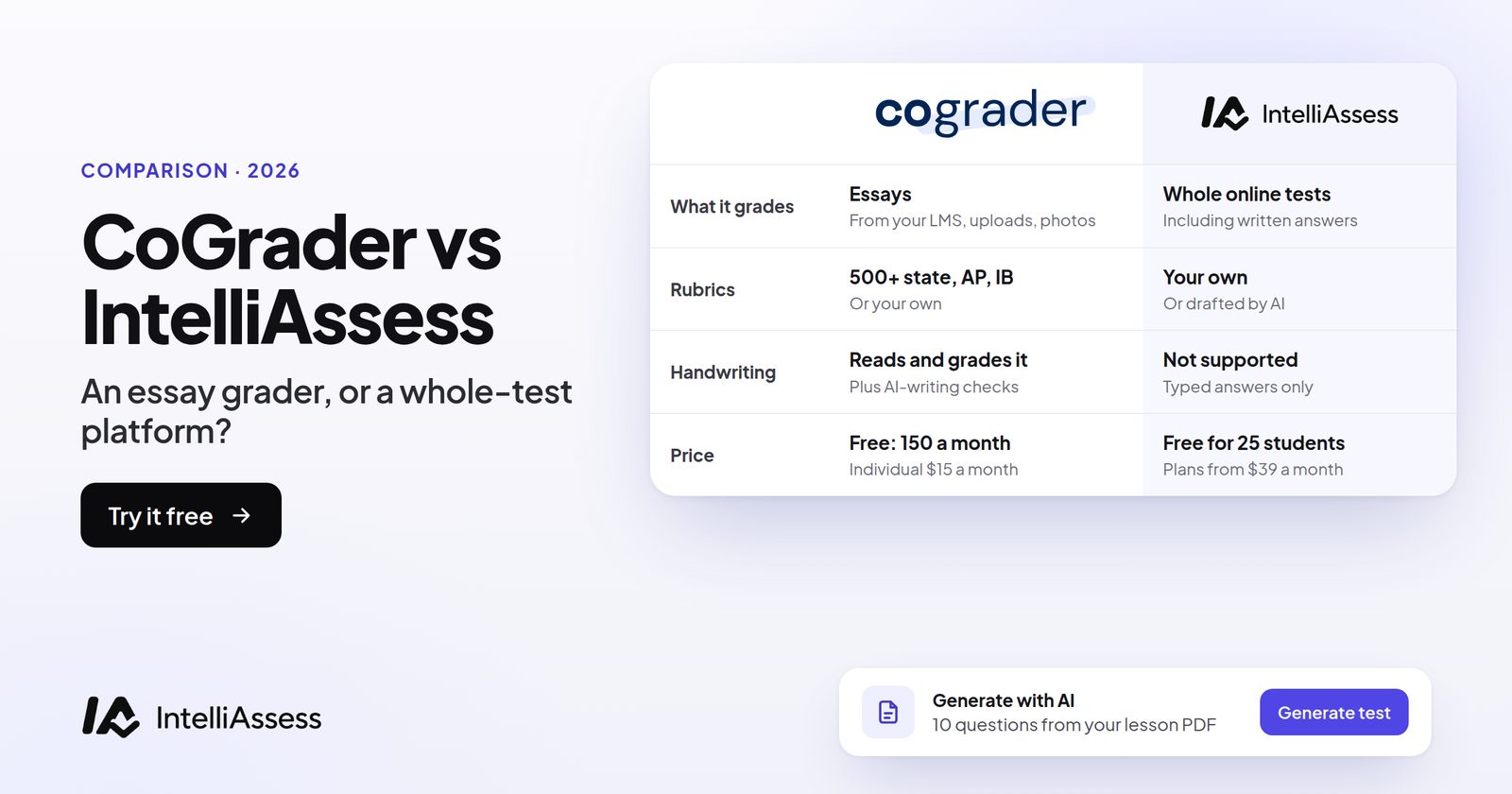
CoGrader vs IntelliAssess compares a specialist AI essay grader with an assessment platform that scores written answers as one part of the whole test. CoGrader grades essays from Google Classroom, uploads or photos of handwriting against your rubric or 500+ state, AP and IB rubrics, with AI and plagiarism checks on paid plans, free for 150 submissions a month. IntelliAssess writes the test from your material, proctors it, and scores written answers against your rubric at hand-in, from $39 a month. If the writing happens outside a test, CoGrader is the better tool; if it happens inside tests you set, IntelliAssess covers more of the job.
The short answer
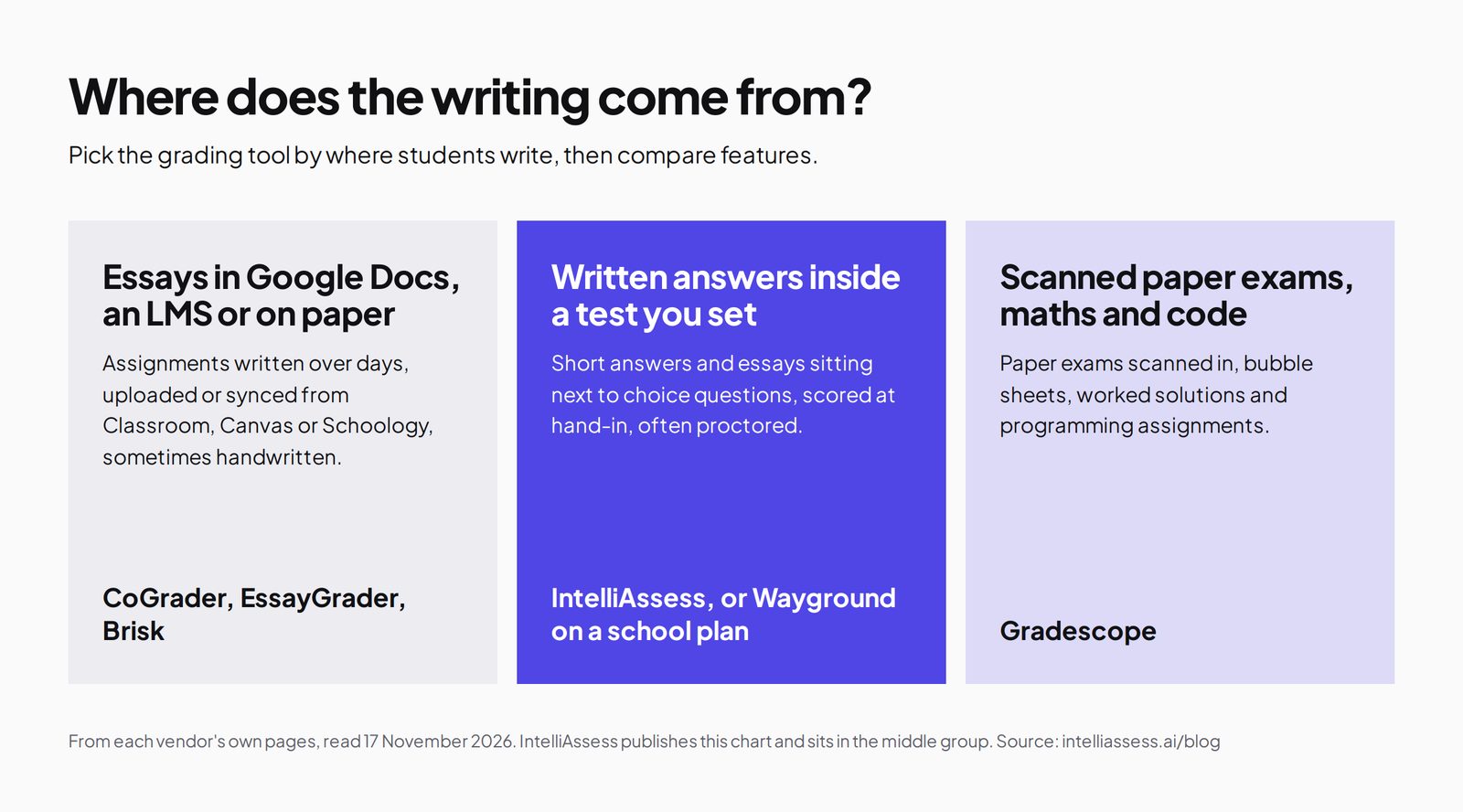
Choose CoGrader if your marking load is essays: written in Google Docs, your LMS or on paper, graded against state or AP rubrics, with grammar, plagiarism and AI-writing checks. Choose IntelliAssess if you set tests that mix question types, want the test written for you from your material, and need it proctored, with written answers scored in the same place.
Why the two are compared at all
Teachers search for a CoGrader alternative for different reasons, and only some of them lead to IntelliAssess. If the essays themselves are the problem (too many, too long, handwritten, or graded against a state rubric), another essay grader such as EssayGrader is the closer swap. IntelliAssess comes into the picture when the written answers are part of tests: a unit test with twenty choice questions and two short responses, a quiz with one explain-your-reasoning question, or an exam sat at home where you also need to know who is answering.
In that situation, an essay grader handles only part of the work. The test still has to be written, delivered, marked for its choice questions and, sometimes, supervised. IntelliAssess does all of that in one place, and CoGrader does none of it, because it is built for something else. This page compares them on that basis rather than pretending they are the same kind of tool.
CoGrader vs IntelliAssess at a glance
| CoGrader | IntelliAssess | |
|---|---|---|
| What it grades | Essays from Google Classroom, uploads (PDF, DOCX) or photos of handwriting | Every answer in its own online tests, including written answers |
| Rubrics | Your own, or 500+ from state standards, plus AP and IB | Your own, or drafted by its rubric generator |
| Handwriting | Reads it and sorts pages by student, on the free plan | No |
| AI-writing and plagiarism checks | Individual plan (its FAQ says school and district plans) | No text checks; proctoring watches the screen for AI tools during a test |
| Creates tests | Not described | Yes, from files, YouTube or web pages, 8 question types |
| Proctoring | Not described | ID and liveness check, webcam, microphone, screen, browser |
| Integrations | Google Classroom (two-way); Canvas and Schoology; file export for others | Google Classroom |
| Published accuracy | 98.3% within one point of state raters (own report, not peer reviewed) | No published study |
| Arabic | Not stated on the pages we read | Writes and grades in Arabic, right to left |
| Price | Free for 150 submissions a month; Individual $15 a month billed annually | Free for 25 students; AI grading from $39 a month |
What CoGrader is
CoGrader grades essays against your rubric or its library of 500+ state-standard rubrics, naming Texas STAAR, New York Regents, CCSS, TEKS, Florida B.E.S.T., California Smarter Balanced, AP and IB. You upload PDFs, Word files or photos of handwriting, or sync with Google Classroom; it "reads the handwriting, sorts the pages by student" and grades each essay, and you export a gradebook CSV. It says teachers "still review every score and comment before students see it".
On accuracy, its October 2026 technical report, which it labels "not peer reviewed", found scores "within one point of official TEA raters in 98.3% of cases" across 1,764 Texas STAAR responses. It is research-funded through a US Department of Education award, which it describes as "research funding, not an endorsement".
What IntelliAssess is
IntelliAssess runs the whole test. Its AI quiz generator writes questions from your PDF, Word or PowerPoint files, a YouTube video or a web page across eight types, and its rubric generator drafts criteria for each written question. Students take the test online, optionally with proctoring. Choice questions are marked at hand-in, and AI grading scores each written answer against every criterion with a comment you can change before students see it. Grades and criterion scores sync to Google Classroom.
What it does not do: grade essays written elsewhere, read handwriting, use state-standard rubric libraries, or check text for plagiarism or AI writing.
Feature by feature
Rubrics
CoGrader starts from a library of 500+ rubrics built from state standards, naming Texas STAAR, New York Regents, CCSS, TEKS, Florida B.E.S.T. and California Smarter Balanced, plus AP and IB, or your own rubric. For a teacher preparing students for a state writing test, that saves the work of rebuilding the official rubric. IntelliAssess uses your own criteria, or drafts them with its rubric generator for each written question, and you edit them before the test. It has no state library, so a STAAR-aligned rubric is one you enter yourself.
Getting the writing in
CoGrader takes essays from Google Classroom (two-way), Canvas and Schoology, or from uploaded PDF and Word files and photos of handwriting, which it reads and sorts by student, even on the free plan. IntelliAssess only grades answers typed into its own tests. A student's essay in Google Docs, or a handwritten page, is outside its reach.
Feedback to students
CoGrader drafts a score and comments per essay, which the teacher reviews before students see them, and its Individual plan adds grammar checking. IntelliAssess drafts a score and a comment for every criterion of the rubric, which the teacher can change before releasing results. On Learning-purpose quizzes, on the Pro plan and up, it can also give each student AI notes per question and a short study plan with links, built from the final marks.
Integrity
CoGrader checks the submitted text for AI writing and plagiarism on its paid plans; its pricing page puts this on Individual, while its FAQ mentions school and district plans, so ask which applies. IntelliAssess does not check text. It supervises the writing instead: an ID and selfie check before a proctored test, then webcam, microphone, whole-screen and browser checks during it, with a report per attempt. One judges the product; the other watches the process.
Building the test
CoGrader does not describe writing questions or building tests. IntelliAssess writes questions from your PDF, Word or PowerPoint files, a YouTube video or a web page across eight types, checks each answer key in a second pass, and lets you mix choice and written questions in one test, with timers, scheduled starts, shuffling and attempt limits on paid plans.
Results
CoGrader exports a gradebook CSV, syncs grades back through its integrations, and its Individual plan includes a class dashboard. IntelliAssess analytics show completion, average and median score, pass rate, a question map sorted hardest first, results by topic and question type, and results by rubric criterion, with PDF reports per test, per student and per submission. Grades and criterion scores sync to Google Classroom.
Languages
CoGrader's pages we read do not mention languages other than English. IntelliAssess writes questions, rubrics and feedback and grades written answers in Arabic as well as English, with right-to-left display.
One term, two ways
Take an eighth-grade English teacher in Texas with four classes of 30. Over a term they set three STAAR-style practice essays and four unit tests, each test with fifteen choice questions and two short constructed responses.
With CoGrader, the three practice essays go through Google Classroom: 360 essays graded against the STAAR rubric from the library, with handwritten drafts photographed and read, and AI-writing checks on the Individual plan. The four unit tests are built and marked elsewhere, perhaps in Google Forms, where the 960 short responses (120 students, two per test, four tests) are marked by hand.
With IntelliAssess, the four unit tests are written from the teacher's slides, delivered online and marked at hand-in, with the 960 short responses scored against a rubric for the teacher to review. A test sat at home can be proctored. The practice essays are the hard part: IntelliAssess can only grade them if students write them as a long answer inside a test, and it has no STAAR rubric ready, so the teacher would enter it.
With both, CoGrader takes the essays and IntelliAssess the tests, and both send grades to Google Classroom. For this teacher that split is probably the best fit, at $15 a month (CoGrader Individual, billed annually) plus $39 (IntelliAssess Starter), or less if the free CoGrader plan's 150 submissions a month is enough.
Two kinds of trust
Teachers usually ask two questions of an AI grader: is the score right, and is the work the student's own? CoGrader answers the first with a published study and the second with text checks. IntelliAssess has no published accuracy study; it answers the first by showing a reason for every criterion so you can check it quickly, and the second by supervising the test. Neither approach is complete. A vendor study on standardised state essays does not prove accuracy on your prompt, and supervision only covers writing done inside the test. Check a sample of scores against your own marking in the first weeks with either tool, and keep checking a few each time you change the prompt or the rubric.
How far to trust the AI score
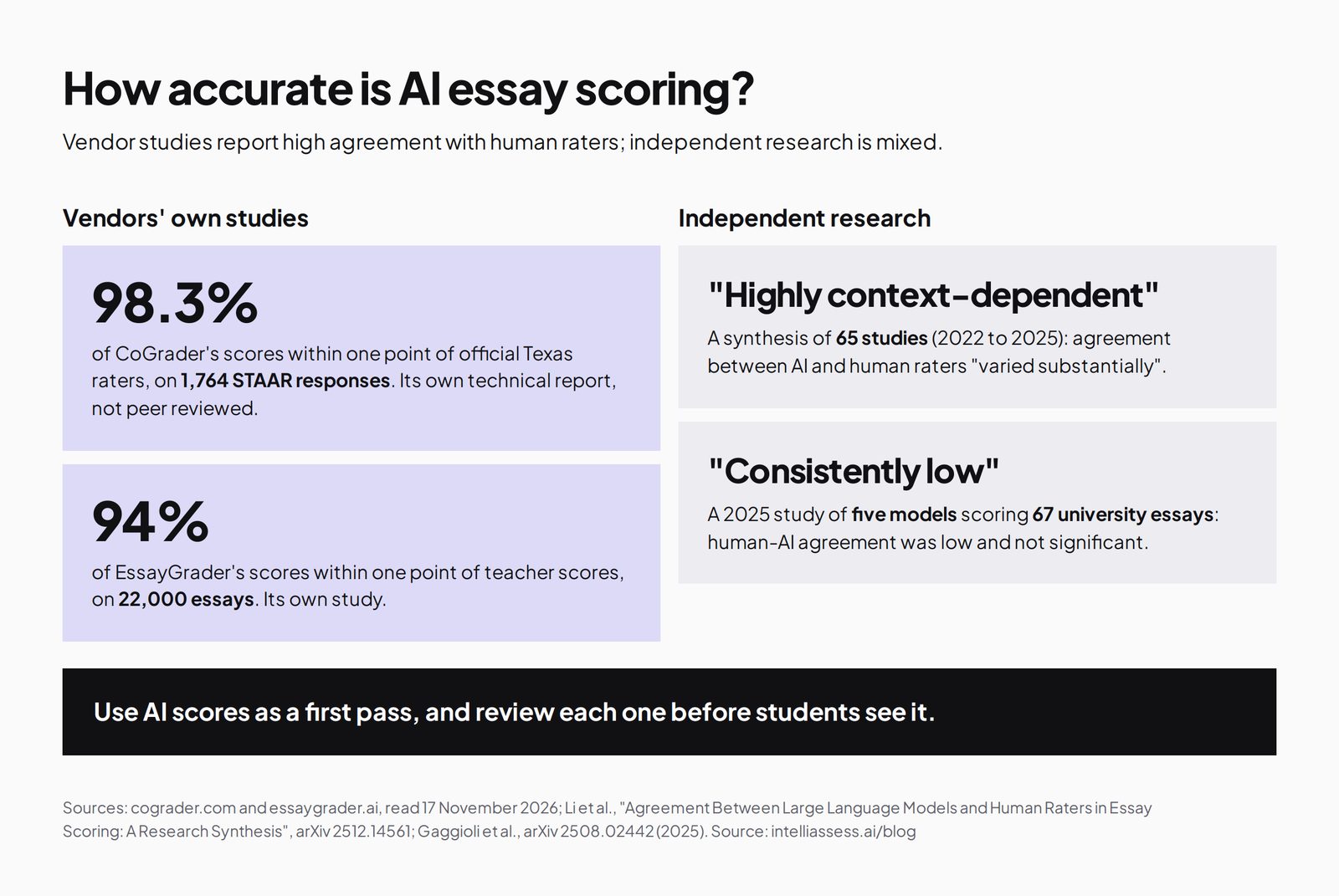
CoGrader's 98.3% comes from its own study on standardised state-test essays. Independent research is more mixed: a synthesis of 65 studies found agreement between AI and human raters "highly context-dependent", and a 2025 university study found it "consistently low" for five models. Both tools keep the teacher in charge; use either as a first pass and check each score.
A closer look at CoGrader's accuracy study
CoGrader's October 2026 technical report compared its scores with those of official Texas Education Agency raters on 1,764 STAAR responses, and found them within one point in 98.3% of cases. Three things are worth knowing when you read that figure. First, CoGrader itself labels the report "not peer reviewed". Second, STAAR essays are written to set prompts and scored with a fixed rubric by trained raters, which is close to the best case for any automated scorer; your own prompts and rubric may behave differently. Third, "within one point" on a short scale is a looser test than exact agreement. None of that makes the figure wrong; it makes it a starting point. CoGrader also notes that its research funding comes through a US Department of Education award and describes that as "research funding, not an endorsement".
IntelliAssess has not published an accuracy study, so there is no equivalent number to compare. What it offers instead is a reason for each criterion score, which makes disagreements quick to spot and fix.
What students see
With CoGrader, students see the score and comments their teacher has reviewed and released, usually back in Google Classroom, Canvas or Schoology alongside the assignment. With IntelliAssess, students see their marks and a comment for each rubric criterion when the teacher releases results. They also get a progress page with their scores over time and by rubric criterion, and a PDF of their own results; they never see other students' scores. Younger students without email can join with a nickname and PIN.
Getting consistent AI scores in IntelliAssess
Because IntelliAssess has no state library, the quality of its scores depends on the rubric you give it. Write one idea per criterion, describe each level in terms you could point to in an answer, and keep the number of levels small. A written question with no rubric is left "not evaluated" rather than scored zero, and ungraded answers stay out of class averages until they are marked, so a missing rubric never silently lowers a student's result. Before using it on a full class, run five answers you have already marked through the rubric and adjust any criterion where the AI and you disagree.
Student data
Both tools process student writing, and IntelliAssess's proctoring also collects identity photos. IntelliAssess stores identity and evidence photos encrypted, opens them only through short-lived links, and records location only if you switch that check on. Our pages do not list certifications or data location, so ask us if your district needs them. We did not compare CoGrader's privacy terms for this page; ask it whether student work is used to train models, how long it is kept, and whether it has a data-privacy agreement with your district.
Pricing
CoGrader's Starter plan is free for up to 150 student submissions a month. Individual is $15 a month billed annually or $19 monthly, for 350 submissions with grammar checking, AI and plagiarism detection and a class dashboard. Schools and districts are priced by size; higher education and enterprise are custom.
IntelliAssess's plans are sized by students: Free for 25, Starter $39 a month for 200, Pro $99 for 500, Intensive $249 for 2,000. AI grading and proctoring start on Starter. For essays alone, CoGrader costs less; IntelliAssess's price also covers writing, delivering and proctoring the test.
The cost over a school year
Billed yearly, CoGrader Individual is $180 a year ($15 a month) for 350 submissions a month, and IntelliAssess Starter is $390 a year (ten months at $39) for up to 200 students. A teacher who only needs essays graded, and stays under 150 submissions a month, pays nothing for CoGrader. A teacher who needs tests written, proctored and marked pays $390 for IntelliAssess, whatever the number of tests. A teacher who wants both pays $570 a year for the two together, or $390 if CoGrader's free plan covers the essays. School and district pricing for CoGrader is quoted by size; IntelliAssess's larger plans are published at $99 and $249 a month.
Questions to ask before choosing
- Where do my students write: in Google Docs and on paper, or inside tests I set?
- Do I need a state, AP or IB rubric ready-made, or do I mark against my own?
- Is handwriting part of my marking load?
- Is AI-written work a concern for take-home essays, or for tests sat at home?
- How many submissions a month: under CoGrader's free 150, or more?
- Do I also need tests written and proctored, or only marked?
Choose CoGrader if
- Most of your marking is essays, including handwritten ones.
- You grade against STAAR, Regents, AP or IB rubrics.
- You want plagiarism and AI-writing checks with the grade.
- Students already write in Google Classroom, Canvas or Schoology.
Choose IntelliAssess if
- Your tests mix choice questions and written answers, and you want all of it marked in one place.
- You want the test written from your material, not only graded.
- Students sit tests at home and you need identity and webcam checks.
- You teach in Arabic.
Comparing more tools? See CoGrader and EssayGrader alternatives, EssayGrader vs IntelliAssess, or every comparison.
Frequently asked questions
Is IntelliAssess an alternative to CoGrader?
For tests, yes; for essays written elsewhere, CoGrader is the specialist. IntelliAssess writes, proctors and grades whole tests, including written answers against your rubric.
How much does CoGrader cost?
On 17 November 2026: free for 150 submissions a month; Individual $15 a month billed annually ($19 monthly) for 350; schools and districts priced by size.
Can CoGrader grade handwritten essays?
Yes. It reads handwriting from photos or PDFs, sorts pages by student and grades each essay, on its free plan. IntelliAssess grades only answers typed into its own tests.
How accurate is CoGrader?
Its own technical report, not peer reviewed, found scores within one point of official Texas raters in 98.3% of 1,764 STAAR responses. Teachers still review every score.
Does IntelliAssess detect AI-written answers?
It does not check text for AI writing. Its proctoring watches the whole screen during a test for AI tools and chat apps.
Can I use CoGrader and IntelliAssess together?
Yes. Use CoGrader for essays written in Google Docs, your LMS or on paper, and IntelliAssess for tests that mix choice questions and written answers. Both send grades to Google Classroom, so students see one gradebook.
Does IntelliAssess have STAAR or Regents rubrics?
No. IntelliAssess has no state rubric library; you enter your own criteria or let its rubric generator draft them. CoGrader lists 500+ state-standard rubrics, including STAAR and Regents.
Which is better for a teacher with 150 students?
For essays alone, CoGrader: its free plan covers 150 submissions a month, and Individual covers 350 for $15 a month billed annually. For tests with written answers, IntelliAssess Starter covers 200 students for $39 a month, however many tests they take.
Does CoGrader build tests or quizzes?
Its pages we read do not describe building tests; it grades essays you assign elsewhere. IntelliAssess writes tests from your files, a YouTube video or a web page, and marks them, including written answers.
Does CoGrader work with Canvas?
Yes. CoGrader lists Canvas and Schoology alongside its two-way Google Classroom integration, with file export for other systems. IntelliAssess works with Google Classroom only.
Does CoGrader read handwritten essays on the free plan?
Yes. CoGrader says its free plan reads handwriting from photos or PDFs and sorts the pages by student, within the 150 submissions a month. IntelliAssess does not read handwriting; students type their answers into the test.
Which tool gives students more detailed feedback?
Both draft comments for the teacher to review. IntelliAssess gives a score and comment for each rubric criterion, and on Learning-purpose quizzes on Pro and up, a short study plan built from the final marks. CoGrader adds grammar checking on its Individual plan, which helps most with long essays where spelling and punctuation errors are common.
Keep reading
All articles
Read next
SchoolAI alternatives: 7 AI tools for teachers and students scored (2026)
Seven AI tools scored on the same nine facts, with SchoolAI as the reference, and what each lets teachers see when students use AI.
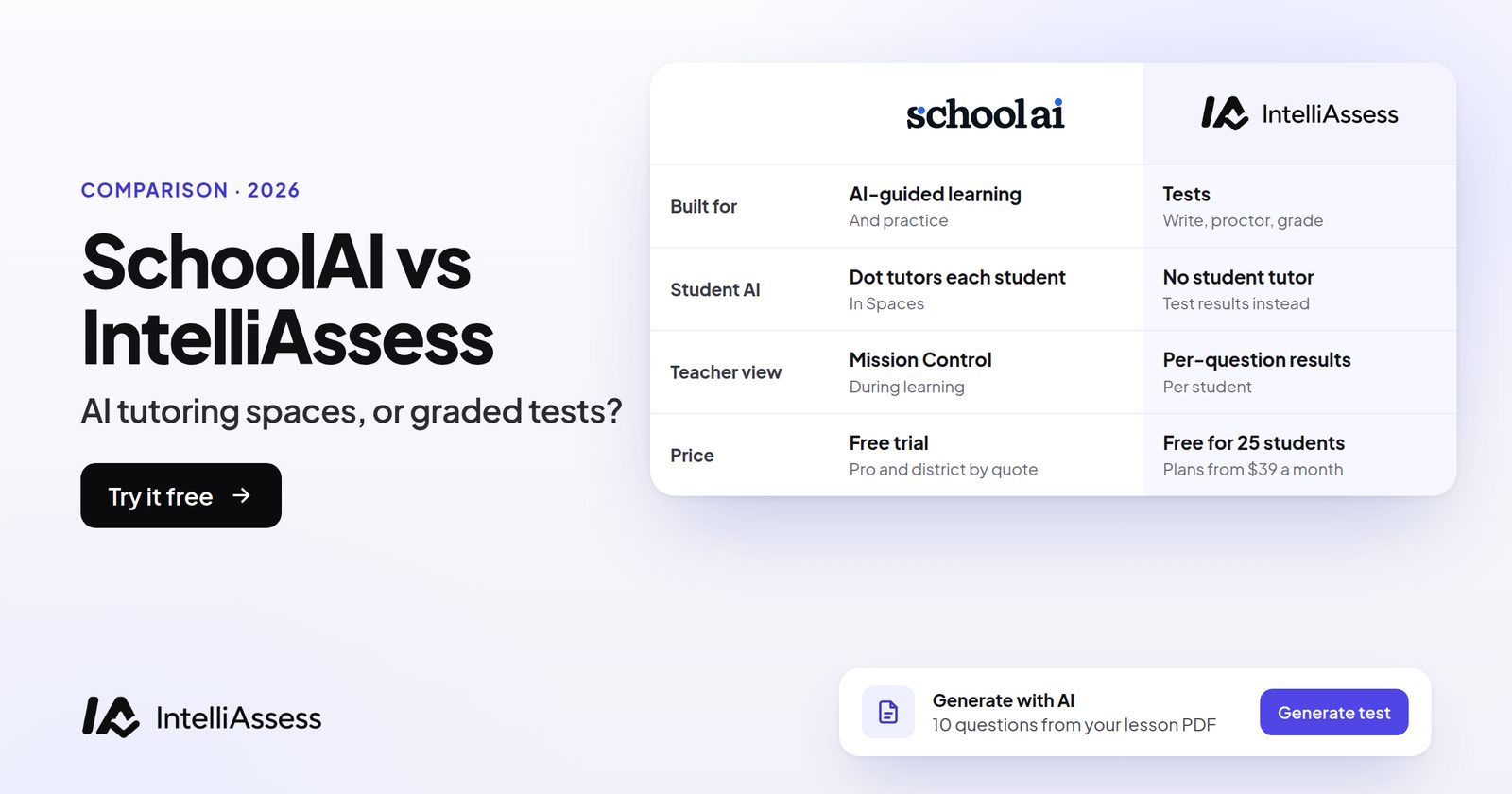
SchoolAI vs IntelliAssess: an AI tutor for students or feedback after a test?
SchoolAI puts students in supervised conversation with AI; IntelliAssess marks their tests and uses AI to help them learn from their own answers.
Motasem Aldiab 12 min read
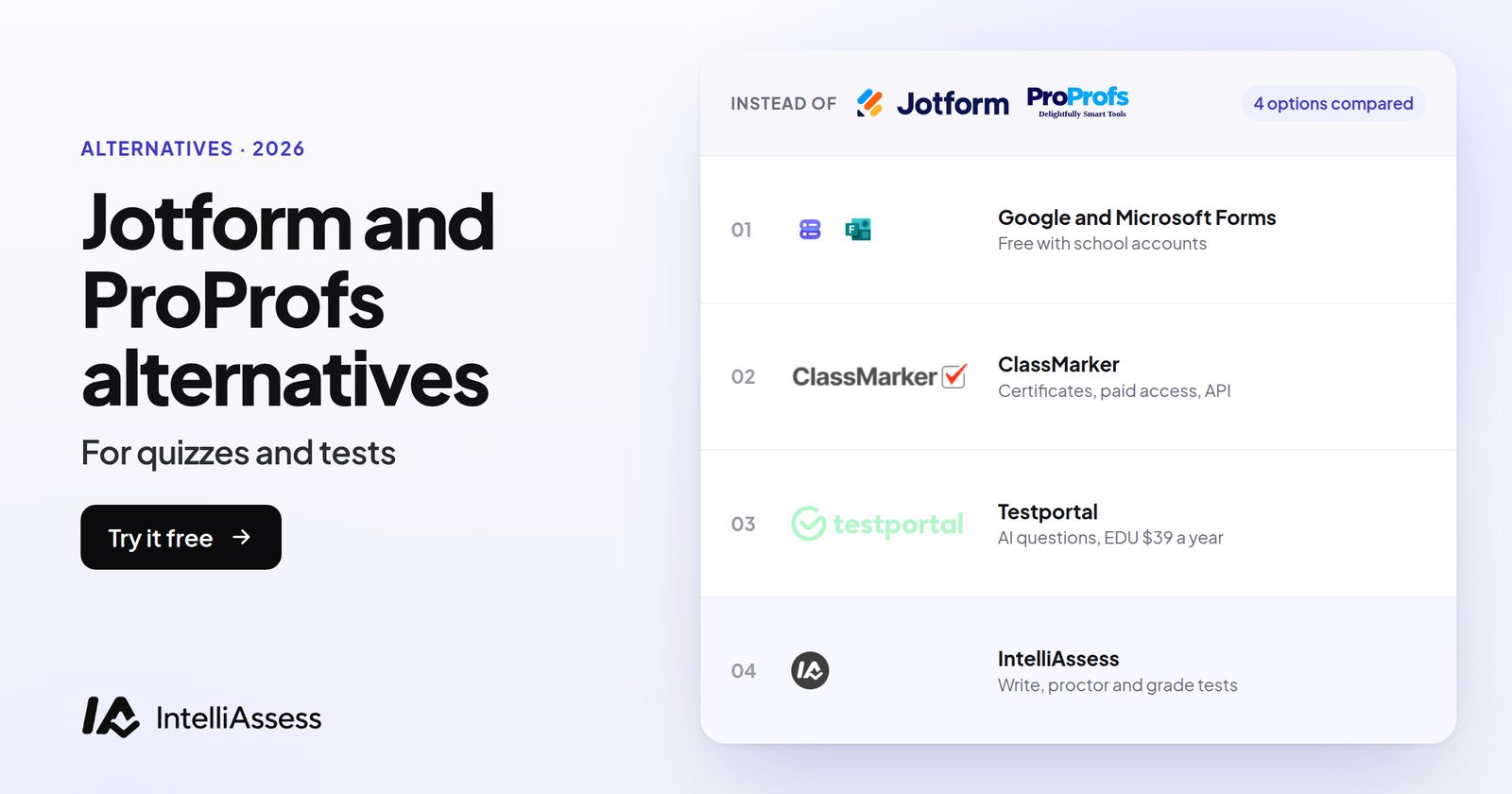
Jotform and ProProfs alternatives for quizzes and exams (2026)
Jotform and ProProfs side by side, then the alternatives by forms, certificates or real exams.
Motasem Aldiab 2 min read