
CoGrader and EssayGrader alternatives: AI grading tools compared (2026)

By Motasem Aldiab, Technology Consultant and Trainer - Cloud, DevOps, Java, Data Science
Contents19
- Where does the writing come from?
- CoGrader vs EssayGrader
- Prices side by side
- What a month of essays costs one teacher
- The scorecard: 7 tools on 7 published facts
- 1. EssayGrader: the largest rubric library
- 2. CoGrader: the most generous free plan
- 3. Brisk: feedback inside Google Docs
- 4. MagicSchool: writing feedback in a teacher toolkit
- 5. Wayground: AI grading on school plans
- 6. IntelliAssess: written answers inside tests you set
- 7. Gradescope: scanned exams, maths and code
- How accurate is AI essay grading?
- How to write a rubric AI can use well
- Which tool for which teacher
- Student data: what to ask before you upload
- AI-writing checks: what they can and cannot tell you
- What to check in a free trial
- How to choose
Key takeaways
- 1CoGrader and EssayGrader are each other's closest alternatives.
- 2Brisk drafts feedback inside Google Docs; MagicSchool and Wayground add writing feedback to wider toolkits.
- 3IntelliAssess scores written answers inside tests you set, not essays written elsewhere.
- 4Vendor accuracy figures are high; independent research finds AI-human agreement varies widely.
The best CoGrader and EssayGrader alternatives are each other: both grade essays from Google Classroom, Canvas, Schoology or scanned paper against your rubric or hundreds of state, AP and IB rubrics, read handwriting, and add AI-writing and plagiarism checks on paid plans. Beyond those two, Brisk drafts feedback inside Google Docs, MagicSchool and Wayground add AI writing feedback to broader teacher toolkits, IntelliAssess scores written answers inside tests you set, and Gradescope suits scanned paper exams. Below, seven tools are scored on the same seven published facts, with what research says about AI essay scoring.
Where does the writing come from?
The question that decides the tool is not which AI is better but where the students' writing lives.
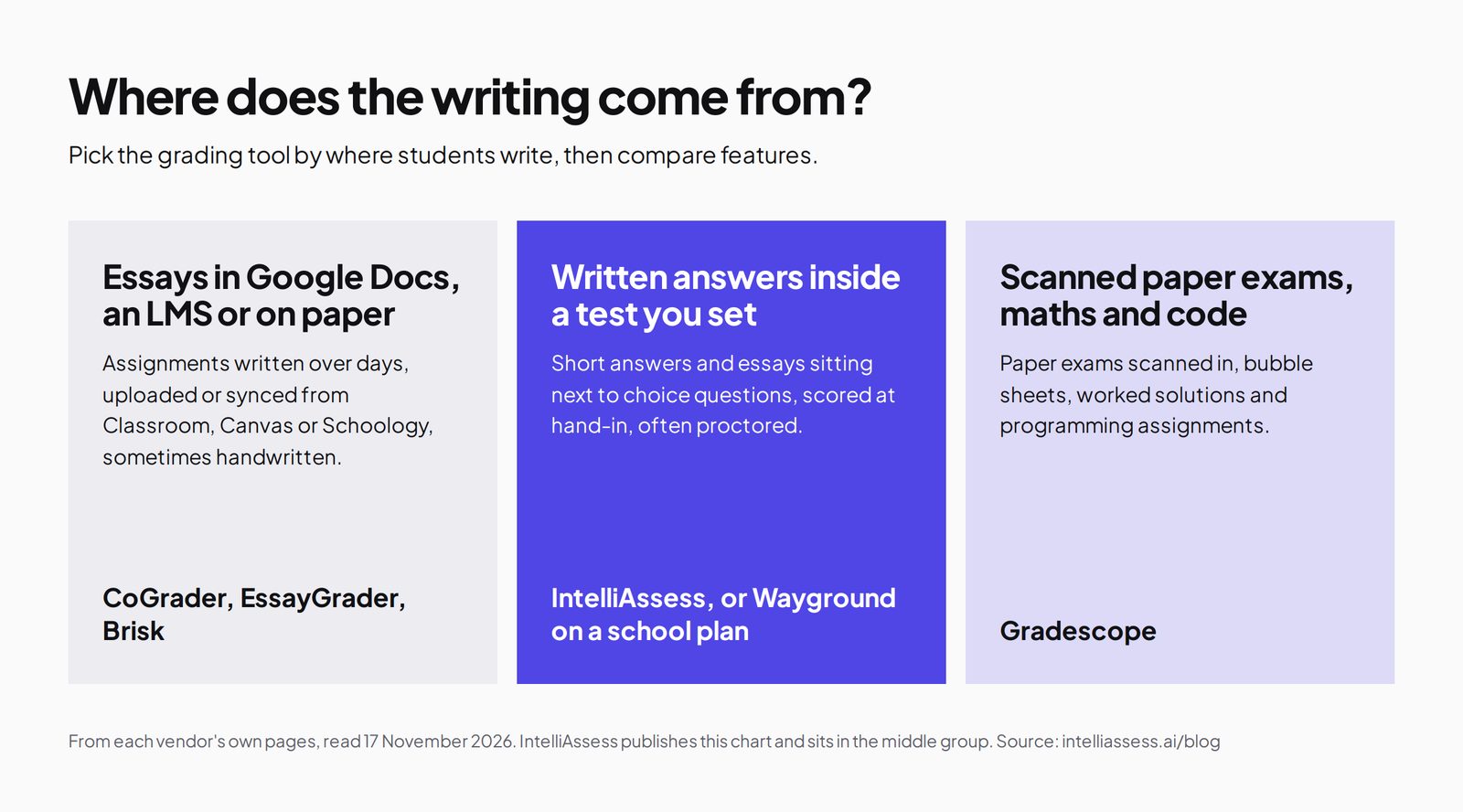
- Essays and papers written in Google Docs, an LMS or on paper: an essay grader (CoGrader, EssayGrader) or feedback in the document (Brisk).
- Written answers inside a test you set: a test platform that scores them at hand-in (IntelliAssess, or Wayground on a school plan).
- Scanned paper exams, maths and code: Gradescope.
CoGrader vs EssayGrader
| CoGrader | EssayGrader | |
|---|---|---|
| Free plan | 150 submissions a month, including handwriting | 100 essays a month, up to 1,000 words |
| First paid plan | Individual $15 a month billed annually ($19 monthly), 350 submissions | Pro $14.99 a month, 350 essays up to 3,500 words |
| Rubric library | 500+ state-standard rubrics, plus AP and IB | 800+ standards-aligned rubrics, all 50 states, AP, IB |
| AI-writing and plagiarism checks | Individual plan | Pro and Premium |
| Learns your grading | Not stated on the pages we read | From essays you upload with your grades |
| Integrations | Google Classroom (two-way); Canvas and Schoology | Google Classroom, Canvas, Schoology, with grades synced back |
| Published accuracy (vendor's own) | 98.3% within one point of state raters, 1,764 STAAR responses | 94% within one point, 22,000 essays |
From CoGrader's pricing and home page, and EssayGrader's pricing and home page, read 17 November 2026. CoGrader's FAQ also says AI detection is on school and district plans, which conflicts with its pricing page; ask which applies.
Prices side by side
| Tool | Free plan | First paid plan | Schools and districts |
|---|---|---|---|
| CoGrader | 150 submissions a month, handwriting included | Individual $15 a month billed annually ($19 monthly), 350 submissions | Quoted |
| EssayGrader | 100 essays a month, up to 1,000 words | Pro $14.99 a month, 350 essays up to 3,500 words; Premium $34.99, 800 essays up to 8,000 words | Quoted |
| Brisk | Free for teachers, with an upload limit on batch feedback | School and district plans | Quoted |
| MagicSchool | Free for teachers | Plus $8.33 a month billed annually | Quoted |
| Wayground | Basic, free for teachers (no AI grading) | School and District plan, with AI grading | Quoted |
| IntelliAssess | 25 students, AI question writing, no AI grading | Starter $39 a month for 200 students, with AI grading and proctoring; yearly costs ten months | Pro $99, Intensive $249, published |
| Gradescope | Basic, free | Institutional plan, with AI answer groups | Quoted |
From each vendor's pricing page, read 17 November 2026; see each tool's section for the source link.
What a month of essays costs one teacher
Take an English teacher with five classes of 28 students, setting one essay a month per class: 140 essays a month, most under 1,000 words.
- CoGrader: free, inside the 150-submission limit, including handwritten essays. AI-writing and plagiarism checks would need Individual at $15 a month.
- EssayGrader: Pro at $14.99 a month, since 140 essays is over the free plan's 100. Pro adds AI-writing and plagiarism detection and essays up to 3,500 words.
- Brisk and MagicSchool: free for feedback drafts, within each one's limits, though neither scores against a state rubric library.
- IntelliAssess: Starter at $39 a month covers the 140 students, but only if the essays are written as answers inside IntelliAssess tests. It does not grade essays written in Google Docs or on paper.
Double the essays to two a month per class, 280 in all, and CoGrader moves to Individual ($15), EssayGrader stays on Pro ($14.99), and IntelliAssess stays at $39, because it charges by students rather than by essays.
The scorecard: 7 tools on 7 published facts
A tick means the vendor's own page says so; a half means partly, on a higher plan, or in a different form; a cross means its page does not say so. The list follows the total; ties go to the larger rubric library, then to a free plan that includes the AI feedback.
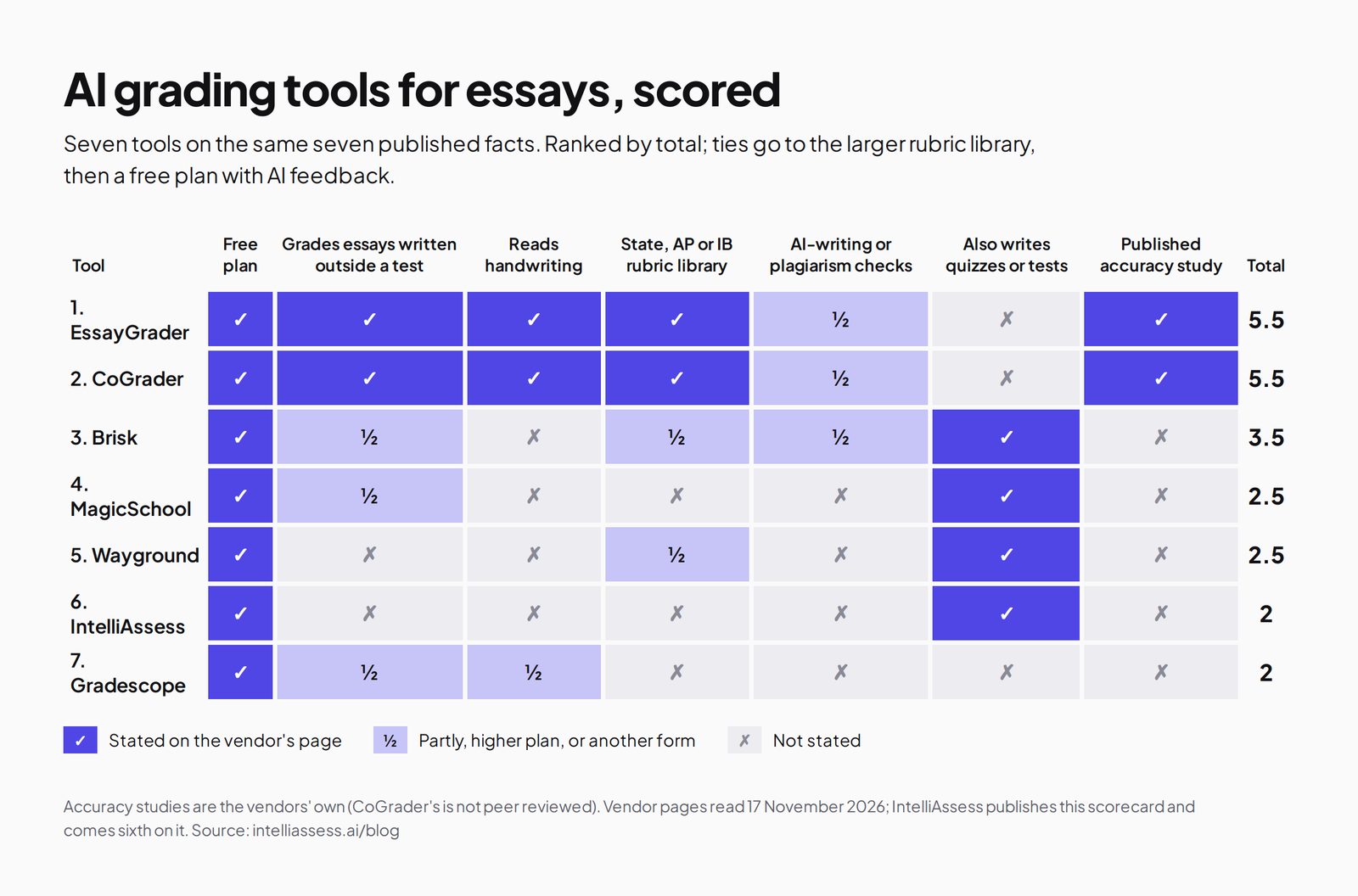
| Tool | Free plan | Grades essays written outside a test | Reads handwriting | State, AP or IB rubric library | AI-writing or plagiarism checks | Also writes quizzes or tests | Published accuracy study | Total |
|---|---|---|---|---|---|---|---|---|
| 1. EssayGrader | ✓ | ✓ | ✓ | ✓ | ½ | ✗ | ✓ | 5.5 |
| 2. CoGrader | ✓ | ✓ | ✓ | ✓ | ½ | ✗ | ✓ | 5.5 |
| 3. Brisk | ✓ | ½ | ✗ | ½ | ½ | ✓ | ✗ | 3.5 |
| 4. MagicSchool | ✓ | ½ | ✗ | ✗ | ✗ | ✓ | ✗ | 2.5 |
| 5. Wayground | ✓ | ✗ | ✗ | ½ | ✗ | ✓ | ✗ | 2.5 |
| 6. IntelliAssess | ✓ | ✗ | ✗ | ✗ | ✗ | ✓ | ✗ | 2 |
| 7. Gradescope | ✓ | ½ | ½ | ✗ | ✗ | ✗ | ✗ | 2 |
Halves: AI-writing and plagiarism checks are on paid plans only (CoGrader, EssayGrader); Brisk's Inspect Writing replays how a Google Doc was written rather than scoring it; Brisk and MagicSchool draft feedback on writing rather than grades; Wayground's state rubrics and AI grading are on its school and district plans; Gradescope grades uploaded and scanned work by hand, with AI answer groups on its Institutional plan. Accuracy studies are the vendors' own.
1. EssayGrader: the largest rubric library
Best for: teachers who grade many essays and long papers and want standards-aligned rubrics.
EssayGrader lists 800+ standards-aligned rubrics covering all 50 US states, AP, IB and Common Core, reads cursive and print from one class PDF, learns from essays you upload with your grades, and syncs grades back to Google Classroom, Canvas and Schoology. "You review, adjust and share."
Price: free for 100 essays a month of up to 1,000 words; Pro $14.99 a month (350 essays, 3,500 words, AI-writing and plagiarism detection); Premium $34.99 (800 essays, 8,000 words); districts quoted. Where it falls short: essays only, no test creation. See EssayGrader vs IntelliAssess.
2. CoGrader: the most generous free plan
Best for: teachers grading against state tests such as Texas STAAR or New York Regents, including handwritten essays.
CoGrader lists 500+ rubrics from state standards plus AP and IB, reads handwriting and sorts pages by student on the free plan, syncs with Google Classroom, and says teachers "still review every score and comment before students see it". Its October 2026 technical report, which it notes is not peer reviewed, found scores within one point of official Texas raters in 98.3% of 1,764 STAAR responses.
Price: free for 150 submissions a month; Individual $15 a month billed annually ($19 monthly) for 350 with AI and plagiarism detection; schools quoted. Where it falls short: essays only. See CoGrader vs IntelliAssess.
3. Brisk: feedback inside Google Docs
Best for: teachers who want feedback where students already write.
Brisk's Chrome extension drafts feedback "in your voice" in Google Docs and other files, with batch feedback, a rubric generator and a quiz generator. Its Inspect Writing replays how a document was written and, in its words, "doesn't produce an accuracy score". It works inside Canvas, Schoology and Google Classroom through the extension.
Price: free for teachers with an upload limit on batch feedback; school and district plans quoted (plans). Where it falls short: feedback rather than rubric scores, and no handwriting. See Brisk vs IntelliAssess.
4. MagicSchool: writing feedback in a teacher toolkit
MagicSchool's Class Writing Feedback lets you "review, personalize, and send AI-generated feedback on written assignments in batches, based in your rubric", alongside a quiz maker and dozens of other tools. Free for teachers; Plus $8.33 a month billed annually (pricing). Where it falls short: no handwriting, rubric library or AI-writing checks described. See MagicSchool vs IntelliAssess.
5. Wayground: AI grading on school plans
Wayground (formerly Quizizz) is free for teachers, and its plans page lists "full AI grading with custom and state rubrics" on its School and District plan, for activities inside Wayground. Where it falls short: AI grading needs a school plan, and it grades work done in Wayground, not uploaded essays. See Wayground alternatives.
6. IntelliAssess: written answers inside tests you set
Best for: teachers whose written answers come from tests they set, alongside choice questions, who also want the test written and proctored.
IntelliAssess writes the test from your files, a YouTube video or a web page, drafts a rubric for each written question with its rubric generator, and at hand-in AI grading scores each written answer against every criterion with a comment you can change before students see it. Proctoring checks identity and watches webcam, microphone, screen and browser, including for AI tools during the test. Grades and criterion scores sync to Google Classroom, and it works in Arabic.
Price (from our pricing page): free for 25 students; AI grading from Starter at $39 a month for 200. Where it falls short: it does not grade essays written elsewhere, read handwriting, offer state rubric libraries or check text for AI writing or plagiarism, and we have not published an accuracy study.
7. Gradescope: scanned exams, maths and code
Gradescope, from Turnitin, grades uploaded and scanned work, bubble sheets and code with dynamic rubrics; on its Institutional plan "Gradescope AI automatically forms groups" of similar answers for you to grade together. Basic is free (Gradescope). See Gradescope alternatives.
How accurate is AI essay grading?
Vendors' own figures are high; independent research is mixed. Both are worth knowing before you trust any score.
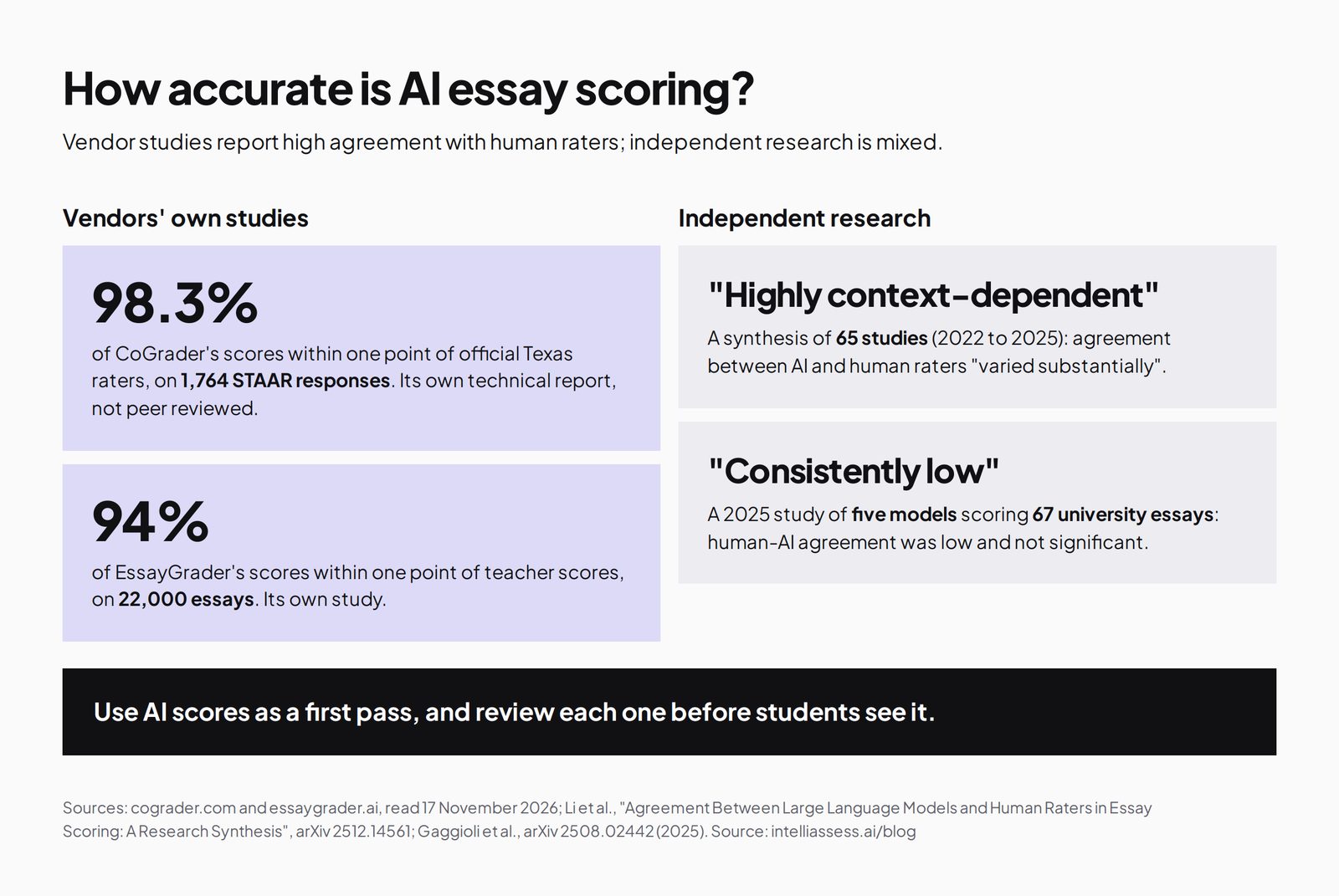
- A synthesis of 65 studies from 2022 to 2025 found agreement between LLMs and human raters "varied substantially both across and within studies" and is "highly context-dependent".
- A 2025 study of five models scoring 67 university essays found human-LLM agreement "consistently low and non-significant".
- CoGrader's and EssayGrader's figures come from their own studies on large sets of school essays, where rubrics and prompts are standardised.
The practical lesson is the same for every tool here: use the AI as a first pass and review each score. CoGrader, EssayGrader and IntelliAssess all keep the teacher in charge of the final grade.
How to write a rubric AI can use well
Every tool on this list grades against a rubric, and the rubric decides more about the quality of the scores than the AI does. A few habits help with any of them:
- One idea per criterion. "Argument and evidence" invites the model to blend two judgements; split them into "states a clear position" and "supports it with evidence from the text".
- Describe each level in observable terms. "Uses two or more quotations, each explained" is easier to score consistently than "uses evidence well".
- Keep the number of levels small. Four levels are easier to tell apart than ten, for a person and for a model.
- Say what does not count. If spelling should not lower the argument score, say so in that criterion.
- Test it on five essays you have already marked. Where the AI disagrees with you, the rubric wording is often the cause. Fix the wording before you grade a full class.
The state, AP and IB libraries in CoGrader and EssayGrader give you a tested starting point. IntelliAssess's rubric generator drafts a rubric for each written question, which you should edit to match how you actually mark.
Which tool for which teacher
- A US secondary English teacher grading to state standards, sometimes on paper: CoGrader or EssayGrader, starting on the free plan.
- A teacher who marks long research papers: EssayGrader Premium, for essays up to 8,000 words.
- A teacher who wants comments, not scores, in Google Docs: Brisk.
- A teacher who wants one toolkit for planning and feedback: MagicSchool.
- A teacher whose written answers sit inside unit tests with choice questions, sometimes sat at home: IntelliAssess.
- A university course with scanned exams and problem sets: Gradescope.
- A school teaching in Arabic: IntelliAssess, the only tool here that describes Arabic.
Student data: what to ask before you upload
Uploading student writing to any AI tool sends personal data to a company. Before you start, ask your school or district whether the tool is approved, and ask the vendor four things: whether student work is used to train its models, how long submissions are kept, where the data is stored, and whether it has a signed data-privacy agreement with your district. We did not compare the vendors' privacy terms for this page, so check each one directly. For IntelliAssess, identity and evidence photos from proctoring are stored encrypted and opened only through short-lived links; our pages do not list certifications or data location, so ask us if you need them.
AI-writing checks: what they can and cannot tell you
CoGrader and EssayGrader both offer AI-writing and plagiarism detection on paid plans. A plagiarism check compares text with existing sources and can point to the passage that matches. An AI-writing check is different: there is no source to point to, so it estimates how likely the text is to be machine-written. Treat that estimate as a reason to talk to the student, not as proof.
Two other approaches avoid guessing from the text alone. Brisk's Inspect Writing replays how a Google Doc was written, so you can see whether an essay was typed over days or pasted in at once; Brisk says plainly that it "doesn't produce an accuracy score". IntelliAssess moves the writing into a supervised test, where proctoring shares the whole screen and checks the browser, so an AI tool open in another window shows up in the report. Neither replaces a conversation with the student, but both give you evidence you can show them.
What to check in a free trial
- Use essays you have already marked. Five is enough to see whether the AI's scores sit near yours, and where they differ.
- Include a weak and a strong essay. Tools that compress every score toward the middle are less useful than their average agreement suggests.
- Read the comments, not only the scores. Would you send them to a student as they are? How long does it take to fix them?
- Check the round trip. Do grades and comments arrive in Google Classroom, Canvas or Schoology the way your students expect?
- Time yourself. The point is to mark a class set faster without lowering quality; compare the minutes per essay with your usual pace.
How to choose
- Where is the writing? Docs, the LMS or paper: an essay grader. Inside your own test: IntelliAssess.
- Which rubrics? For state, AP or IB rubrics ready-made, EssayGrader or CoGrader.
- Is AI-written work a worry? Essay graders check submitted text on paid plans; IntelliAssess watches the screen during a test instead.
- Try two free plans with the same five essays and compare the scores with your own.
Browse every comparison or see IntelliAssess for schools.
Frequently asked questions
Is CoGrader or EssayGrader better?
They are close. CoGrader's free plan is larger (150 submissions a month against 100) and it publishes a validation study against state raters; EssayGrader has a larger rubric library (800+) and learns from essays you have graded. Try both free plans with the same essays.
What is the best free alternative to EssayGrader?
CoGrader's free plan grades 150 submissions a month, including handwriting. Brisk and MagicSchool are free for teachers and draft writing feedback.
Can AI grade essays accurately?
Sometimes. Vendor studies report scores within one point of human raters 94 to 98% of the time on school essays, while a synthesis of 65 studies finds agreement highly context-dependent. Review every AI score.
Which alternative grades whole tests, not only essays?
IntelliAssess writes, proctors and grades whole tests, including choice questions and written answers scored against your rubric. It does not grade essays written outside its tests.
Which tools check for AI-written essays?
CoGrader and EssayGrader on paid plans; Brisk's Inspect Writing shows how a Google Doc was written. IntelliAssess does not check text for AI writing.
Which alternative works in Arabic?
IntelliAssess writes and grades in Arabic, right to left. The essay graders' pages we read do not mention Arabic.
How much does CoGrader cost?
CoGrader is free for 150 submissions a month. Its Individual plan is $15 a month billed annually, or $19 monthly, for 350 submissions with AI-writing and plagiarism detection. School plans are quoted.
Can these tools grade handwritten essays?
CoGrader and EssayGrader read handwriting from scanned pages, and Gradescope grades scanned work by hand with its rubrics. Brisk, MagicSchool, Wayground and IntelliAssess work with typed answers.
Can I use an essay grader and IntelliAssess together?
Yes, and many teachers' workloads suit both. Use CoGrader or EssayGrader for essays and papers written over days in Google Docs or on paper, and IntelliAssess for unit tests that mix choice questions with short written answers, especially tests sat at home that need identity checks. Both send grades to Google Classroom, so students see one gradebook.
Is MagicSchool good for grading essays?
MagicSchool drafts feedback on written assignments in batches, based on your rubric, which you review and send. It does not describe a state rubric library, handwriting or AI-writing checks, so for grading at volume CoGrader or EssayGrader go further. MagicSchool's strength is the wider toolkit for planning and teaching.
Which is cheapest for a teacher with 300 essays a month?
CoGrader Individual at $15 a month billed annually and EssayGrader Pro at $14.99 a month both cover 350 a month. Free plans cover 150 (CoGrader) and 100 (EssayGrader). Brisk and MagicSchool are free for feedback drafts within their own limits.
Keep reading
All articles
Read next
SchoolAI alternatives: 7 AI tools for teachers and students scored (2026)
Seven AI tools scored on the same nine facts, with SchoolAI as the reference, and what each lets teachers see when students use AI.
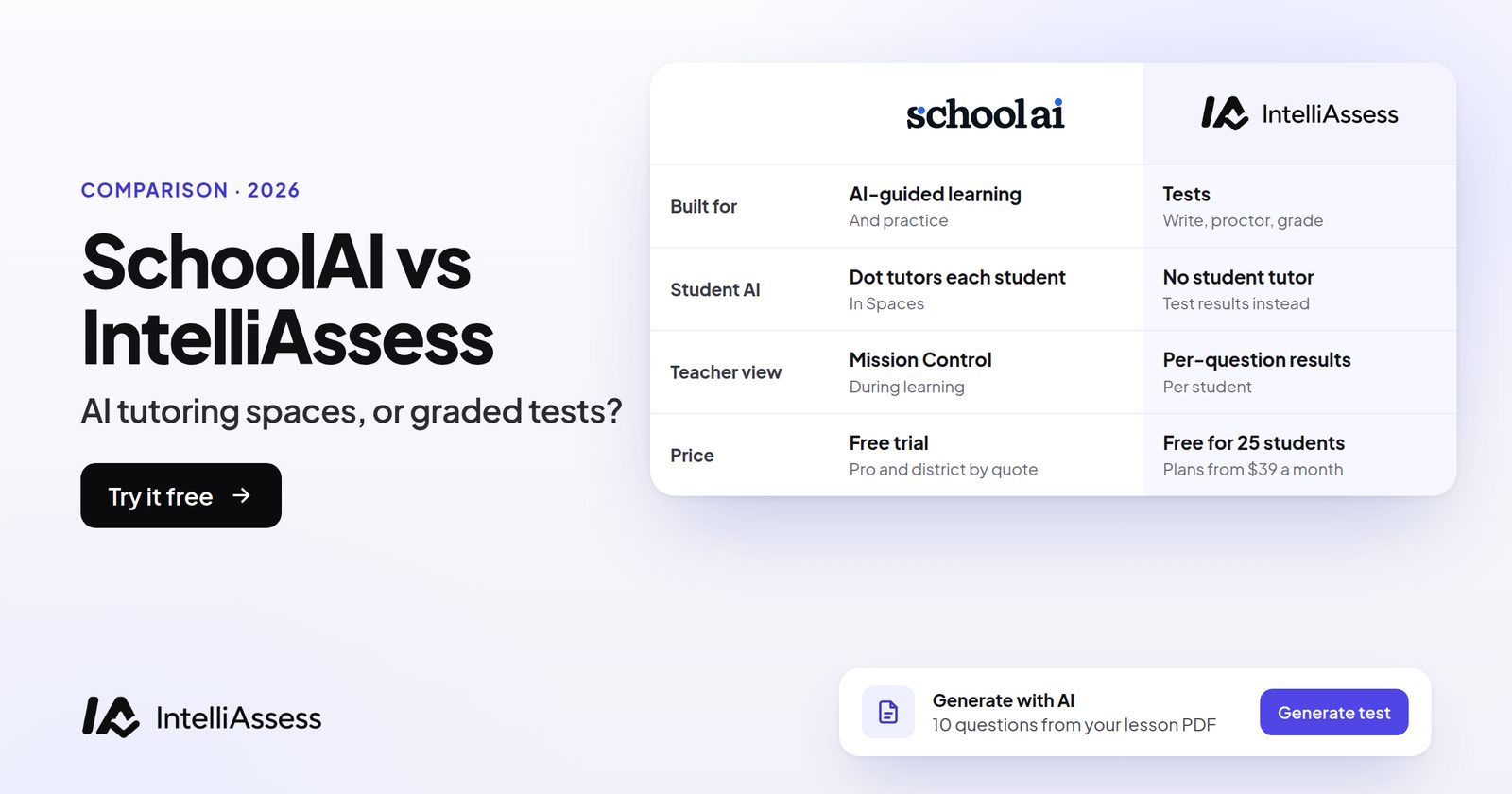
SchoolAI vs IntelliAssess: an AI tutor for students or feedback after a test?
SchoolAI puts students in supervised conversation with AI; IntelliAssess marks their tests and uses AI to help them learn from their own answers.
Motasem Aldiab 12 min read
Jotform and ProProfs alternatives for quizzes and exams (2026)
Jotform and ProProfs side by side, then the alternatives by forms, certificates or real exams.
Motasem Aldiab 2 min read