
Formative vs IntelliAssess (2026): live checks or marked tests?

By Motasem Aldiab, Technology Consultant and Trainer - Cloud, DevOps, Java, Data Science
Contents28
- The short answer
- At a glance
- What Formative is
- What IntelliAssess is
- Why live checks matter
- A lesson week: which tool at which moment
- Monday: a live check in the lesson
- Tuesday: practice inside a lesson
- Wednesday: homework
- Thursday: an exit ticket
- Friday: the unit test
- Real-time view
- Question types and lessons
- AI: writing, explaining and marking
- Standards and data
- Test security
- Feedback to students
- Setting up
- Pricing compared
- Ages and subjects
- Languages and accessibility
- Integrations
- What students see
- Using both
- A school's view
- Questions to ask before you decide
- Who should choose which
- Where IntelliAssess falls short
Key takeaways
- 1Formative is built for live checks: answers appear in real time as students work.
- 2IntelliAssess is built for the graded test: AI marks written answers against a rubric for review.
- 3Formative is $249 a year per teacher; IntelliAssess is free for 25 students and $39 a month for 200.
- 4Many teachers need both: live checks during the unit and a marked test at the end.
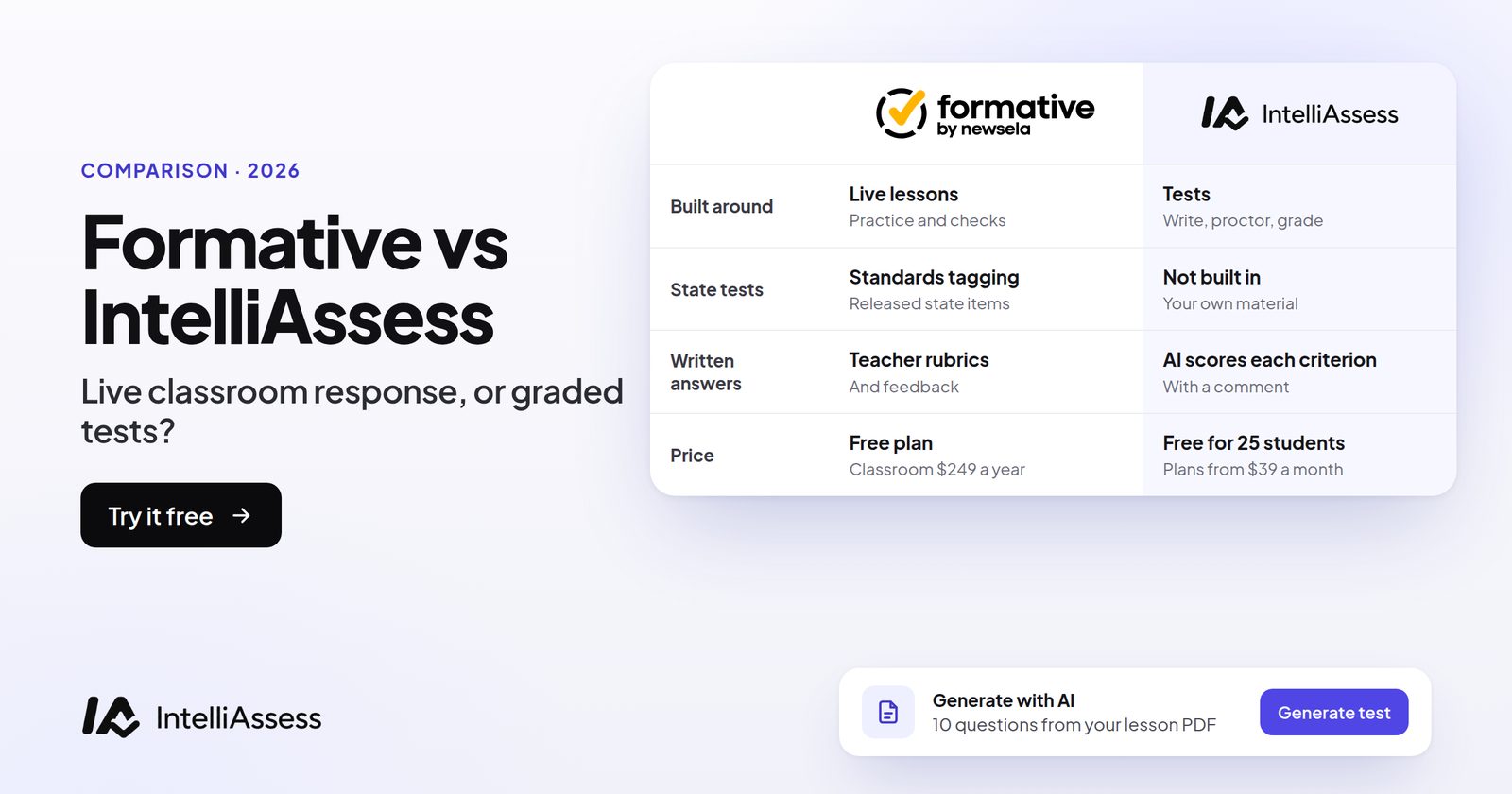
Formative vs IntelliAssess compares a live classroom tool with a test platform. Formative is built around the lesson: teachers see student responses in real time, tag questions to standards, and build interactive lessons with more than 20 question and content types. IntelliAssess is built around the graded test: it writes the test from your material, marks written answers against a rubric with AI for the teacher to review, and can check identity and the webcam when students take it at home. This page walks through a week of lessons to show which tool fits which moment, then compares features, AI, security and price.
The short answer
Choose Formative if your priority is live checks during lessons: watching answers arrive, reteaching on the spot, interactive lessons with slides, and progress against standards, for $249 a year per teacher. Choose IntelliAssess if your priority is the graded test: AI-written tests from your material, written answers marked against a rubric, Google Classroom grade sync, and identity and webcam checks for tests at home. Use both if you want live checks during the unit and a marked test at the end.
At a glance
| Formative | IntelliAssess | |
|---|---|---|
| Built for | Live checks and lessons in class | Graded tests, in class or at home |
| Real-time view of answers | Yes, the core of the product | No |
| Interactive lessons | Lesson blocks, multimedia, Google Slides builder | No |
| Question types | 20+ tech-enhanced and multimedia types | Multiple choice, multi-select, true/false, short answer, fill in the blanks, essay |
| AI | Luna AI builds activities from prompts, PDFs or docs; hints and explanations | Writes tests from files, YouTube or web pages; drafts rubrics; marks written answers |
| Marking | Auto-grading, rubrics, feedback by the teacher | Auto-marking plus AI marking per rubric criterion, teacher reviews |
| Standards | Tag questions and track progress | Not described |
| Security | Anti-cheating features; Respondus LockDown Browser on district plans | ID, face match, webcam, microphone, screen and browser checks |
| Integrations | Roster sync with Google Classroom and Clever (district plans) | Google Classroom with grade sync |
| Price | $249 a year per teacher; $3,125 a year for a small school | Free for 25 students; Starter $39 a month for 200 |
What Formative is
Formative describes itself as "One tool for assessment, data, and collaboration" (Formative for teachers). Its teacher page sets out four parts:
- AI-powered activity creation: "Luna AI helps you make activities in 5 minutes, not 50", with unlimited lessons, assessments and practice sets, lesson blocks, multimedia and a drag-and-drop builder with Google Slides, delivered with teacher pacing, student pacing or gamification.
- Flexible assessment tools: "20+ tech-enhanced questions and multimedia content types", paper-to-digital worksheet conversion, and audio, visual and written feedback.
- Real-time insights: "See student responses in real time, not tomorrow", with AI-powered hints and answer explanations and standards tags.
- Collaboration: shared libraries, district common assessments and dashboards.
Its Classroom Plan adds "Advanced grading & feedback: Auto-grading, customizable rubrics, & direct student feedback" and "Secure assessment tools: Access built-in anti-cheating features and released state test items".
What IntelliAssess is
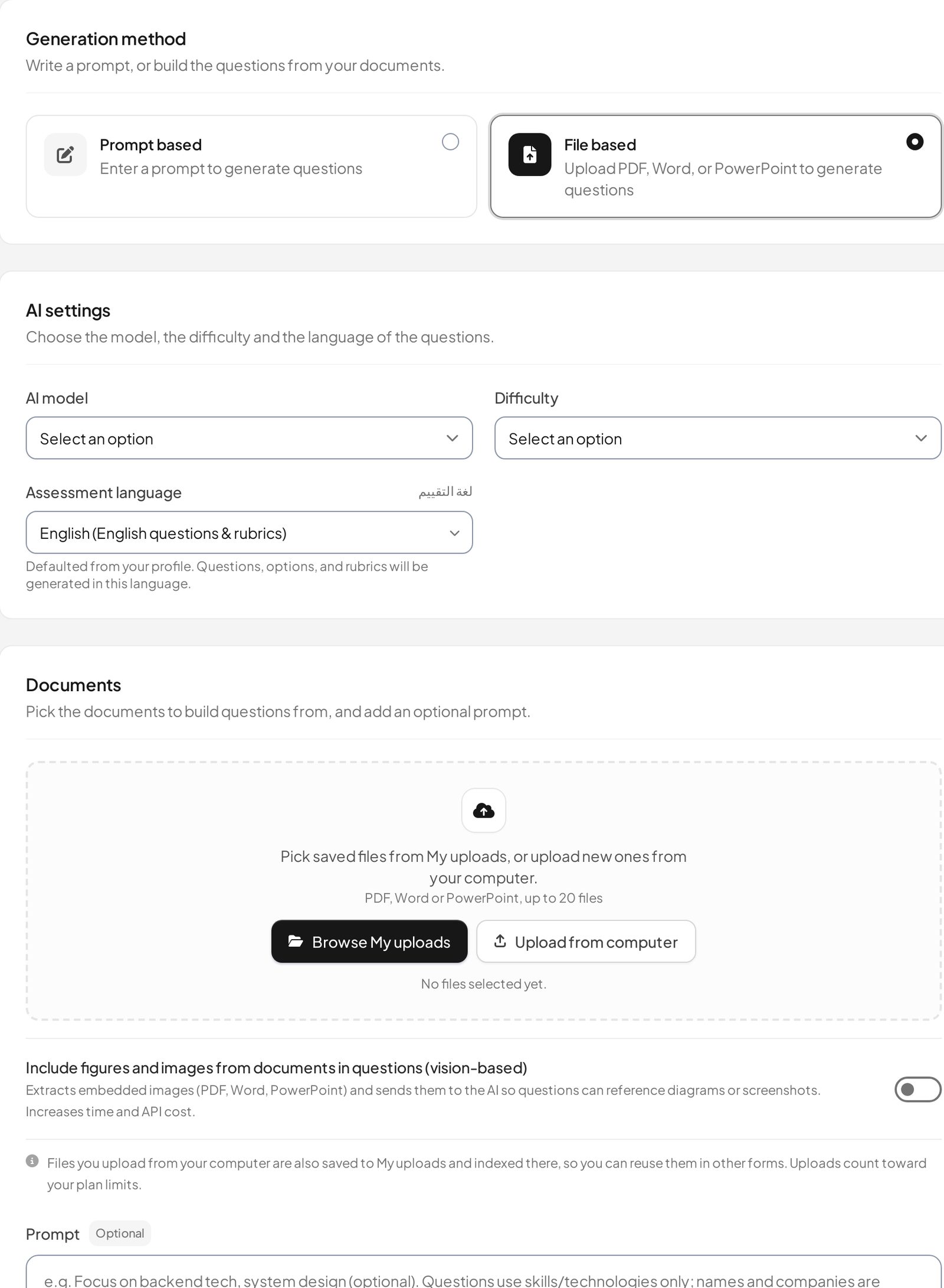
IntelliAssess builds, runs and marks tests. Its AI quiz generator writes questions from a PDF, Word or PowerPoint file, a YouTube video or a web page, checks the answer keys in a second pass, and drafts a rubric for each written question. Tests are shared by link or posted to Google Classroom. Objective questions mark themselves; AI grading scores each written answer on every rubric criterion with a reason, and the teacher reviews before releasing results. Proctoring is optional per test, and assessment analytics show results across the class.
Why live checks matter
Formative assessment, in the sense Formative's name refers to, is evidence of learning used to change teaching while there is still time. Paul Black and Dylan Wiliam's 1998 paper "Inside the Black Box" argued that this practice, done well, raises achievement, and it shaped a generation of classroom practice. The point is timing: a misconception caught during Monday's lesson costs two minutes to fix, while the same misconception found in Friday's test costs a lesson or a lower grade.
Tools like Formative make that timing practical by putting every student's answer in front of the teacher as it is written. A graded test is summative: it records learning at the end. Both are useful, and they answer different questions: "what should I teach next?" and "what did they learn?".
A lesson week: which tool at which moment
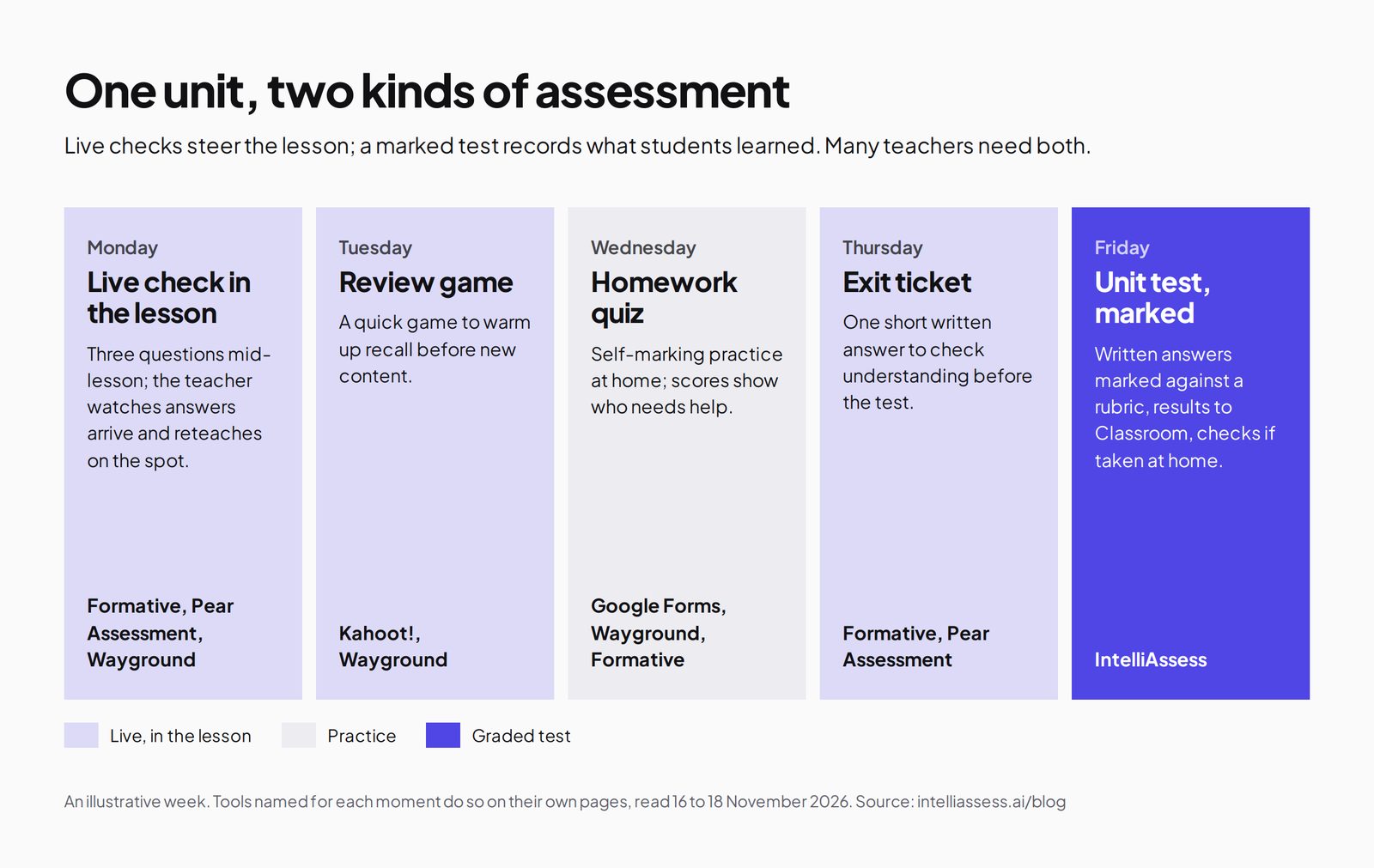
Take a Year 9 science unit on forces, taught over a week, ending in a unit test. Here is where each tool fits.
Monday: a live check in the lesson
Midway through introducing balanced and unbalanced forces, the teacher asks three questions, one of them a quick diagram. With Formative, answers appear on the teacher's screen as students work, so it is clear in two minutes that half the class confuses mass and weight. The teacher stops and reteaches. IntelliAssess has no live view, so it is the wrong tool here.
Tuesday: practice inside a lesson
The teacher builds a short Formative lesson: a slide, a video clip, then practice questions with hints and explanations generated by Luna AI. Students work at their own pace while the teacher watches progress. Again, this is Formative's ground.
Wednesday: homework
Either tool works. Formative's auto-graded practice set lets students check their answers at home; an IntelliAssess learning quiz does the same and lets students practise the questions they missed.
Thursday: an exit ticket
One short written question: "Explain why a parachute slows a skydiver." In Formative, the teacher reads the answers live and sorts the class for Friday's revision. In IntelliAssess, the answers could be marked against a three-point rubric, but for a quick exit ticket, Formative's live view is faster.
Friday: the unit test
Now the job changes. The test counts towards a grade, has ten objective questions and three written answers, and some students are absent and will take it at home next week. With IntelliAssess, the teacher uploads the unit notes, gets a draft test with rubrics, edits it, and posts it to Google Classroom with webcam and identity checks for the students at home. Objective answers mark themselves; the written answers arrive with AI-drafted scores per criterion that the teacher reviews before releasing results. With Formative, the teacher can build and auto-grade the objective questions and mark the written answers by hand with a rubric.
Four days of the week belong to Formative; one belongs to IntelliAssess. That is the honest shape of the comparison: Formative covers more of the teaching week, and IntelliAssess covers the part that ends up on a report.
Real-time view
Formative's live view is its defining feature, and IntelliAssess does not have one. Teachers see students' thinking as it happens, can spot a misconception across the room, and can respond before the lesson ends. IntelliAssess shows results after each student submits, and results for the class once the test is done; that suits a test, not a lesson.
Question types and lessons
Formative offers more than 20 question and content types, including multimedia, and builds whole lessons with slides, videos and embedded checks. IntelliAssess offers six question types aimed at tests: multiple choice, multi-select, true/false, short answer, fill in the blanks and essay. If you teach with interactive lessons, Formative does far more. If you need well-formed test questions with rubrics, IntelliAssess's set is enough.
AI: writing, explaining and marking
Both write questions with AI. Formative's Luna AI creates activities "from prompts, PDFs, or docs", converts paper worksheets, and gives students hints and explanations; district plans add AI guardrails and Luna Next Steps for follow-up activities. IntelliAssess writes tests from files, YouTube videos and web pages, checks answer keys, and drafts rubrics.
The difference is marking. Formative lists auto-grading and customisable rubrics, with the teacher marking written answers. IntelliAssess's AI marks each written answer against every rubric criterion with a reason, and the teacher reviews and changes any score. For a teacher marking 120 short essays after a unit test, that is the main reason to use IntelliAssess.
Standards and data
Formative lets teachers tag any question with standards and track progress, and its school and district plans add dashboards across classes, schools and the district. IntelliAssess shows results per test and per class, written-answer scores per criterion, and each student's strongest and weakest skills from graded tests and practice, but does not describe standards tagging. For standards-based grading, Formative is the better fit.
Test security
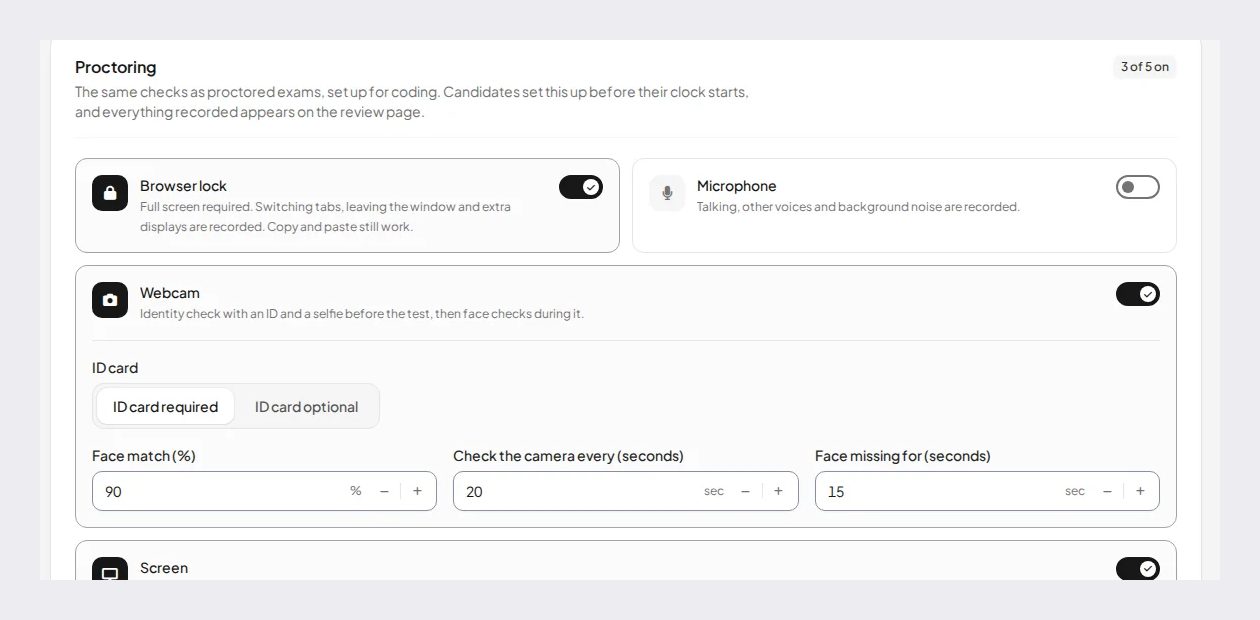
Formative's Classroom Plan includes "built-in anti-cheating features", and district plans include Respondus LockDown Browser, which locks the device. IntelliAssess does not lock the device; it checks identity with an ID photo, selfie, liveness check and face match, then watches the webcam, microphone, whole screen and browser, with rules that warn the student and can submit the attempt if problems keep happening. For tests in class on school devices, Formative's tools may be enough. For tests at home, where you need to know who is taking the test, IntelliAssess does more.
Feedback to students
Formative supports feedback in several forms, "audio, visual, and written response options", plus automatic hints and answer explanations, and the teacher can give "direct student feedback" during or after an activity. That variety suits younger students and lessons, where a short voice note can do more than a paragraph.
IntelliAssess's feedback is tied to the test: each written answer gets a score and a comment for every rubric criterion, drafted by AI and checked by the teacher, released when the teacher chooses. Students can then ask for a re-mark with a reason and practise the questions they missed; on Pro and above, learning quizzes add study notes, study plans and an "Explain this to me" option. It is more structured and less immediate than Formative's in-lesson feedback.
Setting up
Formative: chat with Luna AI or upload a PDF to draft an activity, add slides, videos and questions in the lesson builder, tag standards, and share a link or code. Students join with no setup beyond the code. Building a rich lesson takes longer than a quiz, but Formative says Luna cuts it from 50 minutes to five.
IntelliAssess: upload unit notes or paste a video or page link, choose question types, difficulty and number, review the draft and its rubrics, set the time limit, attempts, schedule and any proctoring, and post to Google Classroom. Setup is about the test and its marking, not about a lesson.
Pricing compared
Formative (plans): Classroom Plan $249 a year per teacher ($20.75 a month billed annually); Small School Plan $3,125 a year for up to 250 students; district plans quoted, including the premium item bank, Respondus LockDown Browser and translations in 50+ languages. Sign-up is free, but no free plan is listed.
IntelliAssess (pricing): Free for 25 students; Starter $39 a month for 200; Pro $99 for 500; Intensive $249 for 2,000; yearly billing costs ten months. AI grading and proctoring start on Starter.
| Case | Formative | IntelliAssess |
|---|---|---|
| One teacher, live checks every lesson | $249 a year | No live view |
| One teacher, 150 students, unit tests with written answers | $249 a year; written answers marked by hand | Starter $390 a year billed yearly, AI marking included |
| A small school, 250 students | $3,125 a year | Pro $990 a year for up to 500 |
| A school with tests at home needing identity checks | Identity checks not described | Starter or Pro, with a monthly face-check allowance |
For one teacher, Formative is cheaper than IntelliAssess Starter and does more in lessons. For a school, IntelliAssess Pro covers twice the students of Formative's Small School Plan for less, but does not do live checks or lessons.
Ages and subjects
Formative is built for K-12 classrooms, and its tech-enhanced question types, multimedia and gamified delivery suit younger students and subjects where students show working, such as mathematics and science. Its district features, state test items and standards tracking reflect the US school system it grew up in.
IntelliAssess works for secondary schools and universities, and for any subject with written answers, from history and English to explanation questions in science. Its rubric marking is most useful where answers are sentences or paragraphs; for younger pupils doing quick visual checks, Formative's lessons are a better fit.
Languages and accessibility
Formative's district plans include translations "in over 50 languages", and feedback can be given as audio, which helps students who read below grade level. IntelliAssess generates questions and rubrics in the language you choose for each test, and its interface works in English and Arabic, right to left included, which matters for schools teaching in Arabic. Both let teachers set time limits; check per-student accommodations, such as extra time for individual students, with each vendor before moving a class with individual learning plans.
Integrations
Formative lists roster sync with Google Classroom and Clever on its district plans, and builds lessons with Google Slides. IntelliAssess posts tests to Google Classroom and sends grades back. Neither describes Canvas or Schoology integration on the pages we read.
What students see
In Formative, students join with a code or link, work through lessons and questions, see hints and explanations, and get feedback from the teacher, sometimes during the lesson.
In IntelliAssess, students open a test link or Classroom assignment, take the test, perhaps with identity and webcam checks, and later see their marks with comments per rubric criterion, can ask for a re-mark, and can practise what they missed.
Using both
The lesson week shows the natural split: Formative for live checks, lessons and exit tickets; IntelliAssess for the marked unit test. Students see each tool for a clear reason, and grades can meet in Google Classroom. A teacher can try the pairing at little cost: IntelliAssess is free for up to 25 students, so one class's unit test can run alongside Formative before anyone pays more.
If you try the pairing, keep the roles clear. Anything that steers a lesson, such as a hinge question, an exit ticket or a practice set, stays in Formative, where the live view earns its keep. Anything that produces a grade for the report, such as the unit test or an end-of-term exam, goes to IntelliAssess, where written answers are marked against a rubric and students at home are checked. After one unit, compare the time you spent marking with the time you spent before. If the marked tests took noticeably less of your evening and the scores held up when you checked them, keep both; if not, stay with Formative alone and mark by hand.
A school's view
A school deciding between the two is really deciding what it wants to standardise. Formative's school and district plans standardise daily instruction: shared libraries, common assessments, standards dashboards and, at district level, a lockdown browser and AI guardrails. IntelliAssess standardises the graded test: tests written from department material, consistent rubric marking across classes, and the same identity checks for every student taking a test at home.
Some schools will want both, with Formative for teaching and learning and IntelliAssess for assessment that counts. Others will pick one and fill the gap with a free tool: a free live-check tool such as Wayground or Pear Assessment's free plan alongside IntelliAssess, or Formative alongside hand-marked tests.
Questions to ask before you decide
- Do you check understanding live during most lessons?
- Do you build interactive lessons with slides and embedded questions?
- How many written answers do you mark after each unit?
- Do students take graded tests at home?
- Does your school report against standards?
- Do you use Google Classroom for grades?
Yes to the first, second and fifth points to Formative. Yes to the third, fourth and sixth points to IntelliAssess. Yes to both groups points to using both.
Who should choose which
- Choose Formative for live checks, interactive lessons, standards tracking, district dashboards, and a low price for one teacher.
- Choose IntelliAssess for graded tests with written answers marked by rubric, AI-written tests from your material, Google Classroom grade sync, and identity checks for tests at home.
Where IntelliAssess falls short
- No real-time view of answers during a lesson.
- No interactive lessons, slides or games.
- No standards tagging or district dashboards.
- Six question types rather than 20+.
- No device lockdown; proctored tests need a laptop or desktop.
- For one teacher, it costs more than Formative's Classroom Plan.
For other tools, see Formative alternatives, Pear Assessment vs IntelliAssess and Wayground vs IntelliAssess, or browse every comparison.
Frequently asked questions
Is IntelliAssess a replacement for Formative?
Not for live checks in a lesson. IntelliAssess has no real-time view of answers or interactive lessons. It replaces Formative for graded tests, where it adds AI marking of written answers and identity checks for tests at home.
How much does Formative cost?
The Classroom Plan is $249 a year per teacher. The Small School Plan is $3,125 a year for up to 250 students. District plans are quoted.
Does Formative use AI?
Yes. Luna AI builds activities from prompts, PDFs or documents, converts paper worksheets, and gives students hints and answer explanations. Its pages do not describe AI marking of written answers.
Which is better for written answers?
IntelliAssess, which marks each written answer against a rubric with AI for the teacher to review. In Formative, the teacher marks written answers with a rubric.
Can I use Formative and IntelliAssess together?
Yes. Use Formative for live checks and lessons during the unit, and IntelliAssess for the marked test at the end, with all grades collected in Google Classroom.
Which is better for tests at home?
IntelliAssess checks identity with an ID photo, selfie and face match, and watches the webcam, microphone, screen and browser. Formative lists anti-cheating features and Respondus LockDown Browser on district plans.
Keep reading
All articles
Read next
SchoolAI alternatives: 7 AI tools for teachers and students scored (2026)
Seven AI tools scored on the same nine facts, with SchoolAI as the reference, and what each lets teachers see when students use AI.
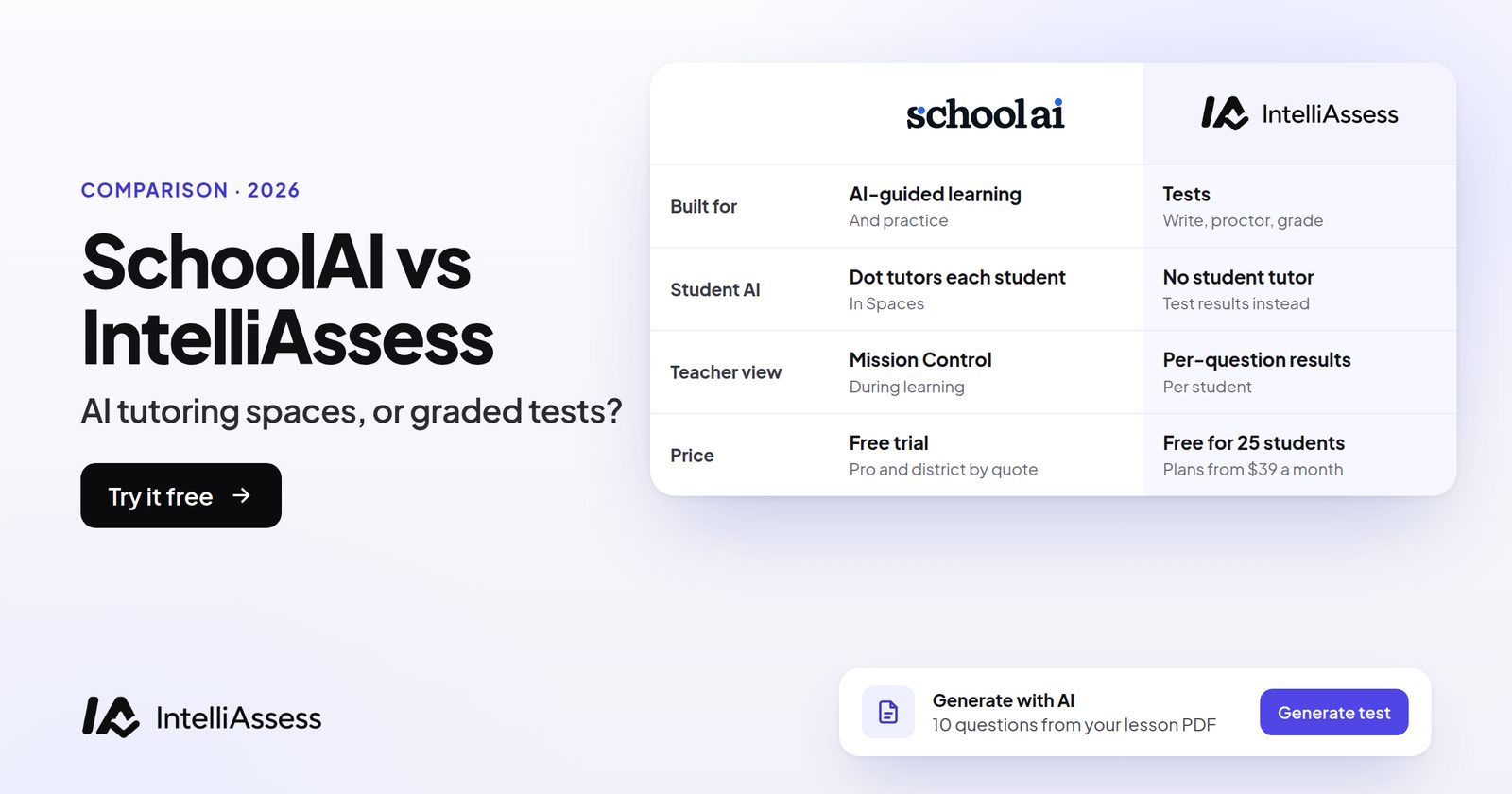
SchoolAI vs IntelliAssess: an AI tutor for students or feedback after a test?
SchoolAI puts students in supervised conversation with AI; IntelliAssess marks their tests and uses AI to help them learn from their own answers.
Motasem Aldiab 12 min read
Jotform and ProProfs alternatives for quizzes and exams (2026)
Jotform and ProProfs side by side, then the alternatives by forms, certificates or real exams.
Motasem Aldiab 2 min read