
Socrative vs IntelliAssess (2026): exit tickets or graded tests?

By Motasem Aldiab, Technology Consultant and Trainer - Cloud, DevOps, Java, Data Science
Contents25
- The short answer
- At a glance
- What Socrative is
- What IntelliAssess is
- Why both kinds of check matter
- An exit ticket and a graded test
- The exit ticket
- The graded test
- Live results and feedback
- Marking
- AI
- Security and integrity
- Rooms, classes and setup
- Ages and subjects
- Free plans compared
- Pricing compared
- What students see
- Reports
- Languages and privacy
- Using both
- A department's view
- Moving between them
- Questions to ask before you decide
- Who should choose which
- Where IntelliAssess falls short
Key takeaways
- 1Socrative is built for quick checks: live results and explanations the moment students submit.
- 2IntelliAssess is built for graded tests: AI marks written answers against a rubric for review.
- 3Socrative Free covers 50 students in one room; Essentials is $120 a year.
- 4Use Socrative for exit tickets and IntelliAssess for the unit test.
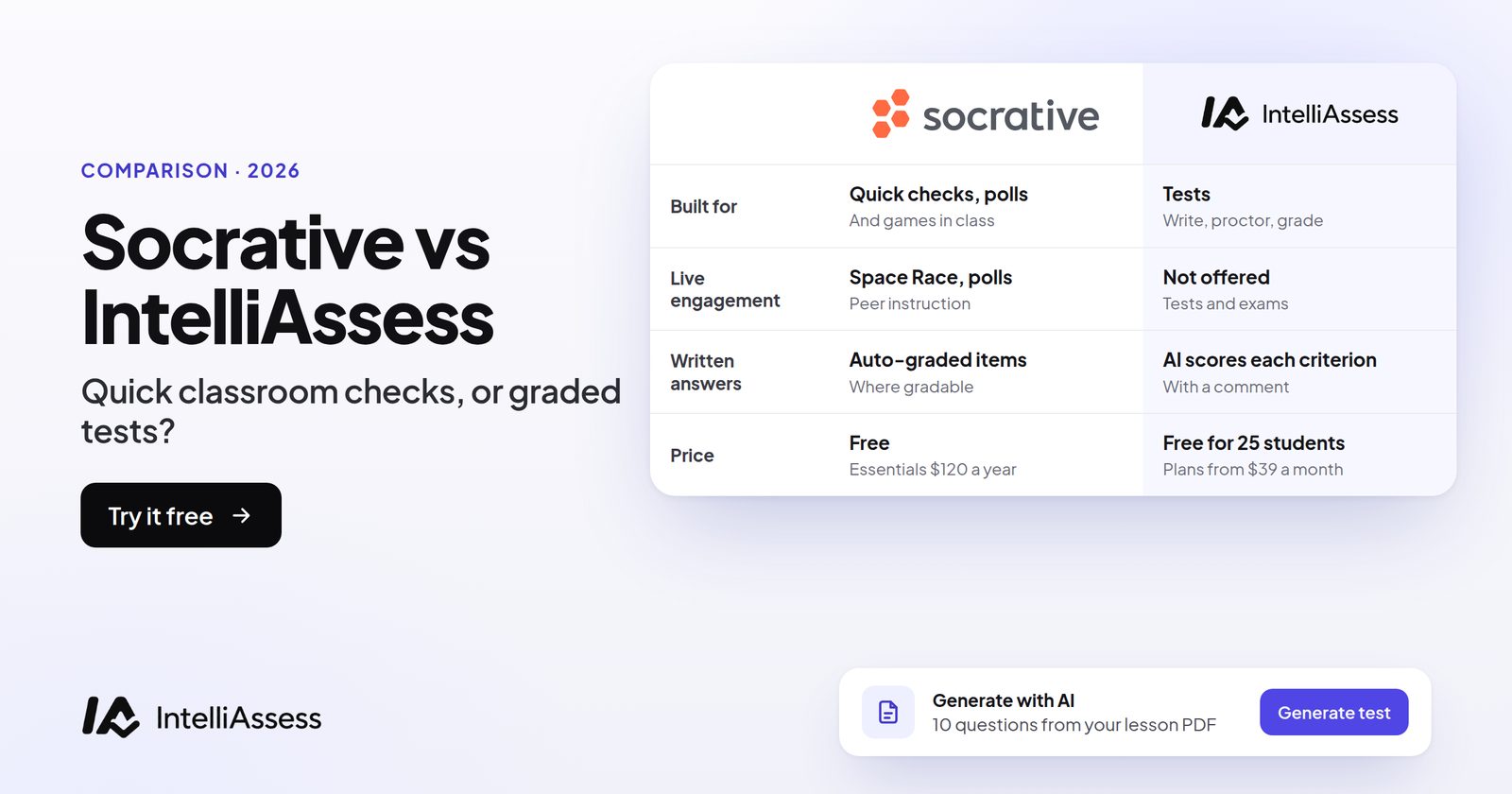
Socrative vs IntelliAssess compares a quick-check tool with a test platform. Socrative is built for the minutes inside a lesson: exit tickets, warm-ups and short quizzes, with answers marked automatically, explanations shown the moment students submit, and live results for the teacher. IntelliAssess is built for the test at the end of a unit: it writes the test from your material, marks written answers against a rubric with AI for the teacher to review, and can check identity and the webcam when students take it at home. This page compares the two through an exit ticket and a graded test, then features, AI, free plans and price.
The short answer
Choose Socrative for quick checks during lessons: exit tickets, warm-ups and short quizzes, with live results and instant explanations, free for up to 50 students in one room or $120 a year on Essentials. Choose IntelliAssess for graded tests: written from your own material, with written answers marked against a rubric by AI, Google Classroom grade sync, and identity checks for tests at home. Use both if you check understanding during the unit and test it at the end.
At a glance
| Socrative | IntelliAssess | |
|---|---|---|
| Built for | Quick checks in lessons | Graded tests, in class or at home |
| Live results | Yes, progress visualised live | No; results after submission |
| Instant feedback for students | Explanation or correct answer on submit | Marks and comments when the teacher releases results |
| Marking | Automatic grading | Automatic for objective questions; AI per rubric criterion for written answers |
| AI | Generates questions, imports quizzes, analyses reports, with weekly limits | Writes tests from files, YouTube or web pages; drafts rubrics; marks written answers |
| Security | Not described | ID, face match, webcam, microphone, screen and browser checks |
| Reports | Customisable tables and exports; 30 days to unlimited history by plan | Results per test and class; PDF export; Google Classroom grades |
| Free plan | 5 quizzes, 1 room, 50 students | Up to 25 students, AI token allowance |
| Paid from | Essentials $120 a year | Starter $39 a month for 200 students |
What Socrative is
Socrative's homepage promises to "Instantly Spot Learning Gaps with Real-Time Assessment Insights" (Socrative). Teachers "Automatically grade responses and deliver ready-made explanations the moment students submit, while visualizing progress live so you can step in when help is needed". It says more than 3 million teachers use it, and 60 million students take part each year.
Its use cases cover instruction ("real-time interactive activities during a lesson to assigning self-paced tasks"), assessment ("From formative knowledge checks to high-stakes summative assessments") and practice (homework, warm-ups and exit tickets). Reports can be shaped into "summary sheets, detailed faculty reports, or individualized student printouts". Its AI creates assessments from a description, generates questions from "class content you already trust", and turns existing quizzes into Socrative assessments. Students use it free on any device.
What IntelliAssess is
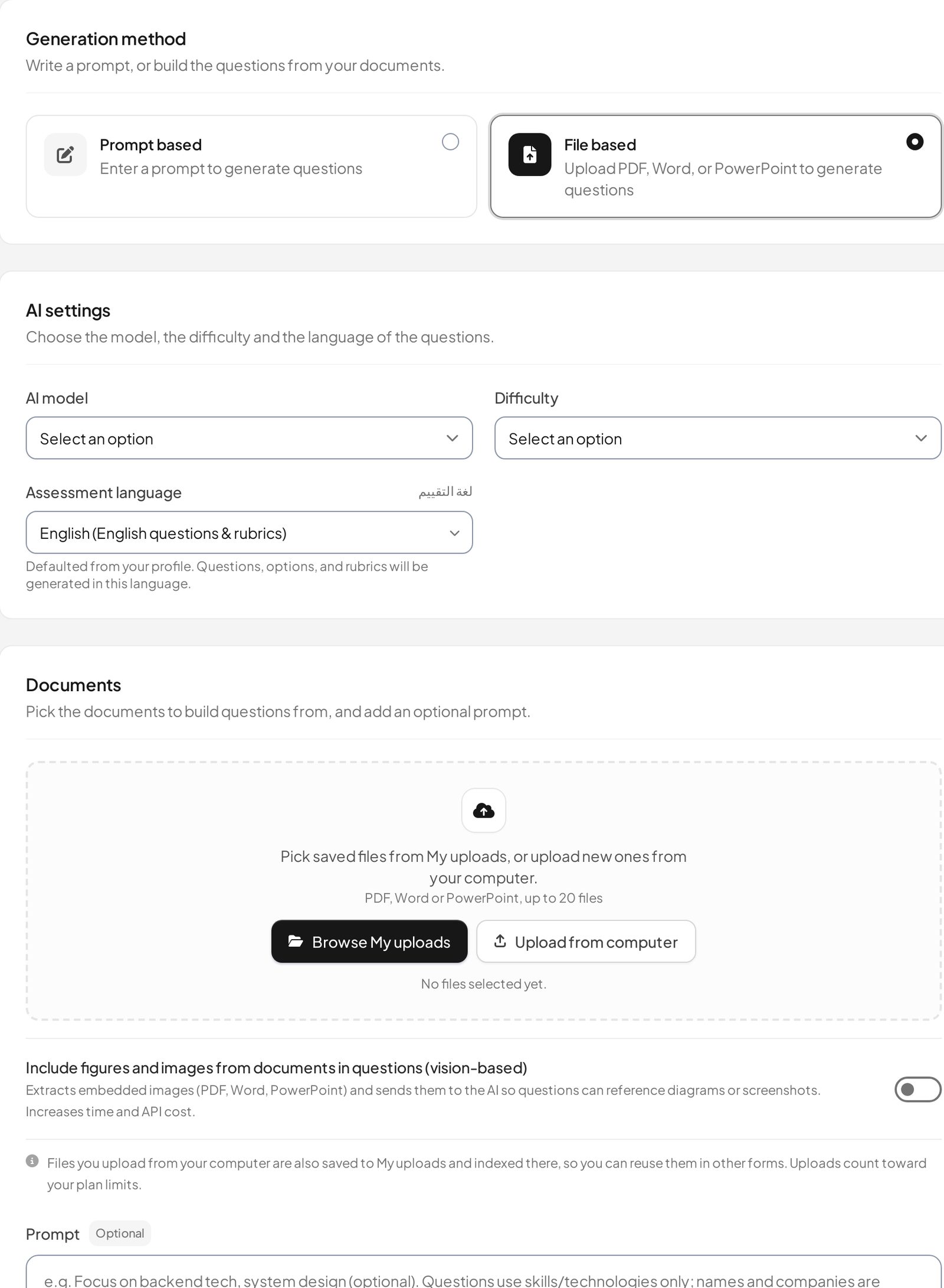
IntelliAssess writes, runs and marks tests. Its AI quiz generator builds questions from your PDF, Word or PowerPoint files, a YouTube video or a web page, checks each answer key in a second pass, and drafts a rubric for each written question. Tests go out by link or to Google Classroom. Objective answers mark themselves, and AI grading scores each written answer on every rubric criterion with a reason, for the teacher to review before releasing results. Proctoring is optional per test.
Why both kinds of check matter
A quick check and a graded test answer different questions. The quick check asks "what should I teach tomorrow?", and its value depends on speed: an answer seen while the lesson is still running can change the lesson. Paul Black and Dylan Wiliam's 1998 paper "Inside the Black Box" made this the centre of formative assessment, and it is the job Socrative is designed for. The graded test asks "what has this student learned?", and its value depends on fairness and accuracy: the right questions, consistent marking and confidence about who took it. That is the job IntelliAssess is designed for. A teacher who uses only one kind usually misses something the other would have caught.
An exit ticket and a graded test
The clearest way to see the difference is to give each tool the job it was built for, and then swap.
The exit ticket
It is the last five minutes of a Year 8 history lesson on the causes of the First World War. The teacher wants to know who can name two long-term causes before tomorrow.
With Socrative, she launches a two-question quiz in her room. Students join on their phones or laptops, answer, and see an explanation as soon as they submit. On her screen, she watches results arrive and sees that a third of the class confuses alliances with the assassination. She notes it for tomorrow's starter. Total time: four minutes.
With IntelliAssess, she could post a two-question test to Google Classroom, but there is no live view; she would see results once students submit, and marking would be by rubric rather than a glance across the room. For an exit ticket, that is slower and heavier than she needs.
The graded test
Three weeks later, the unit ends with a test that counts: ten objective questions and two written answers, such as "Explain how the alliance system turned a regional conflict into a world war". Some students are absent and will take it at home.
With IntelliAssess, she uploads her unit notes, gets a draft test with rubrics, edits it, and posts it to Google Classroom, with identity and webcam checks for the students at home. Objective answers mark themselves; the written answers arrive with AI-drafted scores per criterion, which she reviews and adjusts before releasing results to Classroom.
With Socrative, she can run the objective questions with automatic grading and live results, and its reports are good. Its pages do not describe marking written answers against a rubric with AI or checking identity for students at home, so the two essays per student would be hers to mark by hand.
Each tool wins its own job. That is the comparison in one sentence.
Notice what decided it. In the exit ticket, speed and a live view mattered, and nothing was recorded for a grade, so the lighter tool won. In the graded test, accuracy, written answers and knowing who sat the test mattered, and the result went on a report, so the heavier tool won. If your week has both moments, which most teaching weeks do, the question is not which tool is better but which moment you are buying for first, and whether a free plan can cover the other one.
Live results and feedback
Socrative's live view is the reason teachers choose it: progress appears as students answer, so a teacher can "step in when help is needed". Students also get immediate feedback: "The moment they submit an answer, they receive a concise explanation and/or the correct response". IntelliAssess has no live view. Students see their marks and comments when the teacher releases results, can ask for a re-mark, and can practise the questions they missed. For learning in the moment, Socrative is better. For considered feedback on written work, IntelliAssess gives more.
Marking
Socrative grades automatically and "flags top performers and underachievers". Its pages do not describe AI marking of written answers against a rubric. IntelliAssess marks objective questions automatically and drafts a score and reason for each rubric criterion on every written answer; the teacher reviews and changes any score. If your checks are all multiple choice, both mark them instantly. If students write paragraphs, IntelliAssess saves the marking.
AI
Socrative's AI creates assessments "by describing the assessment you need", generates questions from class content, converts existing quizzes, and analyses reports. Each has a weekly limit by plan:
| Socrative plan | AI questions generated | AI question imports | AI report analyses |
|---|---|---|---|
| Free | 15 a week | 6 a week | 3 a week |
| Essentials | 50 a week | 25 a week | 20 a week |
| Pro | 150 a week | 80 a week | 80 a week |
| Organization | 200 a week | 120 a week | 120 a week |
IntelliAssess's AI writes whole tests from files, YouTube videos and web pages within a token allowance per billing period, checks answer keys, drafts rubrics, and, from Starter, marks written answers. Socrative's AI is about producing quick-check content; IntelliAssess's covers producing and marking tests.
Security and integrity
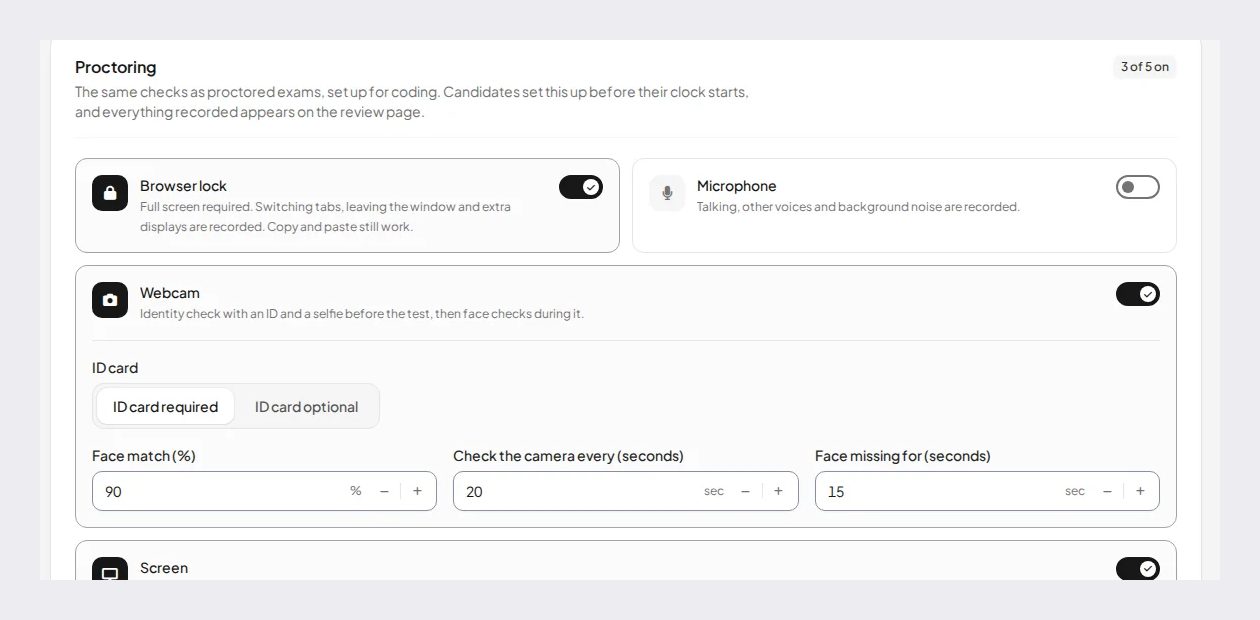
Quick checks rarely need security, and Socrative's pages do not describe lockdown or proctoring. For graded tests at home, IntelliAssess checks identity with an ID photo, live selfie, liveness check and face match, then watches the webcam, microphone, whole screen and browser, with rules that warn the student and can submit the attempt if problems continue.
Rooms, classes and setup
Socrative organises activities into rooms. The free plan has one room, Essentials five and Pro thirty, and each room takes 50 students on Free and Essentials or 300 on Pro. Essentials adds rostered rooms and pausing activities. Quizzes can be imported from Excel and organised in folders, and Pro adds 20 shared libraries for teams. Setting up a quick check is fast: write or generate a few questions, open the room, and share the room name.
IntelliAssess organises tests by class and connects to Google Classroom. Setting up a test means choosing the source material, question types, difficulty and points, reviewing the AI draft and rubrics, and setting time limits, attempts, schedule and any proctoring. That is more setup than an exit ticket deserves, and about right for a test that counts.
Ages and subjects
Socrative's quick checks work in any subject and at any age where students can use a device, and its instant explanations help younger students correct mistakes on the spot. IntelliAssess fits secondary school and university courses where students write answers in sentences: history, English, science explanations, business and similar. For early primary pupils, short quick checks suit better than rubric-marked tests.
Free plans compared
| Socrative Free | IntelliAssess Free | |
|---|---|---|
| Students | 50 per room, 1 room | Up to 25 |
| Quizzes | 5 | No limit stated |
| AI | 15 questions a week, 6 imports, 3 report analyses | AI token allowance each billing period |
| Marking | Automatic grading | Automatic for objective questions; written answers by hand on Free |
| Reports | 30 days of history | Results per test |
Socrative's free plan covers a bigger class; IntelliAssess's places no stated limit on quizzes for a smaller one. Neither free plan includes AI marking of written answers. A teacher with one class of up to 25 can run both free plans side by side for a whole unit before paying for either.
Pricing compared
Socrative (pricing): Free; Essentials $10 a seat a month, $120 billed annually, with unlimited quizzes, 5 rooms and 90 days of reports; Pro $15 a seat a month, $360 billed annually for two seats, with 30 rooms, 300 students per room and unlimited history; Organization $14.40 a seat a month billed annually, through sales.
IntelliAssess (pricing): Free for 25 students; Starter $39 a month for 200; Pro $99 for 500; Intensive $249 for 2,000; yearly billing costs ten months. AI grading and proctoring start on Starter.
| Case | Socrative | IntelliAssess |
|---|---|---|
| One teacher, daily exit tickets for five classes | Essentials $120 a year | No live view; not the right tool |
| One teacher, 150 students, unit tests with written answers | Essentials $120 a year; written answers marked by hand | Starter $390 a year billed yearly, AI marking included |
| A department of four teachers running quick checks | Pro $15 a seat a month, billed annually | Not the right tool |
| A school with graded tests at home needing identity checks | Identity checks not described | Starter or Pro, with a monthly face-check allowance |
For quick checks, Socrative is cheaper and better suited. IntelliAssess costs more because it marks written answers and proctors tests; if you need neither, choose Socrative.
What students see
In Socrative, students join a room, answer, and get an explanation or the correct answer the moment they submit. It is free for students on any device, and joining takes seconds, which suits a five-minute check.
In IntelliAssess, students open a link or Google Classroom assignment. On a proctored test, they take an ID photo and a selfie and allow the camera, microphone and screen first. After the teacher releases results, they see marks with a comment per rubric criterion, can ask for a re-mark, and can practise what they missed. The extra steps suit a graded test, not a quick check.
Reports
Socrative's reports are flexible: customisable tables, summary sheets, faculty reports and individual printouts, with history kept for 30 days on Free, 90 days on Essentials and indefinitely on Pro. IntelliAssess keeps results for each test and class, shows each written answer's score per criterion and the reason, exports results as PDF, and sends grades to Google Classroom. Socrative suits teachers who want to slice quick-check data many ways; IntelliAssess suits teachers who want graded results in Classroom with an explanation for each mark.
Languages and privacy
Socrative's site is in English, and the pages we read do not list other interface languages. IntelliAssess generates questions and rubrics in the language you choose for each test, and its interface works in English and Arabic, right to left included. On privacy, IntelliAssess stores identity and evidence photos encrypted, opens them only through short-lived links, and lists no certifications; Socrative's privacy details sit in its policy pages, which we did not compare in detail. Because IntelliAssess's proctoring collects webcam and ID photos, tell students what is recorded and who sees it before a test.
Using both
The exit ticket and the graded test show the natural split. Run exit tickets, warm-ups and short checks in Socrative, where results appear live and students get instant explanations, and run the unit test in IntelliAssess, where written answers are marked by rubric and students at home are checked. Socrative's free plan or Essentials covers the first; IntelliAssess's free plan covers a class of 25 for tests, and Starter adds AI marking for larger groups.
Keep the purpose clear for students: Socrative checks guide the lesson and do not count; IntelliAssess tests count towards the grade. After a unit, compare the time you spent marking with the time you spent before, and keep the pairing only if it saved real time.
A department's view
A department choosing between the two is choosing what to standardise. Socrative Pro, at $15 a seat a month, standardises quick checks: shared libraries of exit tickets and warm-ups, 30 rooms and unlimited report history. IntelliAssess standardises graded tests: unit tests written from the department's own material, consistent rubric marking across classes, and the same identity checks for every student testing at home, with grades in Google Classroom.
Some departments will use both: Socrative for teaching and IntelliAssess for assessment that counts. Others will choose one and use free tools for the other half.
Moving between them
If you move graded tests from Socrative to IntelliAssess, export your reports first, since history expires on Free and Essentials. Gather the notes and slides your tests should come from, write a short rubric for each written question, and run one unit test before switching every class. Keep Socrative's free plan for exit tickets if it still suits you. If you move quick checks the other way, Socrative imports quizzes from Excel, and its AI can rebuild questions from your class content.
Questions to ask before you decide
- Do you check understanding live in most lessons?
- Do you want students to see explanations the moment they answer?
- How many written answers do you mark after each unit?
- Do students take graded tests at home?
- How many students and classes does your free plan need to cover?
- Do grades need to reach Google Classroom?
Yes to the first two points to Socrative. Yes to the third, fourth and sixth points to IntelliAssess. Yes to both groups points to using both.
Who should choose which
- Choose Socrative for exit tickets, warm-ups and quick quizzes with live results and instant explanations, at a low price.
- Choose IntelliAssess for graded unit tests from your own material, written answers marked by rubric, Google Classroom grades, and identity checks at home.
Where IntelliAssess falls short
- No live results during an activity.
- No instant explanations as students submit; feedback comes when results are released.
- Not built for exit tickets or warm-ups.
- A free plan for 25 students rather than 50.
- It costs more than Socrative Essentials for one teacher.
For other tools, see Socrative alternatives, Kahoot! vs IntelliAssess and Formative vs IntelliAssess, or browse every comparison.
Frequently asked questions
Is IntelliAssess a replacement for Socrative?
Not for quick checks. IntelliAssess has no live results or instant explanations. It replaces Socrative for graded tests, where it adds AI marking of written answers and identity checks for tests at home.
Is Socrative free?
Yes. Socrative Free includes 5 quizzes, 1 room, 50 students per room, 30 days of reports, automatic grading and 15 AI-generated questions a week. Students use it free.
How much does Socrative cost?
Essentials is $120 a year per seat; Pro is $15 a seat a month, with $360 billed annually for two seats; Organization plans are through sales.
Does Socrative mark written answers with AI?
Its pages describe automatic grading and AI report analysis, but not AI marking of written answers against a rubric. IntelliAssess does that from its Starter plan, for the teacher to review.
Which is better for exit tickets?
Socrative. It shows results live and gives students explanations the moment they submit. IntelliAssess is built for graded tests.
Can I use Socrative and IntelliAssess together?
Yes. Use Socrative for quick checks during the unit and IntelliAssess for the graded test at the end, with grades in Google Classroom.
Keep reading
All articles
Read next
SchoolAI alternatives: 7 AI tools for teachers and students scored (2026)
Seven AI tools scored on the same nine facts, with SchoolAI as the reference, and what each lets teachers see when students use AI.
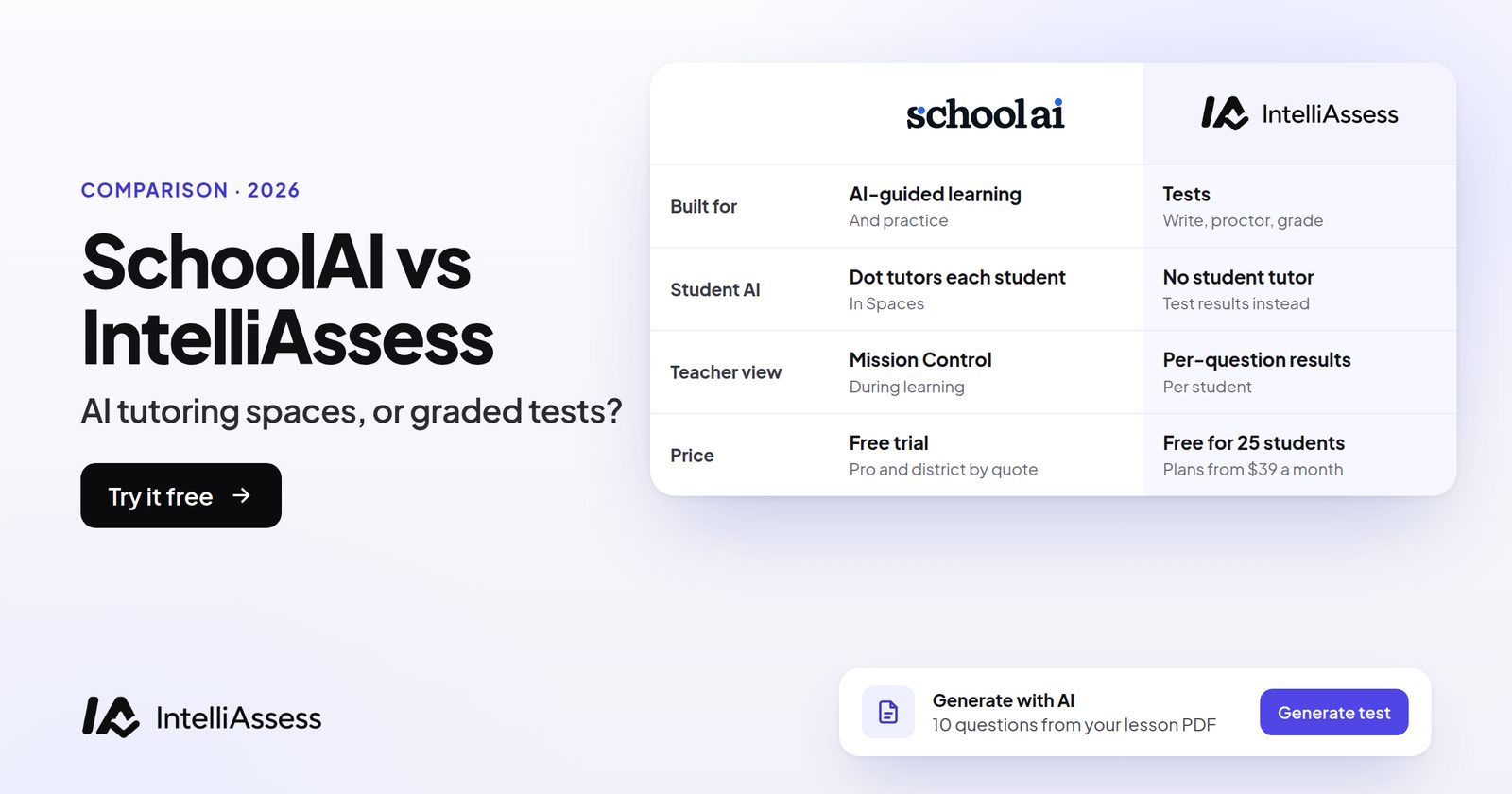
SchoolAI vs IntelliAssess: an AI tutor for students or feedback after a test?
SchoolAI puts students in supervised conversation with AI; IntelliAssess marks their tests and uses AI to help them learn from their own answers.
Motasem Aldiab 12 min read
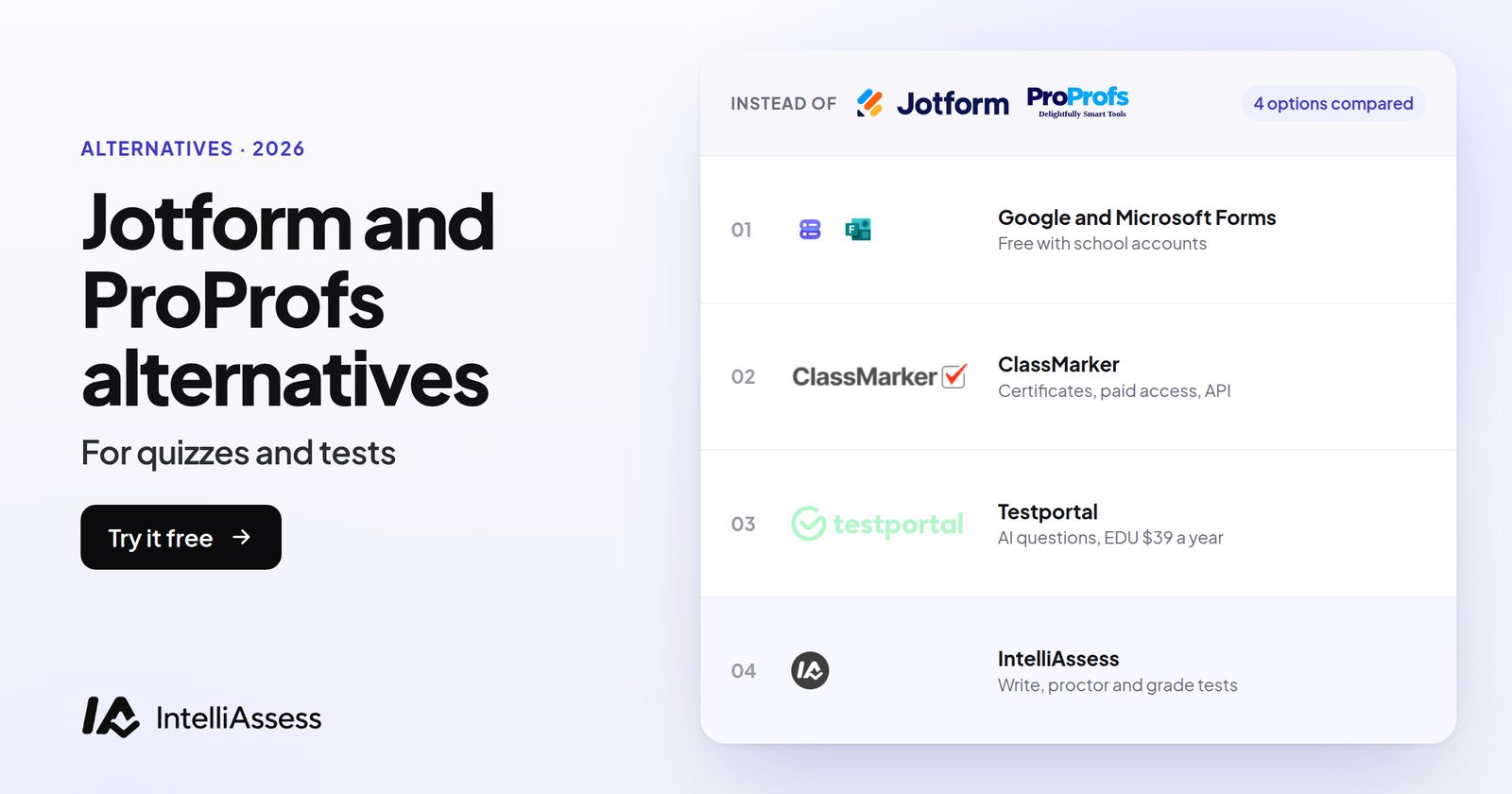
Jotform and ProProfs alternatives for quizzes and exams (2026)
Jotform and ProProfs side by side, then the alternatives by forms, certificates or real exams.
Motasem Aldiab 2 min read