
Socrative alternatives in 2026: free plans compared

By Motasem Aldiab, Technology Consultant and Trainer - Cloud, DevOps, Java, Data Science
Contents20
- What Socrative does well
- Socrative's plans
- Why teachers look for a Socrative alternative
- Free plans side by side
- The scorecard: 5 Socrative alternatives on 7 published facts
- 1. Wayground: the most generous free plan
- 2. Kahoot!: live review games
- 3. IntelliAssess: when the quick check becomes a graded test
- 4. Formative: live checks inside lessons
- 5. Google Forms: free quizzes in Classroom
- Exit tickets: which tool does them best
- What students do
- AI in each tool
- Reports and what happens to results
- Moving from Socrative
- Prices compared
- Which alternative for which teacher
- Where IntelliAssess is not the right choice
- Using a quick-check tool and a test tool together
- How to choose a Socrative alternative
Key takeaways
- 1Wayground has the most generous free plan: up to 100 students with live and self-paced activities.
- 2Kahoot! suits live review games, but its free plan allows 10 players per game.
- 3IntelliAssess comes third: graded tests with written answers marked by AI, not quick checks.
- 4Socrative Free covers 5 quizzes and 50 students; Essentials is $120 a year.
The best Socrative alternatives for quick checks and exit tickets are Wayground, which is free for teachers with up to 100 students, live and self-paced activities and AI; Kahoot! for live review games; and IntelliAssess, which comes third, for teachers whose quick checks grow into graded tests with written answers marked by AI. Formative suits teachers who want lessons and live data for $249 a year, and Google Forms is free for self-marking quizzes in Classroom. Because most teachers ask about free plans first, the free-plan limits of every tool are set side by side below, followed by a scorecard of seven published facts with Socrative as the reference.
What Socrative does well
Socrative promises to "Instantly Spot Learning Gaps with Real-Time Assessment Insights": it grades responses automatically, delivers "ready-made explanations the moment students submit", and lets teachers visualise progress live (Socrative, read 18 November 2026). It says more than 3 million teachers use it, with 4 million activities launched and 60 million student participations a year.
- Quick checks: real-time activities during a lesson, self-paced tasks, warm-ups and exit tickets, for in-person and online classes.
- Instant feedback: students get a concise explanation or the correct answer the moment they submit.
- Automatic grading: it flags top performers and students who need help.
- Reports and exports: customisable results tables, summary sheets and individual student printouts.
- AI: create assessments by describing them, generate questions from "class content you already trust", and turn existing quizzes into Socrative assessments; AI report analysis on every plan.
- Free for students on all devices.
Socrative's plans
From Socrative's pricing page, read 18 November 2026:
| Plan | Price | Quizzes and rooms | Students per room | Reports | AI a week |
|---|---|---|---|---|---|
| Free | $0 | 5 quizzes, 1 room | 50 | 30 days | 15 questions generated, 6 imports, 3 report analyses |
| Essentials | $10 a seat a month, $120 billed annually | Unlimited quizzes, 5 rooms | 50 | 90 days, advanced reports | 50 generated, 25 imports, 20 analyses |
| Pro | $15 a seat a month, $360 billed annually for 2 seats | 30 rooms, 20 shared libraries | 300 | Unlimited history | 150 generated, 80 imports, 80 analyses |
| Organization | $14.40 a seat a month, $172.80 billed annually per seat; contact sales | As Pro, with consolidated accounts | 300 | Unlimited history | 200 generated, 120 imports, 120 analyses |
Essentials adds pausing activities and rostered rooms; Pro adds embedded videos and shared libraries. The free plan is enough for one class's occasional quick checks, but five quizzes and one room run out quickly for a teacher with several classes.
Why teachers look for a Socrative alternative
- The free plan is small. Five quizzes and one room are fine for trying it, tight for daily use.
- Games. Socrative is quieter than game-based tools; some classes respond better to a competitive review game.
- Written answers. Socrative grades automatically and explains answers, but its pages do not describe AI marking of written responses against a rubric.
- Graded tests. For tests that count, at home, teachers may want identity checks Socrative does not describe.
Free plans side by side
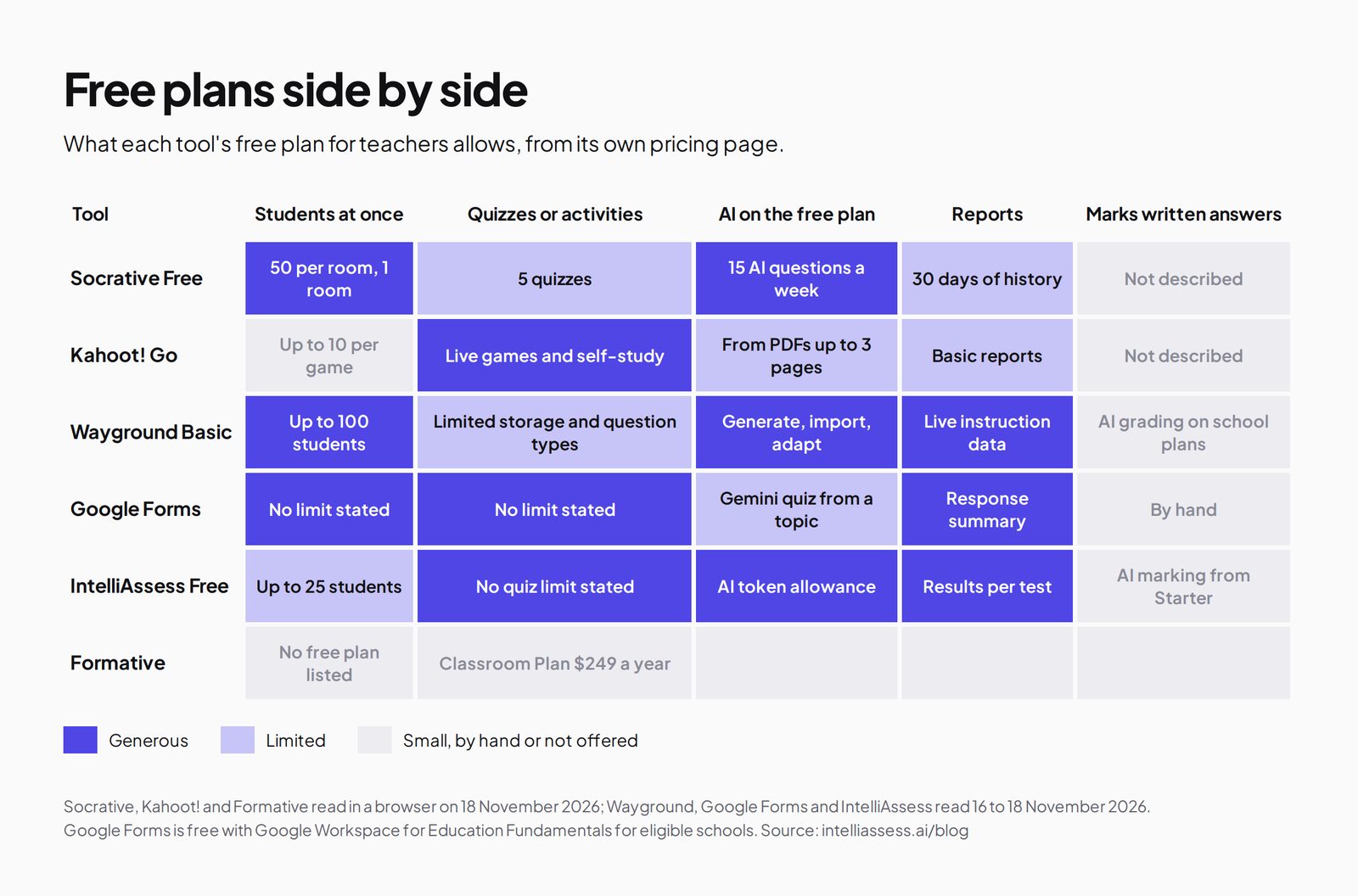
This is the question most Socrative users ask first, so here is what each free plan allows, from each tool's own pricing page.
| Free plan | Students at once | Quizzes or activities | AI | Reports | Written answers |
|---|---|---|---|---|---|
| Socrative Free | 50 per room, 1 room | 5 quizzes | 15 AI questions a week | 30 days of history | Not described |
| Kahoot! Go | Up to 10 per game | Live games and self-study | From PDFs up to 3 pages | Basic reports | Not described |
| Wayground Basic | Up to 100 students | Limited storage and question types | Generate, import, adapt, explain | Live instruction data | AI grading on school plans |
| Google Forms | No limit stated | No limit stated | Gemini quiz from a topic | Response summary | Marked by hand |
| IntelliAssess Free | Up to 25 students | No quiz limit stated | AI token allowance each billing period | Results per test | AI marking from Starter |
| Formative | No free plan listed; the Classroom Plan is $249 a year | ||||
Kahoot!'s plans FAQ says Go allows "Up to 10 participants per game", Bronze 50, Silver 100 and Gold 200. Wayground's 100-student limit is from its plans table. Google Forms comes with Google Workspace for Education Fundamentals, free for eligible schools.
For a full class on a free plan, Wayground (100 students), Socrative (50) and Google Forms are the most generous. Kahoot! Go's 10 players suit small groups only, and IntelliAssess Free covers one class of up to 25.
The scorecard: 5 Socrative alternatives on 7 published facts
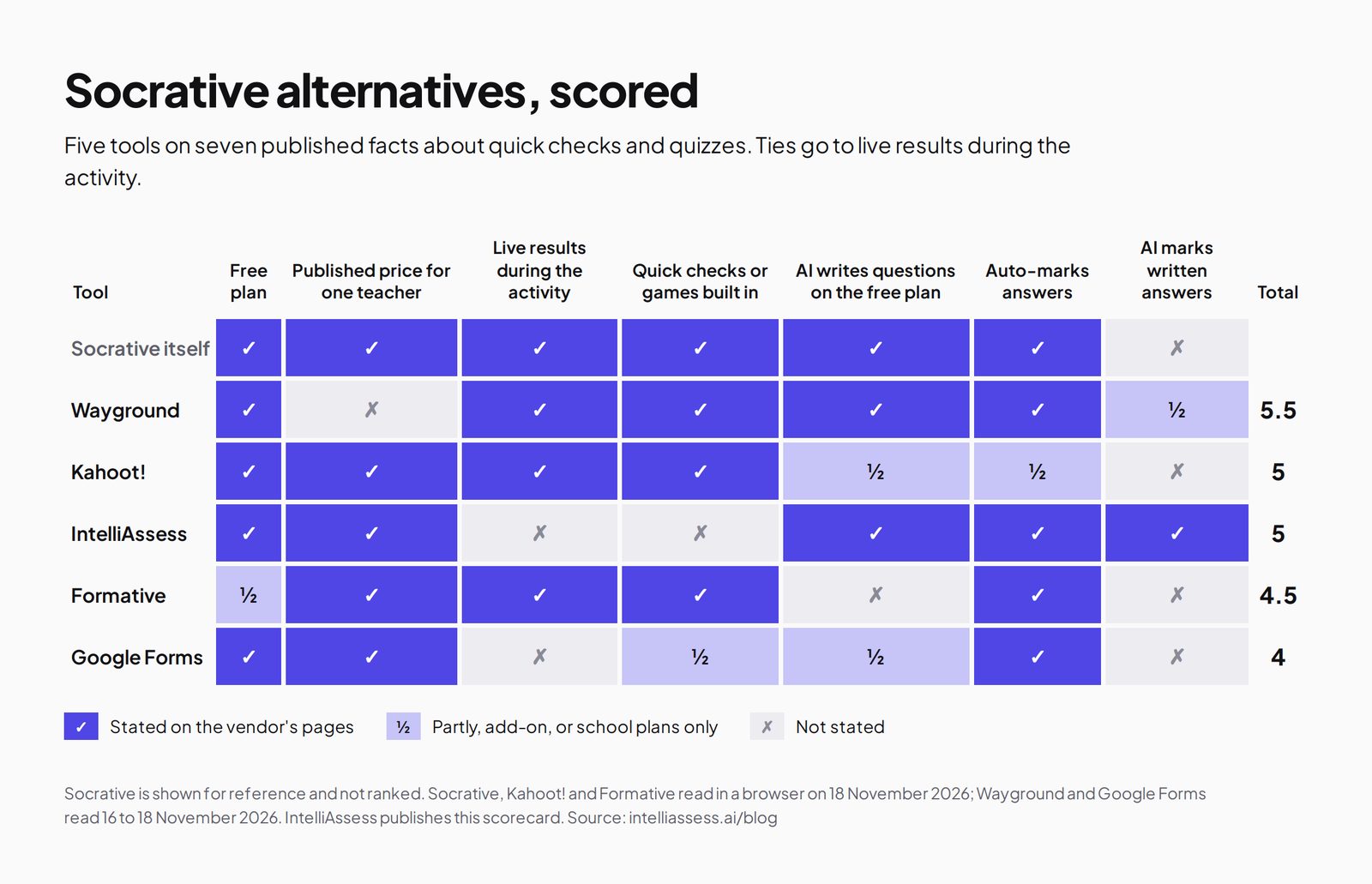
We scored each tool on what Socrative users weigh: a free plan, a price for one teacher, live results, quick checks or games, AI on the free plan, automatic marking and AI marking of written answers. A tick means the vendor's own page says so; a half means partly or on paid or school plans only; a cross means its page does not say so. Ties go to live results during the activity, the reason most teachers use Socrative.
| Tool | Free plan | Published price for one teacher | Live results during the activity | Quick checks or games built in | AI writes questions on the free plan | Auto-marks answers | AI marks written answers | Total |
|---|---|---|---|---|---|---|---|---|
| Socrative itself | ✓ | ✓ | ✓ | ✓ | ✓ | ✓ | ✗ | 6 |
| 1. Wayground | ✓ | ✗ | ✓ | ✓ | ✓ | ✓ | ½ | 5.5 |
| 2. Kahoot! | ✓ | ✓ | ✓ | ✓ | ½ | ½ | ✗ | 5 |
| 3. IntelliAssess | ✓ | ✓ | ✗ | ✗ | ✓ | ✓ | ✓ | 5 |
| 4. Formative | ½ | ✓ | ✓ | ✓ | ✗ | ✓ | ✗ | 4.5 |
| 5. Google Forms | ✓ | ✓ | ✗ | ½ | ½ | ✓ | ✗ | 4 |
Wayground's halves: no published paid price for one teacher; AI grading with rubrics on School & District plans. Kahoot!'s halves: Go generates from PDFs up to 3 pages, with full AI creation on paid plans; scores and reports rather than marking described. Formative: free sign-up but no free plan listed, so no AI on a free plan. Google Forms: self-marking quizzes but no live view; Gemini drafts quizzes from a topic. IntelliAssess's AI marking starts on Starter.
Socrative scores 6 on its own card, more than any alternative, which is fair: for quick checks it is a strong, simple tool. Teachers who leave usually want a bigger free plan, games, or marking help for written answers.
1. Wayground: the most generous free plan
Best for: teachers who want free live and self-paced activities for a full class, with AI and accommodations.
Wayground, formerly Quizizz, offers on its free Basic plan "Live and student-paced delivery", "Live instruction data with Classroom Pulse", AI to "generate, import, adapt, and explain", and "20+ accommodations, including Read Aloud", for up to 100 students (plans). Its homepage lists "Auto-graded homework" and "Lockdown mode, tab-switching alerts, and academic integrity reports". School & District plans add AI grading with custom and state rubrics, and Canvas, Schoology, Clever and ClassLink integrations. Against Socrative: a bigger free plan, more game-style options and accommodations. Where it falls short: no published paid plan for one teacher, and limited question types and storage on the free plan. See Wayground alternatives.
2. Kahoot!: live review games
Best for: teachers who want energetic, competitive review in class.
Kahoot! lets teachers "Host a live kahoot with questions displayed on a shared screen" on every plan, with class reporting that shows where "every student stands, in real time" (Kahoot! for schools). Paid plans add AI creation from topics and trusted sources. Price (plans): Kahoot! Go is free for up to 10 participants per game; Kahoot!+ Bronze is $36 a year for 50 players, Silver $84 for 100, and Gold $120 for 200, billed annually; a Black Friday offer was running when we read the page. Against Socrative: more energy and game formats. Where it falls short: the free plan only fits small groups, and marking of written answers is not described. See Kahoot! alternatives.
3. IntelliAssess: when the quick check becomes a graded test
Best for: teachers who use quick checks during a unit and need the end-of-unit test written, marked, including written answers, and secured for students at home.
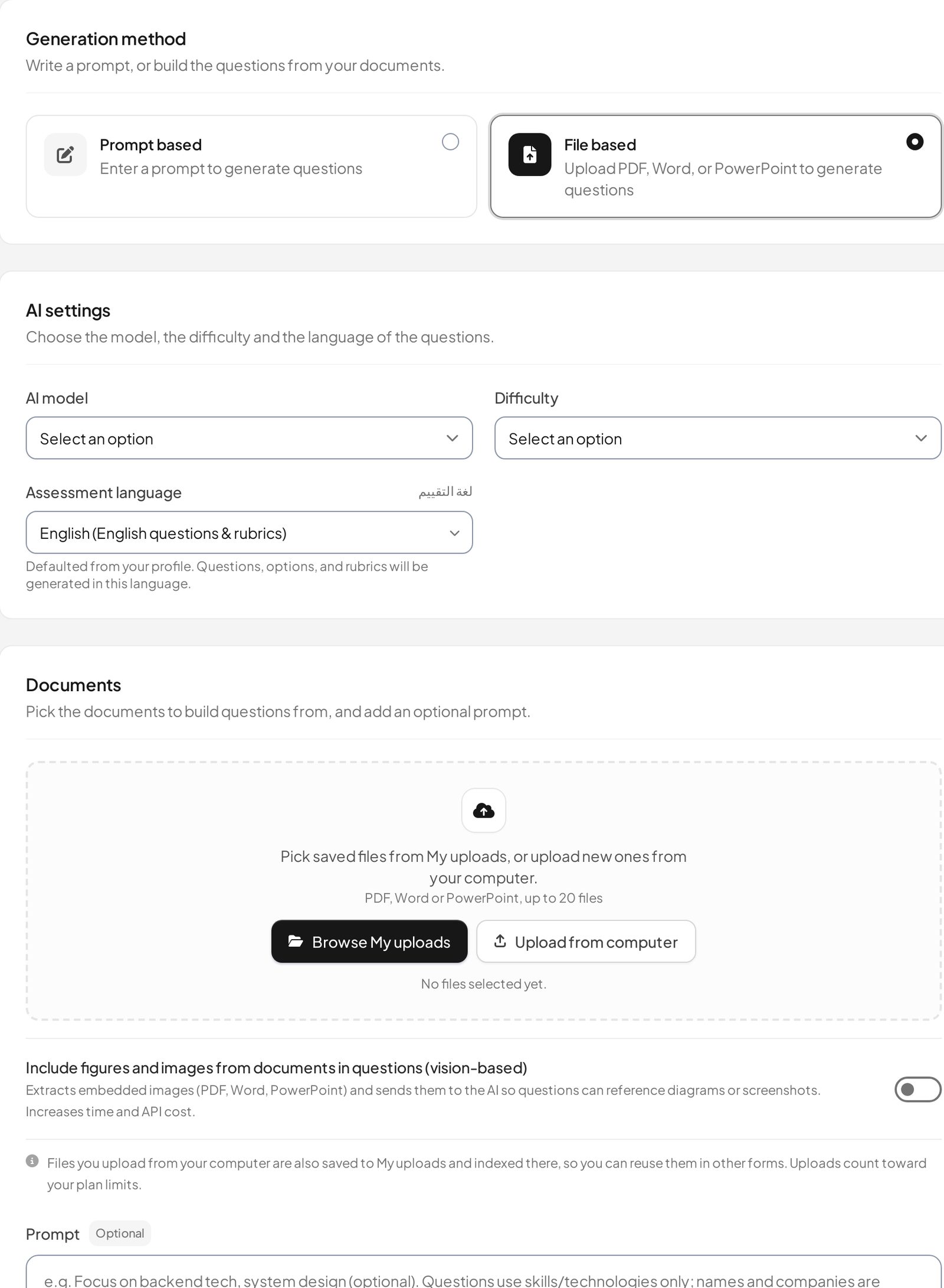
IntelliAssess's AI quiz generator writes tests from your PDF, Word or PowerPoint files, a YouTube video or a web page. Objective questions mark themselves; on paid plans, AI grading scores each written answer on every rubric criterion with a reason for the teacher to review. Online proctoring adds ID, face match, webcam, microphone, screen and browser checks. Tests post to Google Classroom with grades sent back.
Price (from our pricing page): Free for 25 students with an AI token allowance and five question types; Starter $39 a month for 200 students, with AI grading and proctoring; Pro $99 for 500; Intensive $249 for 2,000; yearly billing costs ten months. Against Socrative: AI marking of written answers and identity checks for tests at home. Where it falls short: no live results during an activity, no quick-check games, a free plan for 25 students rather than 50, and Starter costs more than Socrative Essentials. See Socrative vs IntelliAssess.
4. Formative: live checks inside lessons
Best for: teachers who want live response data inside interactive lessons, with standards tracking.
Formative lets teachers "See student responses in real time, not tomorrow", with 20+ question and content types, a lesson builder with Google Slides, Luna AI to build activities from prompts, PDFs or documents, standards tagging, auto-grading and rubrics (Formative). Price (plans): $249 a year per teacher; $3,125 a year for a small school. Against Socrative: richer lessons and standards data. Where it falls short: no free plan listed, and it costs about twice Socrative Essentials. See Formative alternatives.
5. Google Forms: free quizzes in Classroom
Best for: schools on Google Workspace that want free self-marking quizzes with grades in Classroom.
Google Forms comes with Google Workspace for Education Fundamentals, free to eligible schools. Quizzes have answer keys on six question types, points and feedback; written answers are marked by hand; locked mode works on school-managed Chromebooks, and Gemini in Classroom can draft a quiz from a topic. Against Socrative: no limits stated on the free plan and grades straight into Classroom. Where it falls short: no live view during an activity and no games. See Google Forms alternatives.
Exit tickets: which tool does them best
An exit ticket is one or two questions at the end of a lesson that tell the teacher what to do tomorrow. The best tool is the one that shows answers fastest with the least setup.
- Socrative and Formative are built for this: quick to launch, answers visible live, and explanations for students.
- Wayground does it free for a full class, with live data.
- Kahoot! turns it into a game; fun, but the free plan's 10-player limit rules out most classes.
- Google Forms works if you prepare a form in advance and read the response summary after.
- IntelliAssess is not built for exit tickets: there is no live view, and its strengths show at the end of a unit, not the end of a lesson.
What students do
For quick checks, the student side matters as much as the teacher side: a tool that takes two minutes to join wastes a third of an exit ticket. Socrative says it is "100% free for students to use, on all devices", and students join a teacher's room to answer. Kahoot! and Wayground work the same way, with a join code on the shared screen, and add game elements. Google Forms opens from a link or a Classroom post. Formative uses a join code or link.
IntelliAssess opens from a link or a Google Classroom assignment; for a proctored test, students first take an ID photo and selfie and allow the camera, microphone and screen, which is right for a graded test at home and too much for a two-question exit ticket. That difference in friction is another reason to keep a quick-check tool for lessons and use IntelliAssess for tests.
AI in each tool
Socrative's AI generates questions from a description or from class content, imports existing quizzes, and analyses reports, with weekly limits by plan: 15 generated questions a week on Free, 50 on Essentials, 150 on Pro. Wayground's free plan includes AI to generate, import, adapt and explain. Kahoot! Go generates from PDFs up to 3 pages, with full AI creation on paid plans. Formative's Luna AI builds activities from prompts, PDFs or documents on its paid plans. Gemini drafts Google Forms quizzes from a topic. IntelliAssess's free plan includes an AI token allowance for writing tests from files, videos and web pages, and its paid plans add AI marking of written answers against a rubric.
For quick checks, any of these AI writers is enough. AI marking only matters once students write sentences that someone has to mark.
Reports and what happens to results
Socrative's reports are one of its quiet strengths: customisable results tables and exports for "summary sheets, detailed faculty reports, or individualized student printouts", with history kept for 30 days on Free, 90 days on Essentials and without limit on Pro. If you rely on old reports, check the history limit before choosing a plan, and export what you need.
Wayground's free plan includes live instruction data, and its plans list academic integrity reports. Kahoot! Go has basic reports, with fuller reports on paid plans. Google Forms keeps responses in the form and can send them to a Google Sheet. Formative adds standards tracking and dashboards. IntelliAssess keeps results per test and per class, with written-answer scores per rubric criterion, sends grades to Google Classroom, and exports results as PDF.
Moving from Socrative
- Export your reports before history expires on your plan.
- Move your quizzes: Socrative imports from Excel; check how your new tool imports questions, or let its AI rebuild them from your notes.
- Match rooms to classes in the new tool, or to Google Classroom classes.
- Keep the free plan if you still want Socrative for occasional exit tickets.
- Tell students where to join and run one practice activity first.
Prices compared
| Tool | Free | Cheapest paid plan for one teacher |
|---|---|---|
| Socrative | 5 quizzes, 1 room, 50 students | Essentials $120 a year |
| Wayground | Basic, up to 100 students | Not published; schools quoted |
| Kahoot! | Go, up to 10 per game | Bronze $36 a year, 50 players |
| IntelliAssess | 25 students | Starter $390 a year billed yearly, 200 students |
| Formative | No free plan listed | Classroom Plan $249 a year |
| Google Forms | Free with Education Fundamentals | Free |
For quick checks, Kahoot! Bronze and Socrative Essentials are the cheapest paid plans, and Wayground and Google Forms are free. IntelliAssess costs more because it marks written answers and proctors tests; for quick checks alone, that is more than you need.
Which alternative for which teacher
- A bigger free plan for a full class: Wayground.
- Competitive review games: Kahoot!.
- Graded unit tests with written answers: IntelliAssess, alongside a quick-check tool.
- Live checks inside interactive lessons: Formative.
- Free quizzes with grades in Classroom: Google Forms.
- Simple, calm quick checks with instant explanations: stay with Socrative; Essentials is $120 a year.
Where IntelliAssess is not the right choice
- You want live results during an activity or an exit ticket at the end of a lesson.
- You want games such as team races or review competitions.
- Your free plan must cover more than 25 students.
- You only need quick checks: Socrative, Wayground or Kahoot! cost less.
Using a quick-check tool and a test tool together
Quick checks and graded tests are different jobs, so many teachers use two tools. Keep Socrative, Wayground or Kahoot! for exit tickets and review during the unit, and use IntelliAssess for the end-of-unit test with written answers, marked against a rubric and, if taken at home, with identity checks. Grades from IntelliAssess go to Google Classroom; quick-check results can stay in the quick-check tool, since they guide teaching rather than count towards a grade.
How to choose a Socrative alternative
- Count your classes and students and check them against each free plan.
- Decide whether you want calm checks or games.
- Decide whether written answers need marking help.
- Check where grades go: Google Classroom, an LMS, or nowhere.
- Run one week of exit tickets in the free plan before switching.
Browse every comparison, or see Kahoot! alternatives and Formative alternatives.
Frequently asked questions
What is the best free alternative to Socrative?
Wayground, whose free Basic plan covers up to 100 students with live and self-paced activities and AI. Google Forms is also free with Google Workspace for Education Fundamentals, without a live view.
Is Socrative still free?
Yes. Socrative Free includes 5 quizzes, 1 room, 50 students per activity, 30 days of report history, automatic grading and 15 AI-generated questions a week. Students always use it free.
How much does Socrative cost?
Essentials is $10 a seat a month, $120 billed annually. Pro is $15 a seat a month, with $360 billed annually for two seats. Organization plans are $14.40 a seat a month billed annually, through sales.
How many students can join a Socrative quiz?
Up to 50 students per room on Free and Essentials, and up to 300 on Pro, according to Socrative's pricing FAQ.
Which Socrative alternative marks written answers?
IntelliAssess marks written answers against each rubric criterion with AI, from its Starter plan, for the teacher to review. Wayground lists AI grading with rubrics on School & District plans.
Is Kahoot! better than Socrative?
For competitive review games, Kahoot! is livelier. For calm quick checks with instant explanations and a 50-student free plan, Socrative fits better; Kahoot! Go allows only 10 players per game.
Keep reading
All articles
Read next
SchoolAI alternatives: 7 AI tools for teachers and students scored (2026)
Seven AI tools scored on the same nine facts, with SchoolAI as the reference, and what each lets teachers see when students use AI.
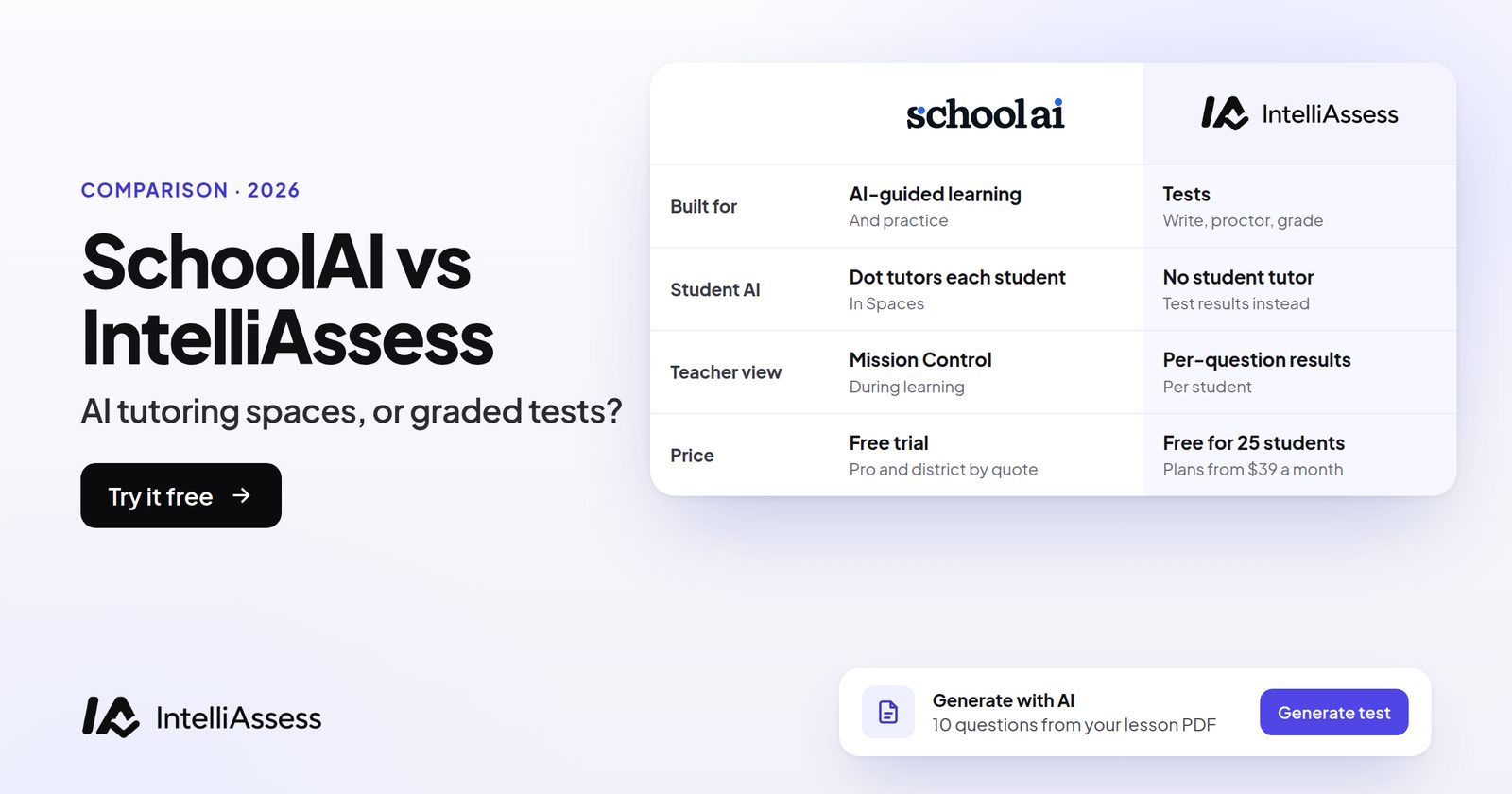
SchoolAI vs IntelliAssess: an AI tutor for students or feedback after a test?
SchoolAI puts students in supervised conversation with AI; IntelliAssess marks their tests and uses AI to help them learn from their own answers.
Motasem Aldiab 12 min read
Jotform and ProProfs alternatives for quizzes and exams (2026)
Jotform and ProProfs side by side, then the alternatives by forms, certificates or real exams.
Motasem Aldiab 2 min read