
Gradescope alternatives in 2026: pick by how students hand in work

By Motasem Aldiab, Technology Consultant and Trainer - Cloud, DevOps, Java, Data Science
Contents19
- What Gradescope does that others rarely match
- Gradescope Basic and Institutional at a glance
- Why instructors look for a Gradescope alternative
- Paper, typed or code: start with how work is handed in
- The scorecard: 5 Gradescope alternatives on 6 published facts
- 1. Apporto PowerGrader: AI draft marks across many kinds of work
- 2. Akindi: bubble sheets on plain paper
- 3. IntelliAssess: typed written answers, marked by rubric
- 4. Canvas SpeedGrader: grading inside your LMS
- 5. Digiexam: digital exams with grading tools
- Dynamic rubrics, regrades and statistics
- Academic integrity across the lanes
- Privacy and security
- Moving from Gradescope
- A term in each lane
- What it costs
- Which alternative for which instructor
- Where IntelliAssess is not the right choice
- How to choose a Gradescope alternative
Key takeaways
- 1For handwritten paper exams, Gradescope is hard to replace; Apporto PowerGrader lists handwritten work.
- 2Akindi scores bubble sheets on plain paper with any scanner.
- 3IntelliAssess comes third: it leads only for typed written answers marked by rubric.
- 4Gradescope Basic is free; its AI grouping and code autograder need the Institutional licence.
The best Gradescope alternatives depend on how your students hand in their work. If they write on paper, Gradescope is hard to replace: Akindi covers multiple-choice bubble sheets, and Apporto PowerGrader lists handwritten work among what its AI drafts marks for. If they type their answers into an online test, IntelliAssess writes the test and marks each written answer against your rubric with AI, which is the one lane where it leads. If they submit code, Gradescope's autograder and Apporto PowerGrader are the options here. Below, five tools are scored on the same six facts about how work is graded, with Gradescope as the reference; IntelliAssess comes third.
What Gradescope does that others rarely match
Gradescope, owned by Turnitin, says it has graded "700M+" questions for "140k+" instructors at "2,600+" universities and "3.2M+" students (Gradescope, read 18 November 2026). Its strength is paper.
- Scanned exams. "After the exams are scanned in, they can be uploaded in batches. We'll attempt to automatically split the scanned pages into submissions," then match them to the roster (getting started).
- Homework as photos or PDFs. Students upload PDFs or photos of their work, including through a mobile app, with variable-length assignments supported.
- Answer groups. Instructors can group similar answers and grade each group once; "for some question types, Gradescope AI automatically forms groups for you to review", for fixed-template assignments.
- Dynamic rubrics. "Make rubric changes that apply to previously graded work", so a late change to how a mistake is scored updates every paper already graded.
- Regrade requests and statistics. Students can request regrades after release, and instructors see statistics per assignment, question and rubric item.
- Bubble sheets and code. Bubble sheets are scored against up to five answer-key versions, and programming assignments "work with all programming languages" with an autograder, manual grading or both, plus code similarity checks.
Price: Gradescope has two plans on its pricing page. Basic is free and includes dynamic rubrics, question-by-question grading, student and instructor PDF uploads, statistics, regrade requests, data export and the student app. Institutional, priced on request with a one-term trial, adds AI-powered grading, answer groups, bubble sheets, programming and online assignments, anonymous grading, code similarity, LMS integration, single sign-on and an administrator dashboard. The pricing page carries a 2023 copyright, so check it with Gradescope.
No other tool on this list matches Gradescope for scanning a stack of handwritten STEM exams, grouping the answers and grading them in one place. Its homepage shows examples from computer science, physics, mathematics, chemistry, biology, engineering and economics, the subjects where answers follow a fixed template and grouping pays off most.
Gradescope Basic and Institutional at a glance
| Feature | Basic (free) | Institutional (quoted) |
|---|---|---|
| Dynamic rubrics, question-by-question grading | Yes | Yes |
| Student and instructor PDF uploads, student app | Yes | Yes |
| Statistics, regrade requests, data export | Yes | Yes |
| AI-powered grading and answer groups | No | Yes |
| Bubble sheets, programming and online assignments | No | Yes |
| Anonymous grading, code similarity | No | Yes |
| LMS integration, single sign-on, admin dashboard | No | Yes, not in the trial |
The split matters when you compare. Many instructors use Basic on their own, which handles scanned and uploaded work well but leaves out AI grouping, bubble sheets and code. An alternative that adds AI marking may beat Basic for typed work while still falling short of Institutional for paper.
Why instructors look for a Gradescope alternative
- The useful features are Institutional. AI grouping, bubble sheets, code autograding and LMS sync need a licence your institution buys.
- AI groups answers but does not score them. The instructor still grades each group; for long essays, grouping helps less.
- Tests are written elsewhere. Gradescope grades work; it does not write the questions.
- Typed answers. Online assignments exist on Institutional, but courses that already test online may want AI marking of written answers against a rubric.
Paper, typed or code: start with how work is handed in
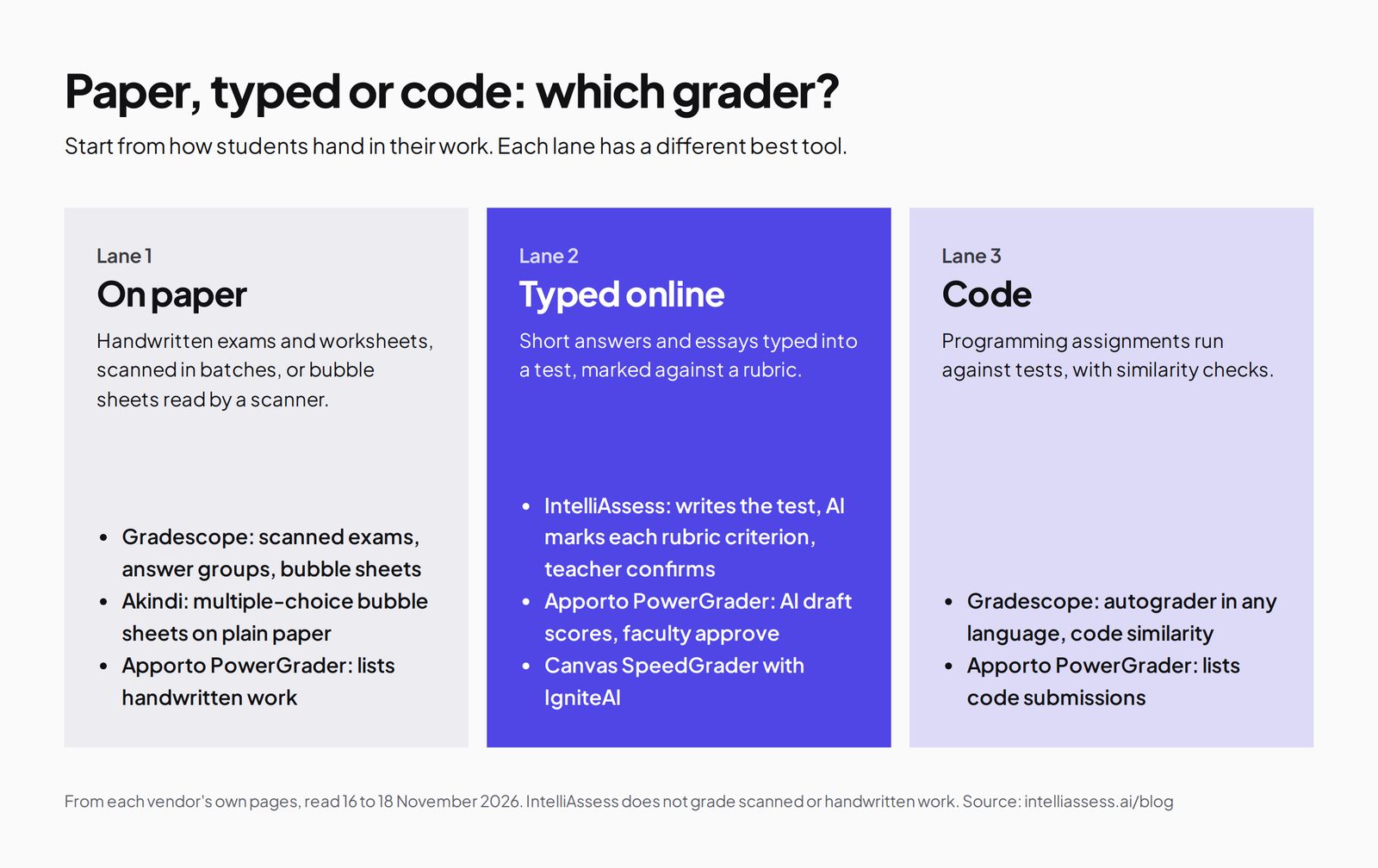
Most comparisons treat these tools as interchangeable. They are not. A tool built for scanned paper does little for an online test, and a tool that marks typed essays cannot read a scanned page. Decide your lane first, then compare within it.
| How students hand in work | What you need | Tools on this list |
|---|---|---|
| Handwritten exams on paper | Scanning, page splitting, roster matching, grouping, rubrics | Gradescope; Apporto PowerGrader lists handwritten work |
| Multiple-choice bubble sheets | Scanner reading against answer keys | Akindi; Gradescope Institutional |
| Typed short answers and essays | Rubric marking, ideally with AI drafts | IntelliAssess, Apporto PowerGrader, Canvas SpeedGrader, Digiexam |
| Programming assignments | Autograder, similarity checks | Gradescope Institutional; Apporto PowerGrader lists code |
The scorecard: 5 Gradescope alternatives on 6 published facts
A tick means the vendor's own page says so; a half means partly, only on some tiers, or that the method is not described; a cross means its page does not say so. Ties go to the tool that covers paper, Gradescope's own lane.
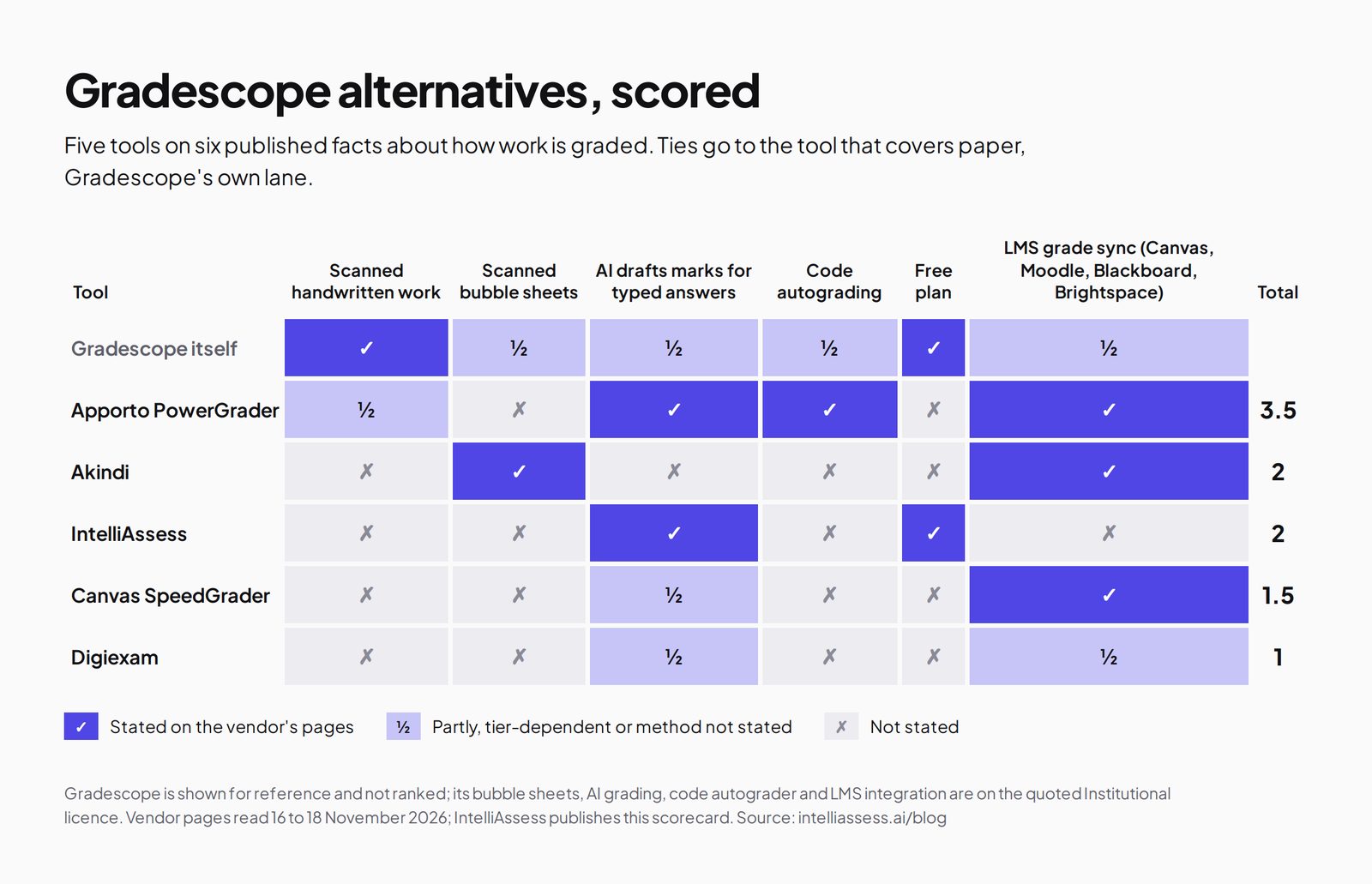
| Tool | Scanned handwritten work | Scanned bubble sheets | AI drafts marks for typed answers | Code autograding | Free plan | LMS grade sync | Total |
|---|---|---|---|---|---|---|---|
| Gradescope itself | ✓ | ½ | ½ | ½ | ✓ | ½ | 4 |
| 1. Apporto PowerGrader | ½ | ✗ | ✓ | ✓ | ✗ | ✓ | 3.5 |
| 2. Akindi | ✗ | ✓ | ✗ | ✗ | ✗ | ✓ | 2 |
| 3. IntelliAssess | ✗ | ✗ | ✓ | ✗ | ✓ | ✗ | 2 |
| 4. Canvas SpeedGrader | ✗ | ✗ | ½ | ✗ | ✗ | ✓ | 1.5 |
| 5. Digiexam | ✗ | ✗ | ½ | ✗ | ✗ | ½ | 1 |
Gradescope's halves: bubble sheets, code, LMS integration and AI-powered grading are on the quoted Institutional licence, and its AI groups answers rather than drafting marks. PowerGrader's half: it lists "Math & handwritten work" without saying how pages are read. LMS grade sync means Canvas, Moodle, Blackboard or Brightspace; IntelliAssess syncs grades to Google Classroom, which this fact does not count. Canvas SpeedGrader's AI half: AI-assisted rubrics and feedback are described for IgniteAI, which depends on the Canvas tier.
1. Apporto PowerGrader: AI draft marks across many kinds of work
Best for: universities that want AI to draft scores and feedback for faculty to approve, across essays, code and other submissions, inside their LMS.
Apporto describes AI PowerGrader as AI that "uses AI to prepare detailed feedback and draft scores for faculty to review, refine, and approve". It lists essays and short answers, code submissions, "Math & handwritten work", PDFs and spreadsheets, discussion posts and multi-file assignments. "No grade is released without faculty confirmation", and faculty can edit scores, refine comments or request targeted regrading. It names "Native Two-Way LMS Integrations" with Canvas, Brightspace, Anthology and Moodle, and lists SOC 2 Type II, FERPA, HECVAT and WCAG 2.2 AA, with "student data never used to train our models". Apporto reports that faculty accepted 96.6% of draft grades at DeVry University; that is the vendor's figure.
Price: not published; demos and pilots on request. Against Gradescope: PowerGrader drafts scores rather than grouping answers, and covers typed work and code as well. Where it falls short: no published price or free plan, and its page does not say how handwritten pages are captured, so test it on your own scans.
2. Akindi: bubble sheets on plain paper
Best for: instructors who give large multiple-choice exams on paper and want them scored quickly.
Akindi calls itself a "Scantron Alternative" for paper and online test scoring: "Use regular paper and any scanner to easily manage high volume scanning times", with LMS integration for Canvas, Blackboard, Moodle and D2L Brightspace. It says it is "Trusted With Over 20 Million Student Tests", and its testimonials come from universities and colleges such as the University of Tennessee and Duke. It lists FERPA and FIPPA compliance.
Price: an annual licence "based on the total number of individual student tests graded through Akindi, regardless of the number of instructors signed up", on quote, with a free 30-day pilot (pricing). Against Gradescope: Akindi does one part of Gradescope's paper lane, bubble sheets, without needing Gradescope's Institutional licence. Where it falls short: multiple choice only, with no written-answer grading or AI described.
3. IntelliAssess: typed written answers, marked by rubric
Best for: instructors and schools whose tests are taken online with short answers and essays, who want the test written and the written answers marked against a rubric.
IntelliAssess's AI quiz generator writes a test from your PDF, Word or PowerPoint files, a YouTube video or a web page, and the rubric generator drafts a rubric for each written question. AI grading then scores each typed answer on every criterion, with a reason for each, and the teacher reviews, changes any score and releases the results. Students can ask for a re-mark and practise what they missed. It also offers browser-based proctoring and publishes to Google Classroom, with grades sent back.
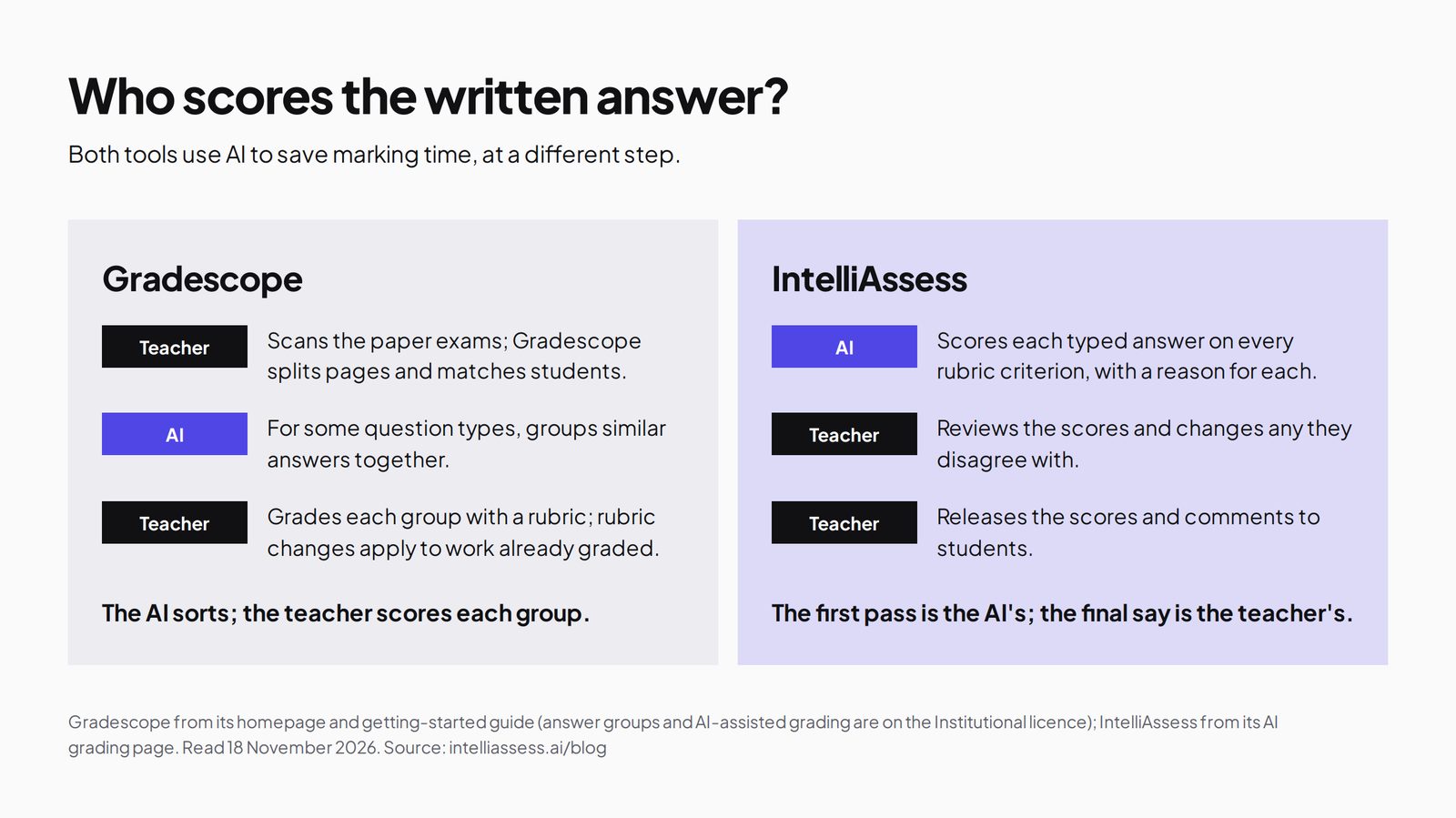
Price (from our pricing page): Free for 25 students; Starter $39 a month for 200; Pro $99 for 500; Intensive $249 for 2,000; yearly billing costs ten months. AI grading starts on Starter. Against Gradescope: IntelliAssess writes the test and drafts a score for every typed answer, where Gradescope groups answers for the instructor to grade. Where it falls short: no scanned or handwritten work, no bubble sheets, no code autograder for classes, and no Canvas, Moodle, Blackboard or Brightspace integration. See Gradescope vs IntelliAssess.
4. Canvas SpeedGrader: grading inside your LMS
Best for: instructors whose institution runs Canvas and who want to grade where the assignment already lives.
Instructure describes SpeedGrader as the place to "Grade student submissions, leave comments, and annotate documents, all in one place", including on the mobile Teacher app (Canvas). Its IgniteAI page promises to "Speed up grading with AI-assisted rubrics, feedback, and discussion insights while staying in control", with opt-in features for institutions; the Canvas page says its most advanced AI is in higher tiers. Against Gradescope: no extra tool for students and no grade sync to set up. Where it falls short: no scanning, grouping or bubble sheets, and AI grading help depends on your institution's tier and settings.
5. Digiexam: digital exams with grading tools
Best for: schools and universities moving exams from paper to supervised digital exams.
Digiexam's site describes automatic and anonymous grading and AI-assisted feedback, and its proctoring page adds ID checks and live proctors who can watch up to 30 students each. Its Lockdown for Canvas is in early access at $1,995 a year or $2.99 per student; the full Exam Platform is quoted. Against Gradescope: Digiexam replaces paper with secured digital exams rather than grading scans. Where it falls short: no free plan or code grading, and the platform price is on request. See Digiexam alternatives.
Also worth a look: Exam.net moves whole-school exams online with a lockdown browser and rule-based marking (Exam.net alternatives), and for essays typed in Google Classroom, see our CoGrader and EssayGrader alternatives.
Dynamic rubrics, regrades and statistics
Three Gradescope features come up most often when instructors explain why they stay. Here is how each alternative handles them, from its own pages.
| Feature | Gradescope | IntelliAssess | Apporto PowerGrader | Akindi |
|---|---|---|---|---|
| Change the rubric after grading starts | Changes apply to work already graded | Teacher can change any AI score and comment before release | Faculty refine scores and comments, or request regrading | Answer key based |
| Students ask for a regrade | Regrade requests after release | Re-mark requests after release | Not stated | Not stated |
| Statistics | Per assignment, question and rubric item | Results and skills reports | Not stated | Item analysis not read |
Gradescope's retroactive rubric is distinctive: change one rubric item and every graded paper updates. If that is how you grade, test whether an alternative's way of editing marks fits before you switch.
Academic integrity across the lanes
Each lane raises a different integrity question, and the tools answer them differently.
- Paper exams are usually sat in a room under supervision, so the grading tool does not need to police them. Gradescope's anonymous grading, on Institutional, helps reduce bias when marking.
- Code is easy to copy, which is why Gradescope adds code similarity checks to programming assignments on Institutional.
- Typed online tests taken at home need checks during the test. IntelliAssess can add an ID photo, a live selfie and face match, and webcam, microphone, screen and browser checks, with rules that warn the student and can submit the attempt if problems keep happening. Digiexam adds live proctors and a lockdown app. Apporto PowerGrader, Akindi and SpeedGrader grade work; they do not describe supervising it.
If your typed tests are taken in a supervised room, you may not need proctoring at all; if they are taken at home and count towards a grade, plan for it.
Privacy and security
Gradescope lists single sign-on and an administrator dashboard on Institutional; its privacy policy is linked from every page. Apporto lists SOC 2 Type II, FERPA, HECVAT Full 3.06 and WCAG 2.2 AA for PowerGrader, and says student data is never used to train its models. Akindi lists FERPA and FIPPA compliance. IntelliAssess stores identity and evidence photos encrypted, opens them only through short-lived links, and lists no certifications. Universities that require HECVAT or SOC 2 in procurement will find PowerGrader already has that paperwork.
Moving from Gradescope
- Export your data. Gradescope Basic includes data export; download grades and submissions for each course before you switch.
- Keep paper where it works. If some exams stay on paper, you can keep Gradescope Basic for those and move only typed work.
- Rebuild rubrics as criteria. Gradescope rubrics are lists of items with points; AI markers such as IntelliAssess and PowerGrader work best with criteria and levels. Write them once and reuse them.
- Run one assignment in parallel. Mark it your usual way and with the new tool, and compare the scores before relying on AI drafts.
- Tell students where to submit and how regrade or re-mark requests now work.
A term in each lane
Picture a first-year physics course with weekly problem sets, two midterms and a final. In Gradescope, students photograph their problem sets, the midterms are scanned after the exam, and staff grade question by question, with answer groups speeding up the repetitive ones. That is the workflow Gradescope was built for, and no tool here replaces it end to end.
Now picture a first-year writing or business course with weekly short-answer quizzes and two essay tests, all typed online. Scanning plays no part. Here the time goes on reading and marking typed answers, and a tool that drafts a score per rubric criterion, such as IntelliAssess or PowerGrader, saves more than one that groups answers. Many departments will have courses of both kinds, which is why the lane matters more than the brand.
What it costs
| Tool | Free option | Paid | Who buys |
|---|---|---|---|
| Gradescope | Basic, free | Institutional, quoted, one-term trial | Instructor (Basic), institution (Institutional) |
| Apporto PowerGrader | Pilots | Quoted | Institution |
| Akindi | 30-day pilot | Annual licence by tests graded, quoted | Institution or department |
| IntelliAssess | Free for 25 students | From $39 a month for 200 students | Teacher, department or school |
| Canvas SpeedGrader | Part of Canvas | Canvas tiers | Institution |
| Digiexam | None | Lockdown $1,995 a year; platform quoted | School or university |
Only IntelliAssess and Gradescope Basic can be started by one instructor without a sales conversation, and only IntelliAssess publishes a paid price. Everything else on this list is bought by the institution.
Which alternative for which instructor
- Handwritten STEM exams on paper: stay with Gradescope; test Apporto PowerGrader on your scans if you want AI draft marks.
- Large multiple-choice paper exams: Akindi.
- Typed short answers and essays in online tests: IntelliAssess, or Apporto PowerGrader inside your LMS.
- Grading inside Canvas: SpeedGrader, with IgniteAI where your institution has it.
- Programming assignments: Gradescope Institutional, or Apporto PowerGrader.
- Moving exams from paper to secured digital exams: Digiexam or Exam.net.
Where IntelliAssess is not the right choice
- Your students write on paper and you scan their exams.
- You give bubble-sheet exams.
- You grade programming assignments with an autograder.
- Grades must sync to Canvas, Moodle, Blackboard or Brightspace.
How to choose a Gradescope alternative
- Count your work by lane: how much is on paper, how much typed, how much code.
- Check what your institution already licenses; Gradescope Institutional, Canvas tiers and others may already cover you.
- Test AI on your own work: run last term's answers through a trial and compare the AI's marks with yours.
- Check rubric editing and regrades, the features instructors miss most when they leave Gradescope.
- Check LMS sync before committing a whole course.
Browse every comparison, or see CoGrader and EssayGrader alternatives for essay graders.
Frequently asked questions
What is the best alternative to Gradescope?
It depends on how students hand in work. For handwritten paper exams, Gradescope is hard to replace; Apporto PowerGrader is the closest AI option. For bubble sheets, Akindi. For typed written answers in online tests, IntelliAssess.
Is Gradescope free?
Gradescope Basic is free, with dynamic rubrics, PDF uploads, statistics, regrade requests and the student app. AI-powered grading, answer groups, bubble sheets, programming assignments and LMS integration are on the Institutional licence, priced on request.
Does Gradescope grade with AI?
Its AI groups similar answers for some question types so the instructor can grade each group once. The pages we read do not say it assigns scores itself. Apporto PowerGrader and IntelliAssess describe AI that drafts scores for the teacher to approve.
Can IntelliAssess grade handwritten exams?
No. IntelliAssess marks answers typed into its online tests. For scanned handwritten work, use Gradescope.
What can replace Scantron or bubble sheets?
Akindi scores bubble sheets printed on plain paper with any scanner, and Gradescope Institutional includes bubble-sheet assignments with up to five answer-key versions.
Which Gradescope alternatives work with Canvas?
Apporto PowerGrader and Akindi list Canvas integration, and SpeedGrader is part of Canvas. IntelliAssess integrates with Google Classroom, not Canvas.
Keep reading
All articles
Read next
SchoolAI alternatives: 7 AI tools for teachers and students scored (2026)
Seven AI tools scored on the same nine facts, with SchoolAI as the reference, and what each lets teachers see when students use AI.
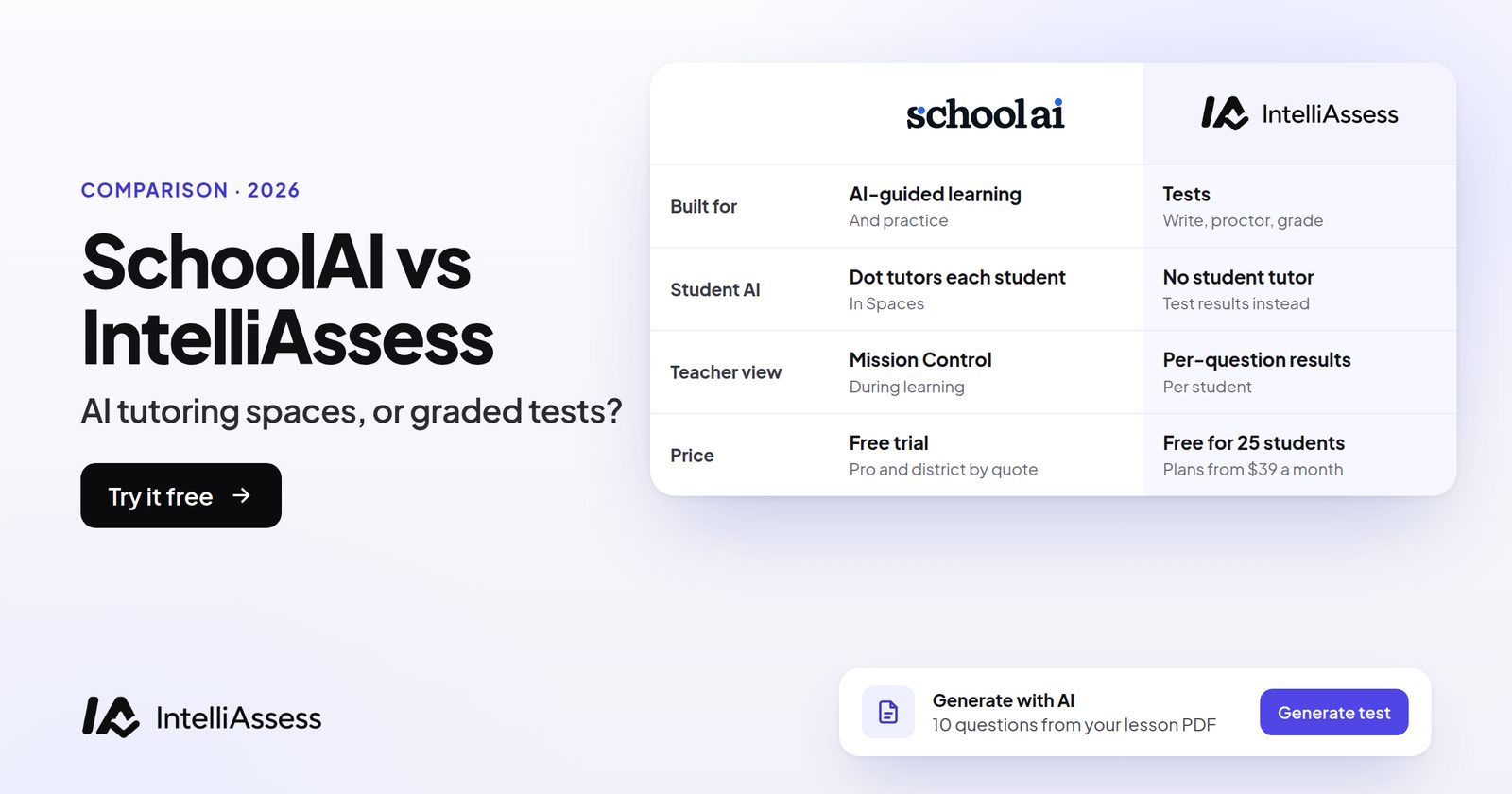
SchoolAI vs IntelliAssess: an AI tutor for students or feedback after a test?
SchoolAI puts students in supervised conversation with AI; IntelliAssess marks their tests and uses AI to help them learn from their own answers.
Motasem Aldiab 12 min read
Jotform and ProProfs alternatives for quizzes and exams (2026)
Jotform and ProProfs side by side, then the alternatives by forms, certificates or real exams.
Motasem Aldiab 2 min read